Jamf Threat Labs has found Mac malware that steals sensitive data and secretly launches a controllable copy of the victim's Chrome or Safari installs, giving attackers a way into accounts that are already unlocked.
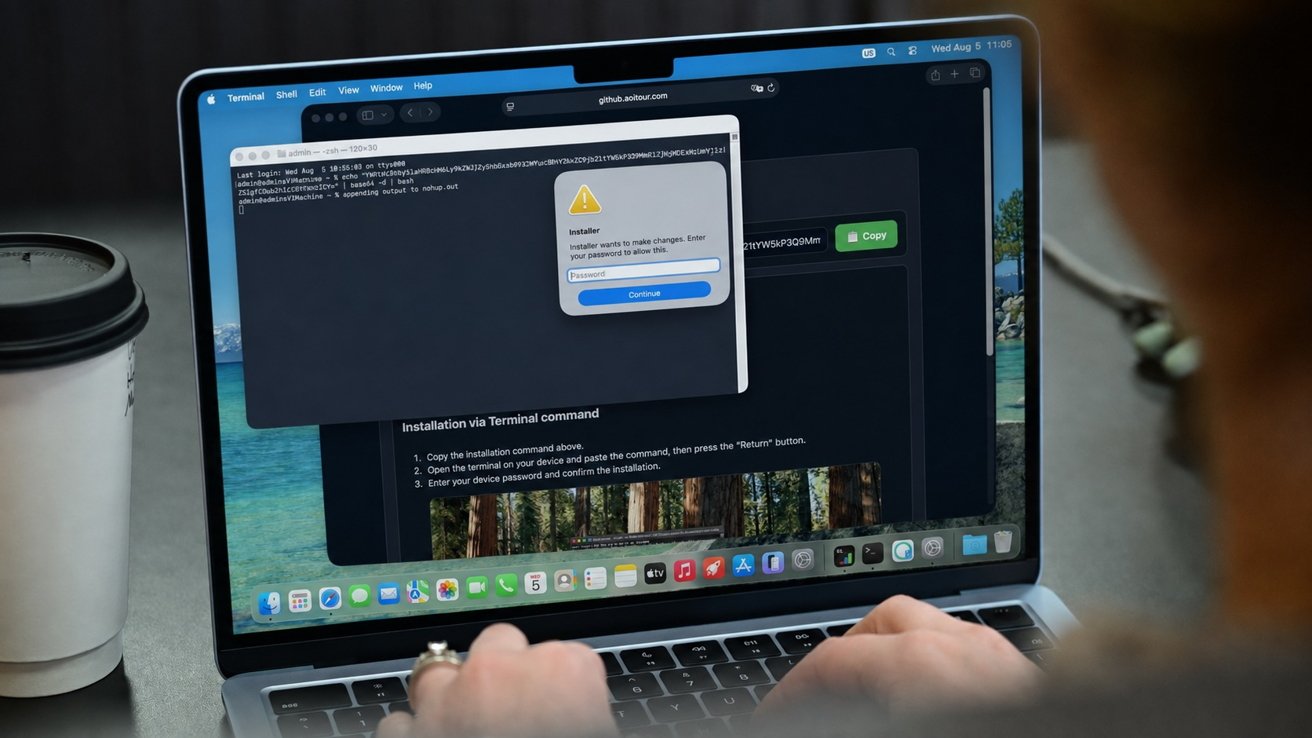
Jamf's August 13 report describes a three-stage AmnesiaStealer infection observed in the wild. The attack begins on a counterfeit GitHub page that tells visitors to paste a command into Terminal.
AmnesiaStealer then displays a fraudulent installer prompt and uses the captured Mac login password to reach Keychain, browser data, Apple Notes, Telegram sessions, and personal files.
The attack doesn't rely on an unknown macOS vulnerability. The victim must run the supplied command and enter a valid password, but the final payload goes beyond the one-time collection associated with a conventional infostealer.
The isolated test established how the browser-control system works, but it didn't show operators using the malware against real victims. Several macOS bypasses included in the sample also failed on macOS 26.
AmnesiaStealer's streaming module arrives only after the operator sends a remote command to the stage-one infostealer. The Rust-based component supports Chrome, Brave, Microsoft Edge, Arc, Opera, Vivaldi and Chromium.
Instead of taking over the browser window visible to the victim, the module copies the existing profile into a hidden directory. It launches the browser's real executable in headless mode and controls it through the Chrome DevTools Protocol, a legitimate interface for browser development and automation.
The operator receives a live view of the hidden session at about three frames per second. Commands cover navigation, keyboard input, mouse clicks, scrolling and tab management.
Jamf verified the controls with a test relay built after researchers reverse-engineered the malware's communications. The module connected to the relay but remained idle until it received operator commands.
The attack begins on a website designed to resemble GitHub, complete with its dark theme, Octocat logo and a "Verified Publisher" badge. Despite the copied branding, the page wasn't hosted on GitHub's domain.
Instead of providing a normal Mac download, the site presents a Terminal installation box and tells visitors to copy a command, open Terminal through Spotlight and paste it. The method is another ClickFix attack, in which the victim manually runs the attacker's command.
The copied text decodes into a command that launches a shell script from an attacker-controlled server. The script downloads a password-protected ZIP file, hides the extracted malware under an Apple-like name and runs it in the background.
Jamf observed the loader removing macOS quarantine metadata and applying an ad hoc signature before execution. An ad hoc signature doesn't identify a developer or mean Apple has notarized the software.
The stage-one payload is a universal Mach-O binary written in Rust, with native code for Intel and Apple Silicon Macs. Its encrypted configuration contains the campaign's build identifier, command-and-control addresses and password-prompt text.
AmnesiaStealer displays a native macOS alert titled "Installer" with an icon resembling System Settings. An incorrect password brings back the prompt, while a valid credential lets the malware run privileged commands when the victim has an administrator account.
Similar password validation has appeared in other Jamf-documented Mac stealers. Confirming the credential lets AmnesiaStealer reject a mistyped or fake password before continuing.
The malware uses the captured password to unlock the login keychain and submit commands through sudo. It also writes the password to the victim's home folder in clear text.
The stage-one payload records hardware identifiers, the macOS version and installed applications. It also estimates the Mac's location from its public IP address.
AmnesiaStealer searches the Desktop, Documents and Downloads folders for potentially valuable files. Targeted formats include documents, wallet files, keys and images.
The malware collects Apple Notes databases, attachments and Telegram session data. It also copies login and data-protection keychain files, though Jamf couldn't determine why it collected the latter.
Cryptocurrency collection isn't limited to known wallet extensions. The malware searches several extension and browser-storage locations, which could expose wallets released after the payload was built.
On macOS 26, a fallback can replace Chrome's Safe Storage password when AmnesiaStealer can't recover the existing key.
AmnesiaStealer compresses the stolen material in a randomly named temporary directory before uploading it. The archive organizes browser data, passwords, wallets, Notes, Telegram files, documents and information about the Mac.
Jamf traced the snapshot code to a partial reuse of CVE-2020-9771, a vulnerability Apple addressed in 2020. macOS Catalina 10.15.4 and 10.15.5 tied snapshot access to Full Disk Access, which root privileges alone don't provide.
Jamf could still read the protected files when researchers manually ran the sequence from a test Terminal that already had Full Disk Access. AmnesiaStealer couldn't grant itself that permission.
Another routine tried to modify the Mac's TCC privacy database and give the malware Full Disk Access. Kernel protections stopped the modified database from replacing the original, and the malware's debug messages recorded the failure.
The failed bypasses show where current macOS protections held. AmnesiaStealer's core collection still worked after the victim supplied a password and ran the attacker's code.
AmnesiaStealer can't infect a Mac through this campaign unless someone runs the copied Terminal command. A legitimate download, CAPTCHA or verification page won't ask visitors to open Terminal and execute instructions from a website.