What you need to know
- YouTube Music is labeling AI-generated songs to help listeners identify AI involvement.
- YouTube combines partner disclosures with AI detection tools to identify tracks, even when creators leave disclosure fields blank.
- YouTube plans to bring AI labels to its main video platform, extending transparency beyond music streaming.
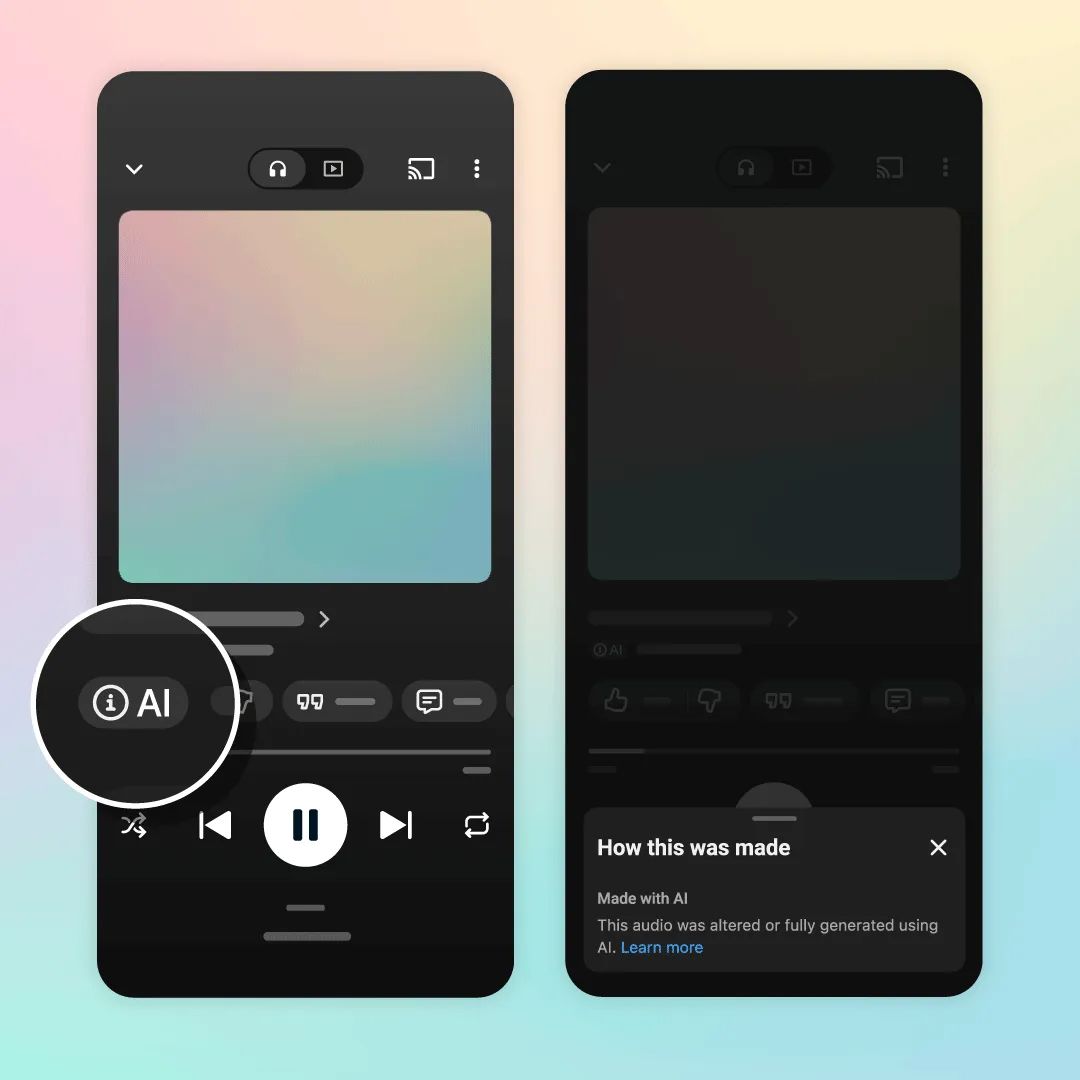
YouTube Music is rolling out new labels that tell listeners when generative AI played a big part in making a song. The labels will appear directly on the music player, providing users a more transparent idea of what they are listening to without having to sift through descriptions or wonder if a track was created by a human artist or an AI model.
The feature covers music created largely with AI, including songs where generative models contribute both the composition and vocals. Tap a label, and a menu appears with more information about the song’s AI participation. YouTube says the labels will eventually reach its main video platform as well.
The move comes as generative AI makes it easier to produce music at scale. The challenge for streaming services is to help listeners distinguish between AI-assisted work and AI-made work, without treating all use of AI as the same.
YouTube pairs creator disclosures with detection tools
YouTube is using a mix of disclosure from its music partners and its own detection tools instead of relying on artists and music distributors to flag AI-created content. Partners can identify delivered tracks as “Fully Gen AI”, “Partly Gen AI”, or “No Gen AI” through supported metadata workflows.
This distinction is important since an artist using AI to help in a certain part of the production is not the same as a fully AI-generated song. The labels are not intended to lump every AI-assisted track into one category but rather to provide more context for listeners about that difference.
YouTube’s help page says it may use additional signals when partners don’t provide AI information. If the platform can detect that a track has content created by AI, it could be marked as fully or partially AI-generated. Therefore, not entering anything in the disclosure field is no guarantee a song won’t be tagged.
Not an AI-free listening experience, but transparency
The new labels are not a prohibition on AI-generated music. Instead, YouTube is providing listeners with more information on how tracks were made and letting them choose what belongs in their playlists.
That approach puts the spotlight on transparency as AI music becomes more prevalent across streaming platforms.
I would love to see AI labels become the standard for everything I consume online, from music and videos to news articles and social media posts. I’m not necessarily against content produced by AI, but I want to be told that I’m hearing or seeing it before I decide what I think about it.
YouTube Music adding these labels is moving in the right direction, and I’d welcome the additional transparency. I just hope the labelling on YouTube is accurate, because a disclosure system is only useful if listeners can trust it.