
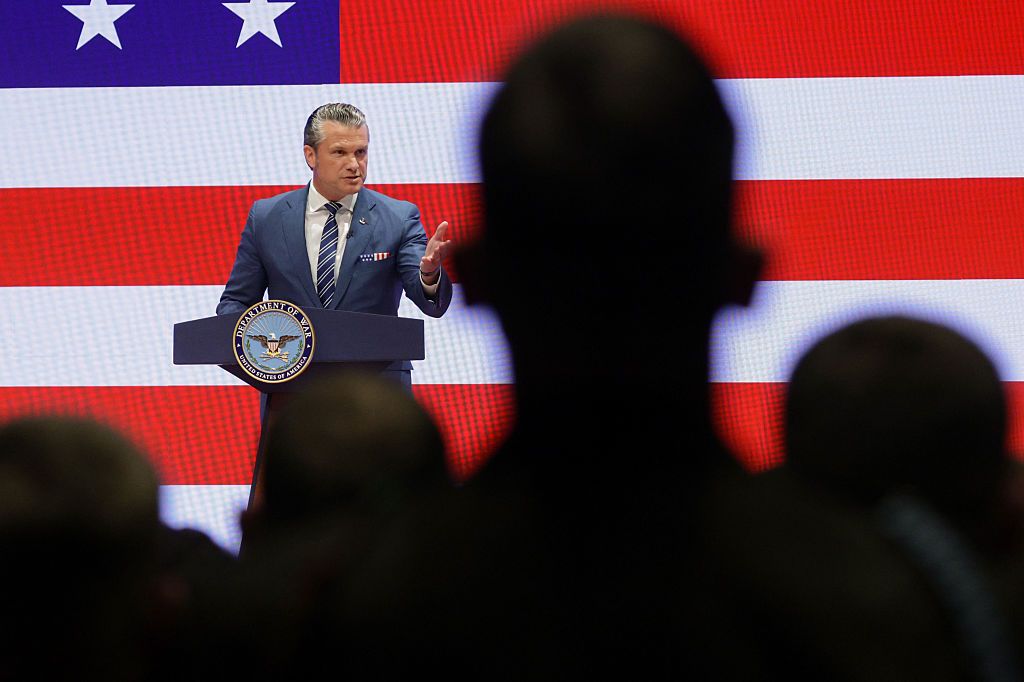
Defense Secretary Pete Hegseth used a “State of the Force” address on Wednesday to launch a new effort to study how war may be fought as tech advances rapidly. It’s being called Project Meridian.
Elon Musk, Anduril founder Palmer Luckey, and former House Speaker Newt Gingrich will co-lead the project. They’ll be joined by others from fields such as academia and policy, all working under the direction of Defense Department CTO Emil Michael. Their job is to “study the battlefields of the future” and the “weapons and technologies warfighters” may use on them, said Hegseth in a letter announcing the project.
The team (it is unclear how many people will be on it) will have 120 days to submit its findings and propose “actionable solutions to start developing, testing, and fielding” advanced technology meant to keep America a dominant military power, per Hegseth.
Hegseth also announced an Autonomous Warfare Command on Wednesday to speed up the development and deployment of autonomous systems and drones. One curious detail in the Pentagon’s announcement is that the study will come through a partner organization, but the announcement does not say what that organization is or who leads it.
After TechCrunch reached out to the Defense Department for comment, the department referred us to a press release, saying it had “nothing further to provide beyond the Secretary’s comments.”
Musk’s and Luckey’s involvement is hardly surprising. Musk, in particular, has reportedly renewed close ties with the administration and recently had lunch with the president — alongside other top AI leaders — to discuss the future of AI. The project seemingly marks his first official return to the administration’s fold since he left the Department of Government Efficiency (DOGE) last year.
Musk’s SpaceX launches satellites for the U.S. government and operates a satellite network that supports national defense and security missions. Luckey’s defense tech company, Anduril, meanwhile, creates autonomous military systems and drones and was recently awarded government contracts to produce long-range missiles and semi-autonomous fighter aircraft and to supply hardware and integration for the Army’s mobile intelligence system.
The Trump administration has made advanced military technology a priority, in both development and purchasing, and has looked to Silicon Valley-approved companies to help make this happen. Critics could argue that putting Musk and Luckey on Project Meridian directly aligns with their business interests, since they would be trying to find solutions their companies already sell.
When you purchase through links in our articles, we may earn a small commission. This doesn’t affect our editorial independence.
Dominic-Madori Davis is a senior venture capital and startup reporter at TechCrunch. She is based in New York City.
You can contact or verify outreach from Dominic by emailing dominic.davis@techcrunch.com or via encrypted message at +1 646 831-7565 on Signal.
Get 50% off a second passThe Disrupt experience is meant to be shared. Get your pass and bring a colleague, partner, or peer at 50% off. Cover more ground by making connections, building momentum, and discovering what’s next in the startup ecosystem.
OpenAI launches Dots, its bubbly agentic avatar
AMD will acquire Fei-Fei Li’s World Labs for $8.2B
Viral AI agent Instinct raises $1B Series C at a $10B valuation
Crusoe abandons $1.25B plan to use Boom turbines at AI data centers
Unsecured OpenAI agents posted 53 user images on the internet without the lab’s knowledge
Astra and Opus just passed Turing’s other test
Kiteworks urges customers to shut down their servers amid ‘imminent’ threat of cyberattack