
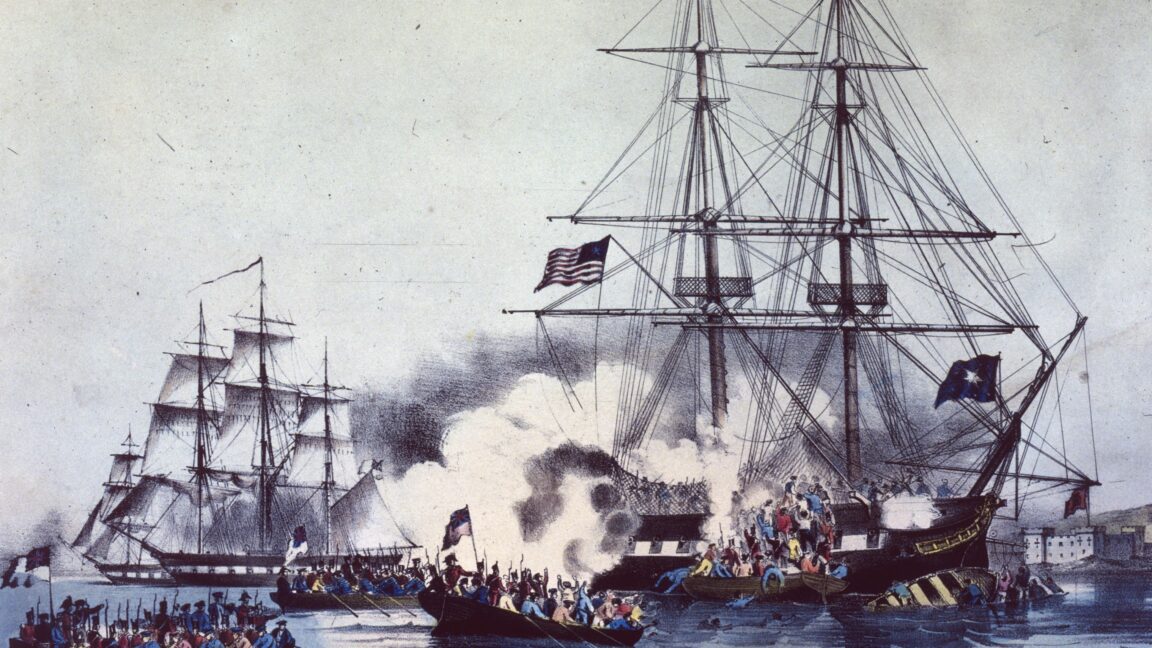
In the early years of the United States, when the nascent US Navy was still getting its sea legs, several presidents used privateers to capture or destroy enemy warships when armed naval vessels were unable to do so.
President John Adams was one of the most vigorous proponents of commissioning private vessels for national ends. His administration issued letters of marque and reprisal during the so-called “Quasi-War” with France in the final years of the 18th century. These letters created the legal distinction between privateering and piracy.
One of the letters signed by Adams, dated November 1799, authorized the use of a merchant ship to “subdue, seize, and take any armed French vessel” found near US coastal waters of “elsewhere on the high seas.” France also routinely used privateers against US shipping at the time.
The Continental Navy also relied on privateers for military purposes during the American Revolution, and President James Madison approved the use of merchant ships to fight against the much larger British Royal Navy in the War of 1812. America’s use of privateers declined as the government expanded the size of the US Navy.
The Constitution explicitly gives the government the power to use privateers. But the practice has become more controversial over the last 250 years. Many leaders in the late 18th century already considered privateering a morally ambiguous practice, according to Michael Crawford, a former senior historian at the Naval History and Heritage Command. The use of private vessels in warfare is largely moot in today’s era of US naval dominance.
Benjamin Franklin wrote essays in the 1780s objecting to the use of privateers, despite his backing of privateering during the War of Independence a few years before. With the war over, he argued on humanitarian and economic grounds that privateering should be banned by all sides in any future conflict. “This will be a happy improvement of the law of nations,” Franklin wrote in a 1785 letter. “The humane and the just cannot but wish general success to the proposition.”
Franklin wasn’t the only Founding Father opposed to privateering. William Whipple, a delegate from New Hampshire of the Declaration of Independence, was more pointed in his criticism: “Those who are actively in it soon lose every idea of right and wrong, and for want of an opportunity of gratifying their insatiable avarice with the properties of the enemies of their country, will without the least compunction, seize properties of their friends.”
Fast forward to today. Privateering is now prohibited under international law, and although it remains enshrined in the Constitution, the US government hasn’t used the practice since the War of 1812 (the Confederacy commissioned privateers against the Union Navy in the Civil War).
Still, some present-day lawmakers want to bring it back. Sen. Mike Lee (R-Utah) and Rep. Tim Burchett (R-Tenn.) authored a bill last year seeking to allow privateering in the fight against drug cartels. Lee and Burchett introduced a separate bill earlier this month calling for the government to use letters of marque and reprisal for cyber warfare.
In a statement, Lee said the legislation “allows American digital privateers to raid cartels, cybercriminals, and foreign adversaries” and seize their assets. “This is the ultimate in white-hat hacking: stealing from America’s enemies at the direction of the president and splitting the profits with the federal government.” Suddenly, it feels like it’s 1812 again.
So why is a space reporter writing about this arcane corner of American history? With the possible exception of cyber, the lines between commercial and military operations in space are blurrier than in any other domain in modern warfare. The rules of engagement in space are still unrefined, if they exist at all. Global debates have weighed the legitimacy of targeting commercial satellites in military operations, especially as communications networks like Starlink and numerous commercial surveillance satellites underpin nearly everything on the terrestrial battlefield.
The tentative verdict seems to be that, yes, these privately owned assets could be legitimate military targets. If that’s true, what is stopping a private operator from going on the offense in space? Would that be space piracy? Not if that operator holds a letter of marque or reprisal.
The US Space Force is already using privately owned satellites in military exercises, simulating offensive and defensive maneuvers to respond to threat scenarios in low-Earth orbit. Those satellites don’t actually have weapons onboard, unless you consider the option of ramming an adversary’s spacecraft. There are good reasons not to do that.
But space-based weapons will soon be part of the US arsenal, if they’re not already. US military officials believe Russia is already operationalizing an anti-satellite (ASAT) weapon system in orbit to go along with ground-based ASAT missiles. The Pentagon’s planned Golden Dome missile defense shield is designed to include space-based missile interceptors in low-Earth orbit, which could, in theory, be used to target other spacecraft.
Some aerospace and defense contractors are already developing prototypes for space-based interceptors with private investment. Others are pursuing SBIs with a mix of private and public funding.
Last year’s National Defense Authorization Act (NDAA), an annual piece of legislation that allows Congress to put its mark on defense policy, included an amendment prohibiting the Pentagon from fielding a privatized or subscription-based missile defense intercept capability. If such a system is developed, it must be owned and operated by the US military, not space privateers.
President Donald Trump signed the bill into law last December, but administration officials have said little about the restriction since then.
Sen. Jack Reed (D-RI), the top Democrat on the Senate Armed Services Committee, brought up the topic during a nomination hearing last week for the next chief of the Space Force.
“Some companies want to lease certain space assets that are actually military weapon systems that can be used to destroy other systems and even kill people,” Reed said. “Last year’s NDAA prohibited temporary ownership of space weapon systems, and the analogy is very plain. We don’t lease M4 rifles. We don’t lease F-15s, etc. This year’s NDA further clarifies the Space Force must own title to a space weapon system.”
Reed asked Lt. Gen. Doug Schiess, the nominee for the next Chief of Space Operations, for his views on the matter. If confirmed for the position, Schiess will serve on the Joint Chiefs of Staff, advising the president on military matters.
“There are definitely different mission areas where having commercial leasing, different ways to do that, makes sense,” Schiess said. “Satellite communications, space domain awareness, things like that. But I also agree when it is a weapon system or a capability that would be able to harm another person’s equipment, their assets, or even people, that needs to be completely owned by the Space Force and needs to be controlled.”
The Space Force is poised for a massive cash infusion. The Trump administration requested $71.1 billion for the Space Force in fiscal year 2027, a nearly 80 percent increase over the service’s overall 2026 budget of approximately $40 billion. Lawmakers appear ready to approve a budget between $50 billion and $60 billion.
Schiess mentioned hybrid models, such as those used by the National Reconnaissance Office, in which contractors actually operate some government-owned satellites. “But they always have a military member or a National Reconnaissance Office civilian that is the mission director over that.”
“I am, if confirmed, happy to work with you on that,” Schiess told Reed. “But I agree that we have to have Guardian control over those systems,” he added, referring to the military’s term for a Space Force service member.
The question is prescient. The idea of space warfare may have become normalized, but the norms themselves are lagging.