A 3D-printed case for a niche e-reader illustrates why mandating gun-blocking software is an unwinnable task.
A 3D-printed case for a niche e-reader illustrates why mandating gun-blocking software is an unwinnable task.
Is an e-reader case as dangerous as a Glock 19?
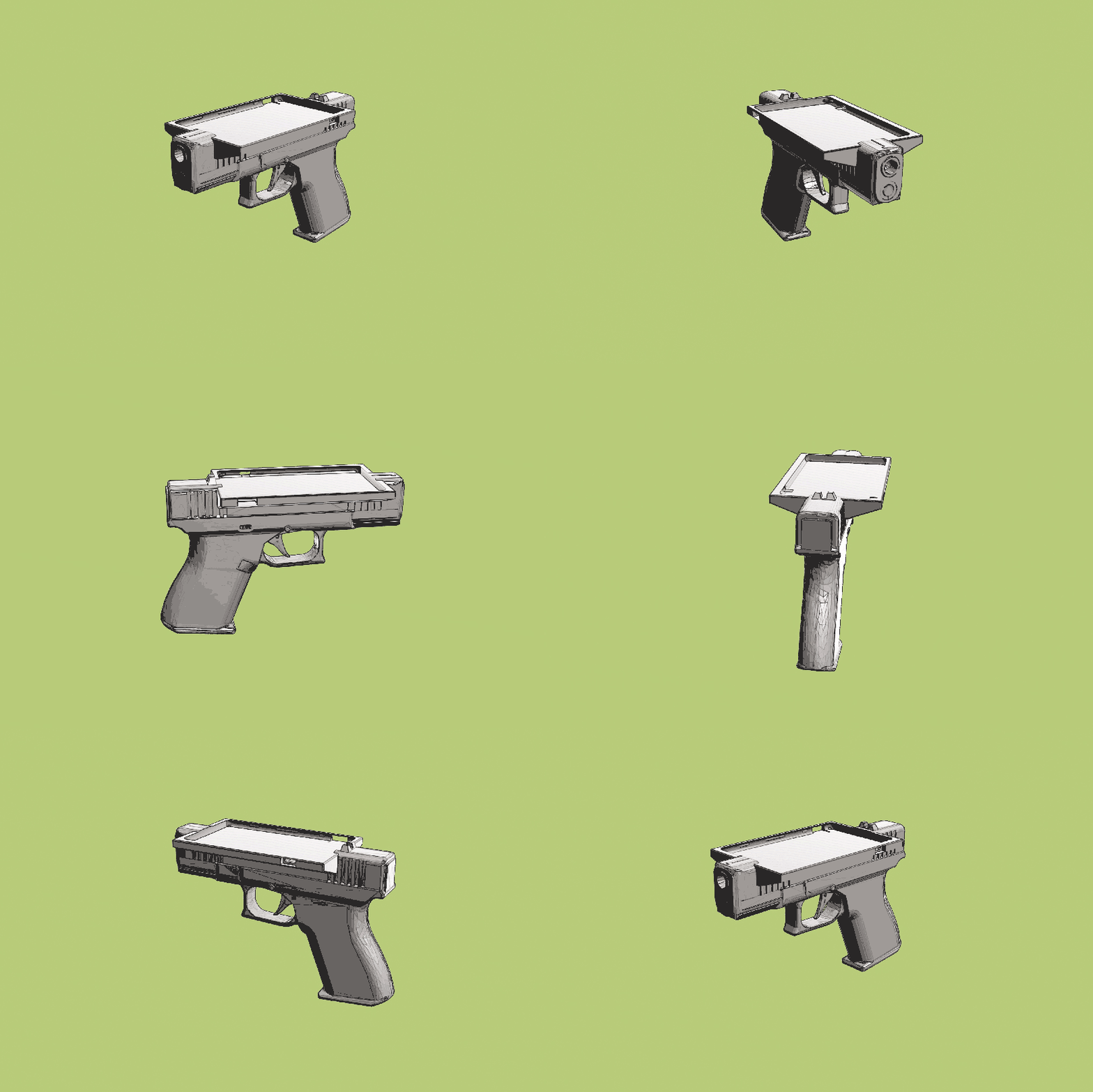
Last month, Louisville, Kentucky-based creator Luke The Maker showed off a bizarre, 3D-printed, pistol-shaped case design for the popular minimalist Xteink X4 e-reader. The X4 lies vertically atop the plastic gun’s slide, with a cutout on the side to access its buttons. Though the frame was digitally modeled after a real gun, this “case” can’t shoot bullets. Squeezing the trigger does nothing at all. He calls his contraption the “Gundle.”
In a post showing off the wacky accessory, Luke (whose last name is Blackford) can be seen flipping through Cormac McCarthy’s Blood Meridian and J.D. Salinger’s The Catcher in the Rye before tossing the gun e-reader case in his car’s center console.
“The perfect e-reader for public reading,” text reads over the clip.
But even though this internet experiment is clearly intended as a joke or commentary, it’s possible future 3D printers won’t see it that way. Lawmakers in multiple states are pushing for laws mandating gun-blocking software on all new printers sold. This still-evolving technology would, in theory, scan every file before it’s physically printed and try to algorithmically determine whether it’s a firearm or firearm part. If the software decides that the thing being printed looks enough like a gun, it stops the printer from completing the job. That is, if it even works. Lawmakers in New York and California are leaving it up to a panel of industry experts to weigh whether the proposed vision is even technically feasible. Despite that cloud of uncertainty, legislation mandating this blocking tech has already become law in New York and passed California’s state assembly.
“I didn’t want it to be so publicly available. I just didn’t want tons of them out there.”
That may sound reasonable enough, but makers and industry experts previously told The Verge that the tech is underdeveloped and risks introducing false positives where non-guns that look gun-like get unnecessarily blocked. Blackford’s e-reader case falls directly in that detection gray area. Blackford says he didn’t explicitly make the Gundle to challenge the proposed laws, but he also didn’t shy away from expressing his opinion about them.
“I’m not for that kind of thing because I’m big into open software,” Blackford says. “It’s just a wild frontier right now, so I definitely don’t trust [gun blueprint scanning tech] now.”
“If people want to 3D print a gun, they’re going to do it,” he adds. “I don’t think it’s up to the people making the slicers to control that kind of thing.”
Those pushing for these mandates, meanwhile, wouldn’t say whether their proposed tech would stop Blackford from making a harmless case. New York Gov. Kathy Hochul’s office didn’t respond to questions about Blackford’s device specifically, or the implications false positives could have for a maker’s ability to freely express themself.
“Governor Hochul is laser-focused on improving public safety and reducing gun violence in New York,” deputy communications director at the Office of Governor Kathy Hochul and spokesperson Jess D’Amelia tells The Verge. “This law relies on the expertise of leading subject matter experts to evaluate and harness emerging technologies while addressing the real and growing threat of ghost guns and illegally manufactured weapons of war. The Governor is confident these measures will make all New York communities safer.”
“The intent of the law is not to block prints like this, but I think this print is a really good example of why that’s hard.”
Cliff Braun, associate director of technology policy and research at the Electronic Frontier Foundation, who has spoken critically of California’s proposal, says it’s unclear whether the proposed system would flag Blackford’s design. While the technology exists, Braun says it’s currently in a “limited form.” Critics say a more cautious detection system that relies on hashes to flag known firearms and parts from a database could be trivially easy to sidestep by simply making small changes to a file’s design. A more expansive approach using AI to analyze a file’s geometry and predict if it’s a gun, by contrast, may be more prone to mistakes. Things that look gun-ish but aren’t, in other words, might get swept up. Lawmakers in both states are leaving it to expert panels to iron out the details of implementation, but the final result, Braun says, will have to grapple with an unavoidable tradeoff between false positives and false negatives.
“The intent of the law is not to block prints like this, but I think this print is a really good example of why that’s hard,” Braun says.
Handguns like the one Blackford modeled his design on are particularly problematic. In 2022, the ATF updated its rules clarifying that the only parts of a firearm that legally require a serial number are those that provide the housing or structure for the weapon’s “primary fire control component.” In AR-15s and other long guns, that’s the receiver. Braun notes that the shapes of receivers are relatively unique and distinguishable, as are machine gun conversion devices. That’s not quite the same with a handgun. There, the part that requires a serial number is the frame. And unlike receivers, frames are visually far more ambiguous. Water hoses, toy guns, and power tools all share somewhat similar shapes.
Dartmouth College associate professor of engineering Solomon Diamond tells The Verge that whether Blackford’s e-reader case gets blocked really depends on the type of technology that particular printer deploys. A more conservative hashing approach would fall flat because Blackford’s device wouldn’t match one of the exact hashes on a database of prohibited files. A different system using computer vision and AI to evaluate where an object likely resembles a gun, however, could flag it by mistake.
“Basing blocking tech on visual resemblance is where the false positive concerns arise because a prop and a real functional firearm resemble one another,” Diamond told The Verge. “The technical challenge here is that depending on training data and algorithms used, setting decision thresholds that have acceptably low false positive rates might have unacceptably high false negative rates and vice versa.”
“Visual resemblance might be fooled by [the] gun-shaped e-reader case,” he added.
Diamond noted a third option, “geometric identification,” could potentially thread the needle. This approach, which is currently being deployed to guide quality control in manufacturing, can be fine-tuned for what Diamond refers to as “exact geometric match,” where a zero false-positive rate is at least theoretically possible. This approach is still relatively new when it comes to 3D print blocking tech.
“Geometric Identification would not be fooled by your gun-shaped e-reader case,” he said.
3D printer manufacturers and the experts setting the standards for how blocking software mandates will work are then left with a complex choice. Requiring systems that are both actually effective at detecting guns and technically feasible to introduce in the near future will necessarily mean some non-guns get caught in the crossfire. Pretty quickly, that starts limiting how makers, hobbyists, and artists can express themselves.
“If you’re going to try and block all of those wonderfully creative humans, you’re going to make it very hard to print props or make social commentary,” Braun said.
Blackford says making the Gundle was relatively straightforward. He first went online and did a simple search for “free gun model,” which turned up the blueprints for the gun shell part of the case. He then uploaded that to Fusion 360, his preferred modeling program, and added the e-reader on top and built the case around it. The Xteink X4 is one of the cheaper e-readers on the market, and though it has limited functionality, its devoted community regularly works to improve it. With the digital design finalized, Blackford sent it off to his Bambu Lab H2D printer. The entire process, from initial idea to printed product, took less than 24 hours.
Even though the device doesn’t shoot, Blackford says he still hasn’t taken it out in public. He’s since published the files on his website, where anyone with a 3D printer can download them and make their own. Blackford admits he did this with some hesitation. The case isn’t a gun, but it looks enough like one that someone brandishing it in the open, or revealing it during a confrontation with law enforcement, could find themselves in a seriously dangerous misunderstanding. He talked things over with his wife before publishing, and ultimately decided to avoid larger marketplaces like Thingiverse or Printables so it wouldn’t spread too widely. This way, he says, people can still find it if they are interested but won’t randomly stumble upon it.
“I didn’t want it to be so publicly available,” Blackford says. “I just didn’t want tons of them out there.”
“If you’re going to try and block all of those wonderfully creative humans, you’re going to make it very hard to print props or make social commentary.”