
The company is betting that the future of blogging looks a lot like group chats.
The company is betting that the future of blogging looks a lot like group chats.
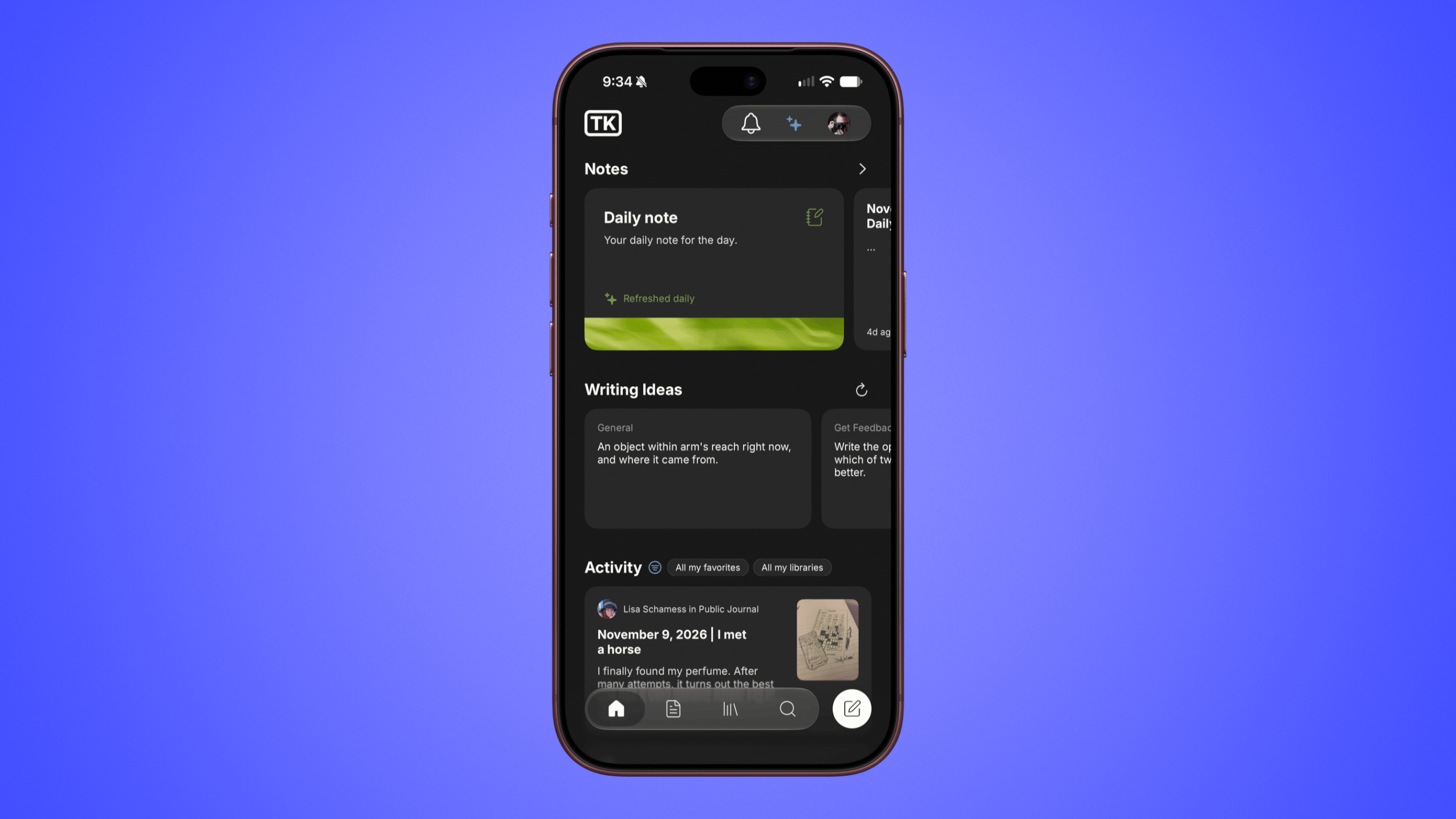
For the first time ever, Medium is becoming more than just a blogging platform. The company is launching a new app, called TK, that combines note taking and journaling with something resembling a private social network. The app is meant to get you writing more, and help you share that writing with friends and fans. And it’s part of a much bigger idea about blogging, and a much broader thesis about the state of the internet.
“I don’t think we’ve actually had a launch of anything important since 2017,” Medium CEO Tony Stubblebine tells me over Zoom, a few days ahead of the company’s biggest launch in apparently almost a decade. That was when Medium’s then-CEO, Ev Williams, decided to quit chasing ad dollars and become a subscription business. “It’s clear that the broken system is ad-driven media on the internet,” Williams wrote at the time. “It simply doesn’t serve people. In fact, it’s not designed to.” Medium began charging for access to most content. “We got out of the attention economy,” Stubblebine says now.
The trend Williams saw back then, though, has only accelerated and metastasized. AI companies are hoovering up any content they can get their hands on, legality be damned; search engines and chatbots are sending less and less traffic back to the web. Medium, like most websites on the internet, relies on Google for a huge portion of its traffic — in the time of Google Zero, that’s an existential risk. “When Google started taking away all the traffic,” Stubblebine says, “what I told them is that this hurts us, but it also hurts you, because I’ll just tell you what my product roadmap is going to do: I’m going to switch to private blogging… We’re just going to take everything underground.”
All of which brings us back to TK, an app and network that has no use or need for Google referrals. The idea behind TK is fairly straightforward: It’s a barebones note-taking app, with emphasis on daily journal-style notes and longer-form writing. The app itself is nice enough, like an ultra-minimalist take on Evernote, but it’s the stuff around the writing that has Stubblebine most excited.
For one thing, you can point an AI model at your writing, and use it to help organize or make sense of all the notes you’ve been taking, by searching through your notes or asking for feedback on your writing. “TK” is both the name of the app and a shortcut in it: type the letters (which writers use frequently as a placeholder — they’re easy to find later, since the letters T and K hardly ever appear next to each other otherwise) and you can summon the model to fill in a bit of information for you. Stubblebine refers to “Unix pipes” a few times in our conversation, and his idea is to use the large language models to do some of the grunt work of both creating and managing notes.
Once you’ve written something – and Stubblebine emphasizes that it doesn’t have to be a blog post — you can then share it however you like. You can share it via links or email the way you’d share a Google Doc, and collaborators can write, comment, and leave emoji reactions. You can also add your writing to what TK calls Libraries. Stubblebine calls the Libraries concept “private blogging,” which is a good metaphor. The early Libraries I’ve seen in the app are mostly centered around a topic, and people can contribute their writing on that topic. There’s no public face to any of it; it’s just a blog for and by its authors. Sometimes a few of them, sometimes a few hundred. There are groups sharing their ongoing book projects, swapping recipes, and posting poetry drafts, all for the eyes of only the other people in the group. It’s blogging meets group chats.
This concept of private blogging is a big part of the future of Medium. “Medium is, at some level, performative,” Stubblebine says. “You have to want to share yourself with the world.” But in a post-Google world, he says, that’s essentially impossible. TK doesn’t measure pageviews or reward authors for getting traffic. “This is a community that’s going to give you feedback and encouragement,” Stubblebine says. “It’s not about the drive to be noticed.” Features like this, he says, are coming to the broader Medium platform soon.