
Google is notching up its chipmaking game as the company seeks to reduce its dependence on chips made by other companies for its cloud computing business. Google on Monday unveiled two new variants of its tensor processing units (TPUs), in-house-developed chips meant for AI workloads, that broaden its chip portfolio to additional use cases: confidential inference and more memory capacity for large workloads.
The new units, TPU 8tx and TPU 8i Max, are part of the company’s eighth generation of chips introduced in April this year, and build on what those chips offered, which was more inference capacity and support for large training requirements.
TPU 8tx, designed with AMD, is based on the TPU 8t chip, and is geared specifically for confidentially training and running AI models, Google said in a blog post. The chip “builds security directly into the hardware layer, keeping sensitive data and model weights protected and isolated even while in active use,” the company wrote.
The chip also has a custom inferencing network that lets it run reasoning alongside training, so it can be used to distill and train small models on the fly. That ability, according to Google, could prove useful for cases where a company might want to train a model on its proprietary data without having to move the data between devices.
Meanwhile, TPU 8i Max basically combines two of the inference-focused TPU 8i chips the company launched in April, doubling the memory capacity, processing power and bandwidth, but in a single package. The result is a chip that lets AI models handle a larger range of information during queries.
The chip launch comes as hyperscalers like Microsoft, Amazon, and even AI labs like OpenAI and Anthropic are working on their own lines of AI-specific semiconductors and accompanying software in order to reduce their reliance on the dominance of Nvidia.
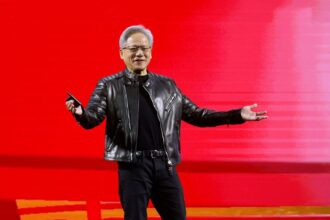
The news also comes at a particularly vulnerable moment for Nvidia, whose CEO Jensen Huang over the weekend admitted to having an affair with someone alleged to be a Chinese spy.
When you purchase through links in our articles, we may earn a small commission. This doesn’t affect our editorial independence.
Ram is a financial and tech reporter and editor. He covered North American and European M&A, equity, regulatory news and debt markets at Reuters and Acuris Global, and has also written about travel, tourism, entertainment and books.
You can contact or verify outreach from Ram by emailing [email protected].
Get an Early Peek at the Next TechCrunch DisruptDisrupt, Startup Battlefield, and more will return next year, and you can be at the front of the line.Sign up for our waitlist
Jensen Huang’s alleged honeypot scandal has inspired some top-notch memes
Musk says Tesla will refund some Cybertruck deposits, defends decision to end production
Tesla will stop making the Cybertruck in 2027
Claude can now analyze your spending with its new Personal Finance tool
Harbinger raises $240M after expanding into defense
Almost no one uses AI agents to book their Uber, company says