
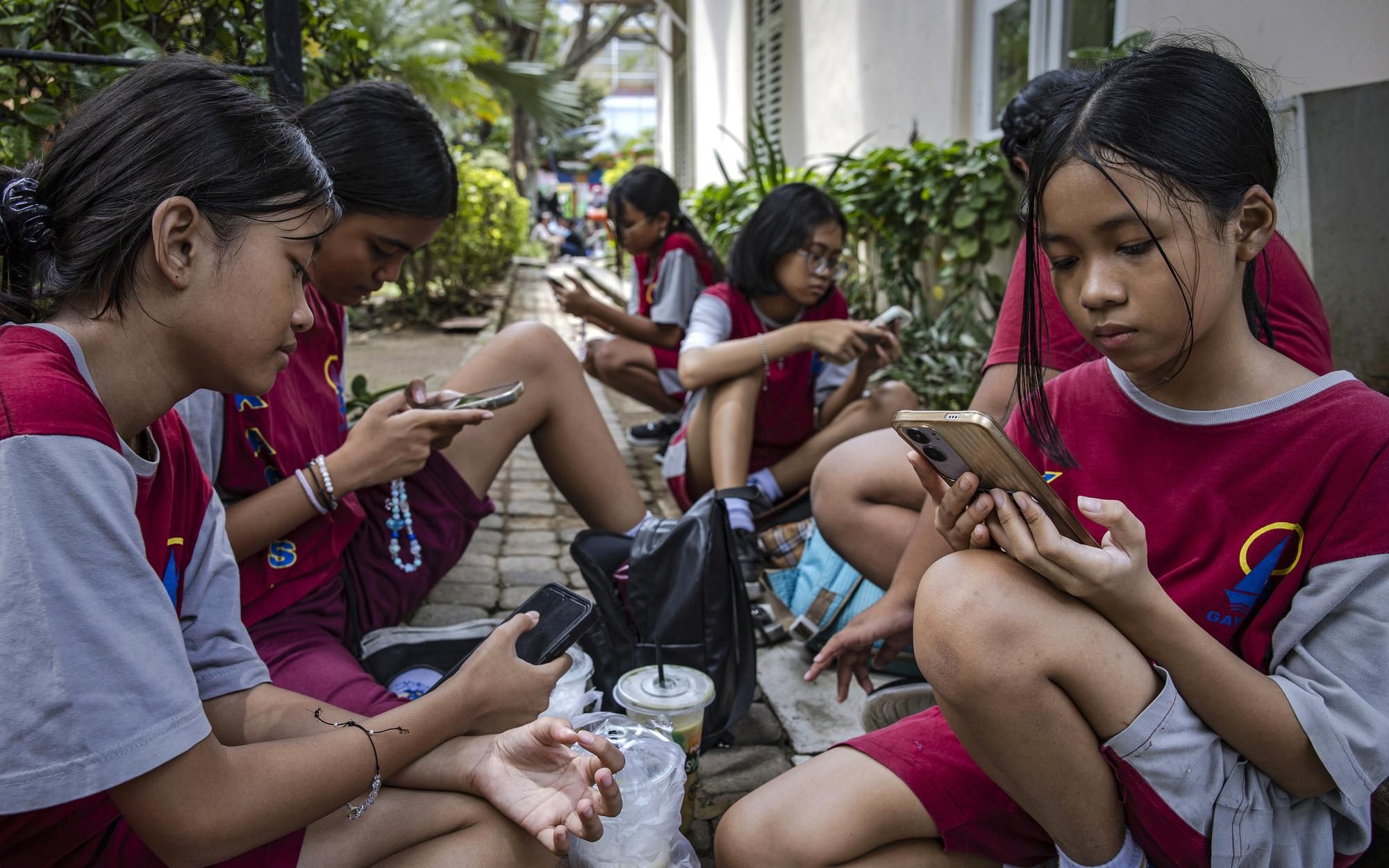

Social media plays a significant, multifaceted role in adolescents’ development, influencing how they communicate, learn, socialize, and express themselves.
The benefits, however, are accompanied by risks that can undermine youngsters’ character as well as their cognitive and social development.
The potential problems include excessive screen time, social media addiction, cyberbullying, misinformation, radicalization, privacy violations, exposure to inappropriate content, sextortion, and doomscrolling.
A recent study published in Nature: Human Behaviour found that adolescents who begin using social media at an early age tend to have significantly lower academic performance. A Mashable article highlights additional issues including effects on mental health, self-harm, addiction to social media, compulsive, repetitive checking, and exposure to pornography and violent material.
Protecting minors has largely fallen to parents, schools, and self-regulation by some social media providers.
But that approach has proven ineffective and inadequate, so some governments and policymakers have stepped in and placed responsibility on social media providers.
Australia’s nationwide ban
Australia was the first country to legislate a nationwide social media ban on children younger than 16—which I wrote about in January for Communications of the ACM.
Enacted in December, the ban initially applied to 10 platforms: Facebook, Instagram, Kick, Reddit, Snapchat, Threads, TikTok, Twitch, X, and YouTube. It excluded messaging, gaming, and nonsocial platforms including Discord, GitHub, Roblox, WhatsApp, YouTube Kids, and educational tools.
The law places the responsibility for enforcement on the platform providers through age-assurance mechanisms, requiring the platforms to take “reasonable steps” to prevent those 15 or younger from creating or holding accounts.
It does not, however, apply to content consumption. Children can view publicly available posts and videos without logging in; they cannot comment or post, according to the law.
The legislation mandates that the user’s age be verified with tools such as government-issued identification, biometric or facial age-estimation tools, behavioral or inference algorithms, and self-declaration with optional checks.
Penalties for noncompliance can reach US $35.6 million.
The 10 platforms subsequently removed nearly 5 million accounts of young users.
Although the ban received widespread support, human rights organizations and digital freedom advisory groups have argued that it limits young people’s freedom of expression and access to useful information. They say the ban might contribute to social isolation and the loss of support networks, particularly among marginalized youth.
Promising early outcomes
The Australian ban is producing positive outcomes, according to a recent Time magazine article, “What the World Should Learn From Australia’s Social Media Law.”
Early findings indicate it has reduced account ownership and social media use among young children. A YouGov survey of Australians found that 61 percent of parents of children age 16 and younger reported positive changes including more face-to-face interaction, greater presence and engagement, and improved parent-child relationships. Three in five Australians surveyed called the ban effective.
The ban has encouraged social media platforms to reconsider their features. Snapchat is moving toward a friends-only experience for 13- to 15-year-olds, for example.
The law is stimulating the development of purpose-built online spaces for children younger than 16 that can support their developmental needs, offering alternatives to mainstream social media.
The longer-term impact could be more significant if “no social media account before age 16” becomes an accepted norm, making it easier for parents and schools to support delayed social media use.
Implementation struggles
Despite the early encouraging outcomes, one study found that online platforms struggle to implement age checks. Many under-16 users in Australia have continued to access platforms with little difficulty, the study said. They children have found workarounds to subvert restrictions, such as using a free VPN to bypass age checks—some of which have questionable data-collection practices.
Seven in 10 children retained their existing accounts on restricted platforms, the study found. Other teens created new accounts using incorrect age information. Some were incentivized to seek unregulated offshore platforms not subject to Australia’s law.
The workarounds prompted Australia to double the maximum fine and warn of court action against tech giants for noncompliance.
Emphasis on age verification
A number of other countries are implementing or considering social media restrictions. They include Brazil, Canada, France, Greece, Indonesia, Norway, Poland, Thailand, Türkiye, and the United Kingdom. The European Union is contemplating its own restrictions.
The countries’ mandates for age verification or age assurance shift the policy focus from whether to verify age to how to do so effectively while protecting user privacy.
An article on think tank New America’s website, “Age Assurance and Verification,” describes some methods:
- Age gating and screening. Users self-attest their age by checking a box or inputting a birth date.
- Age estimation. Several techniques are available, including profiling the user’s online activity and scanning the user’s face.
- Age verification. One way is providing a government-issued identification document. Other approaches include digital identity systems, digital wallets, and third-party verification.
Reliable age verification is technically challenging and raises privacy concerns, as outlined in “The Age-Verification Trap,” written by Cinderpoint consultant Waydell D. Carvalho and published in February in IEEE Spectrum. Carvallo says platforms need to balance age verification with protecting users’ personal information.
IEEE’s contributions
IEEE is working on initiatives to provide a safer online environment for children. To help developers build age-appropriate social media platforms and websites, the IEEE Standards Association (IEEE SA) has published two guidelines.
The IEEE Standard for Online Age Verification (IEEE 2089.1-2024) provides a framework for designing, specifying, evaluating, and deploying verification systems. The standard includes requirements for privacy protection, data security, and information management specific to the age-assurance process. It also provides procedures for verifying a user’s age or age range with a high degree of accuracy.
Based on the 5Rights Foundation’s Principles for Children, the other standard (IEEE 2089-2021) provides practical steps to qualify online products and services for children. It requires systems to present information in an age-appropriate way and to uphold the rights established for youngsters in the U.N. Convention on the Rights of the Child.
IEEE SA also offers an online age-verification-certification program, which assesses systems for compliance with the IEEE 2089.1 standard. The program certifies that organizations implement robust processes before granting access to age-restricted products and services, prioritizing children’s safety, privacy, autonomy, and rights.
As outlined in The Institute article “IEEE Makes Strides to Improve Online Safety for Kids,” certification is based on six key indicators: accuracy, frequency of assurance, counter-fraud measures, authenticity, frequency of authenticity checks, and birth date confidence.
Indonesia used key provisions from the two IEEE guidelines to inform its child-protection regulation, which was signed into law last year.
IEEE’s ethically aligned design framework prioritizes human well-being, transparency, accountability, privacy, and protecting vulnerable populations including children.
Calls for platform reforms
Although social media bans would be globally significant policy responses, deeper structural issues remain largely unaddressed. Platform architecture and features contribute to social media harm.
The focus needs to shift from constraints on account provisioning and content moderation to safer platform design.
Meta in August agreed to pay $17.1 billion to settle a lawsuit brought by U.S. states. The suit said Meta designed its social media to be addictive to children, and the company concealed internal research showing Instagram’s addictive effects on teenagers. As part of the settlement, Meta agreed to implement child-safety measures such as setting daily time limits and disabling Facebook and Instagram push notifications during school hours.
The company still faces other lawsuits that could have far-reaching implications, pressuring other tech companies to design safer social media platforms.
Architecture-driven features such as infinite scrolling, algorithmic recommendations, addictive platform design, data-driven engagement, and personalized advertising to minors are other contributing factors to social media addiction.
IEEE Senior Member Katina Michael, professor at the University of Sydney business school and founding editor in chief of IEEE Transactions on Technology and Society, shared her perspective: “Social media bans may offer a short-term response to growing concerns, but they are not a long-term solution,” she says. “IEEE 2089.1-2024 advocates for socio-technical systems that are designed to promote human well-being, safety, and flourishing. Rather than relying on prohibition alone, we should focus on better design, building digital platforms that embed ethics, accountability, transparency, and human values from the outset.”
Collective responsibility
Protecting children online would require a combination of policy measures, improved platform design, digital literacy, parental involvement, and cultural change.
Building a safe, secure, and inclusive digital ecosystem that supports adolescents’ cognitive, social, and emotional development would require collaboration among technology companies, platform providers, content creators, parents, educators, policymakers, and young people themselves.
Professional organizations such as IEEE can continue contributing through standards development, education, certification while promoting trustworthy and responsible digital technologies.