
Amazon and Nvidia just got a lot closer. The two companies announced Wednesday an expanded partnership that includes a deal to add another 2 million Nvidia GPU chips to Amazon’s data centers.
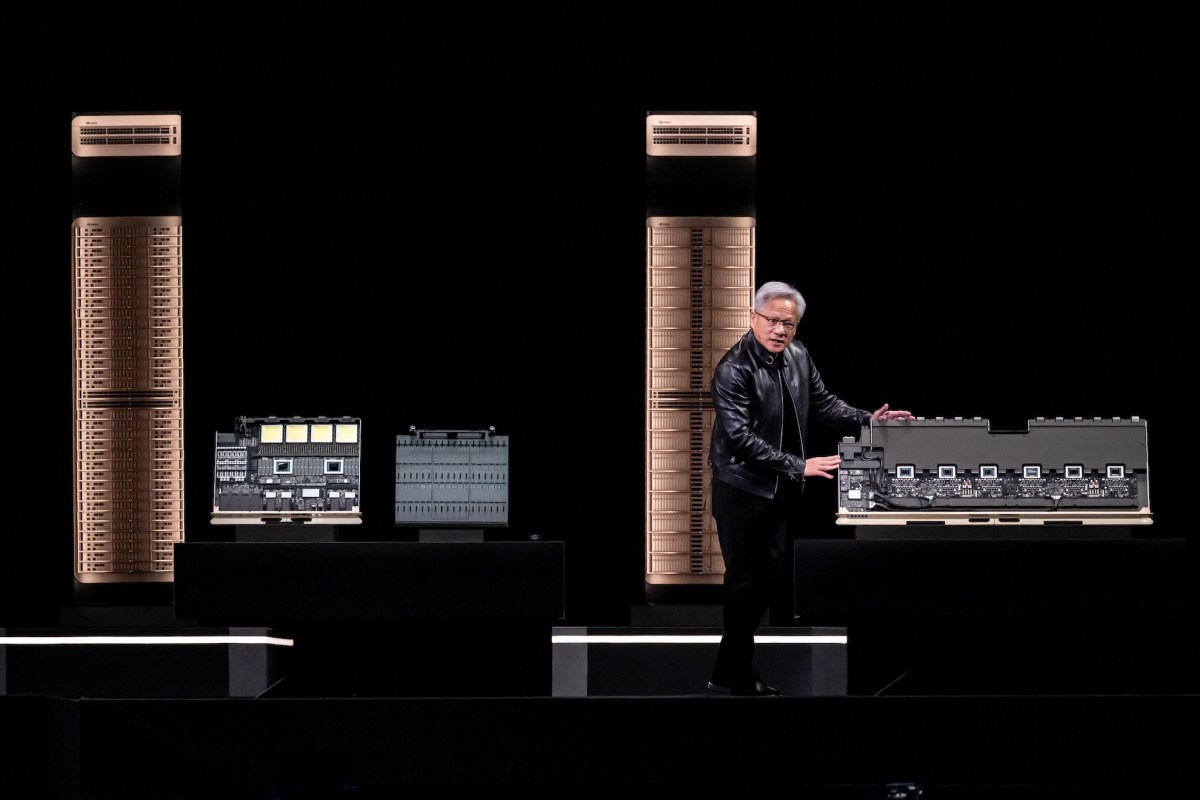
These GPUs, which are designed to handle the heavy compute demands of training and running AI models, include Nvidia Blackwell Ultra, Rubin, and Rubin Ultra GPUs. The chips will head to Amazon Web Services’ data centers in 2027 and 2028.
The announcement, made during Nvidia’s quarterly earnings call, comes just five months after Amazon agreed to deploy more than 1 million Nvidia GPUs across AWS infrastructure starting this year. Nvidia said in a statement that since then, “demand has exceeded those expectations.”
Neither company shared financial terms. It’s unclear what the exact return will be for Nvidia. But considering GPU unit costs, the deal is worth tens of billions of dollars.
The announcement is notable not just for its size and the speed in which it grew, but also because it extends beyond Amazon buying more Nvidia chips. And it’s happening even as Amazon invests in its own potentially competing AI chips.
Nvidia said Wednesday that its technology, including the networking hardware that connects thousands of GPUs into one system, as well as its open models, CPUs, data processing software, and robotics platform, will also be integrated across AWS.
The companies said “surging demand” from startups, enterprises, AI labs, and even governments influenced the decision to work more closely.
The expanded partnership comes as Amazon ramps up its own AI chip efforts — particularly with CPUs, which are the general purpose processors at the heart of servers.
Amazon has been building its own chips to lessen its dependence on Nvidia and even compete with the chip giant. Amazon’s AI chief Peter DeSantis has said that AWS is in talks to sell its Trainium chips — which are a direct alternative to Nvidia’s H100 or Blackwell chips for deep learning workloads — to other companies for use in data centers. Amazon’s Arm-built Graviton CPU is also seen as a challenger to traditional server chips from Intel and AMD.
Amazon has said its custom chip business is growing, noting on its last earnings call that it crossed a $25 billion annualized revenue run rate, driven by $225 billion in total commitments from AI labs like Anthropic and OpenAI.
But, it seems Nvidia is still the GOAT in the world of AI chips.
With the 2 million GPU chips Amazon is adding to AWS starting in the third quarter, Nvidia also plans to send an unspecified number of Vera CPUs, “some integrated with Rubin, others standalone,” according to Nvidia CFO Colette Kress.
Nvidia CEO Jensen Huang has big plans for the company’s Vera CPUs, boasting back in May that he had found a “brand new $200 billion TAM” for the company.
Aside from AWS, Kress said Wednesday that Nvidia expects Vera to be deployed by “every major hyperscaler, neocloud, AI lab, and system OEM, with shipments already underway to our lead partners,” which include Oracle and SpaceXAI.
The partnership is also extending to Amazon’s warehouse robots and enterprise offerings.
Kress said Amazon plans to adopt Nvidia’s full physical AI stack to power its fleet of robots. The stack includes Omniverse (its simulation and digital twin platform); Cosmos (its world model platform); Isaac (its robotics development platform); and Jetson (computing hardware for robots and edge AI). This week, Nvidia also introduced a new version of Jetson designed as a more accessible robotics computer for “entry-level edge AI.”
On the enterprise side, AWS will serve Nvidia’s Nemotron family of open models on Amazon Bedrock, its managed foundation model platform, and SageMaker, its managed cloud service.
Nvidia also reported Wednesday that it recorded sales of $96.2 billion for the second quarter, beating analyst estimates. Data center revenue made up the majority of Nvidia’s sales for the quarter at $89 billion, up 117% from a year ago.
Nvidia said it expects revenue to reach $108 billion in the third quarter, some of which will come from its next-gen Rubin GPUs. Nvidia said it began production shipments this quarter. Investors have been looking out for Rubin’s initial Q3 sales for signs that demand will continue into Nvidia’s next generation of hardware.
Nvidia has committed $279 billion to secure supply and manufacturing capacity for current and future data-center projects, up substantially from $119 billion last quarter, as the chipmaker looks to secure memory and manufacturing capacity to meet AI demand over the next few years. That commitment includes $92 billion in projected spending for the rest of the fiscal year and another $87 billion in fiscal year 2028.
“The thing that matters for the industry is that AI is now doing productive and useful work,” Huang said during Wednesday’s call. “AI is generating profitable tokens… If we had more compute, we could generate more profitable tokens, which results in more profit for all of the services. This is the exact phase where we’re at, which is the reason why everybody’s leaning in.”
Investors will be watching to see if additional compute indeed translates so neatly into additional profits as AI companies pour hundreds of billions of dollars into infrastructure.
When you purchase through links in our articles, we may earn a small commission. This doesn’t affect our editorial independence.
Rebecca Bellan is a senior reporter at TechCrunch where she covers the business, policy, and emerging trends shaping artificial intelligence. Her work has also appeared in Forbes, Bloomberg, The Atlantic, The Daily Beast, and other publications.
You can contact or verify outreach from Rebecca by emailing rebecca.bellan@techcrunch.com or via encrypted message at rebeccabellan.491 on Signal.
Don’t miss out. The startup community will gather to answer a pivotal question: How do you build sustainably in the AI era?
Fitbit founders launch Luffu Link, an LTE health and safety band
Two years after launch, Walmart’s Flipkart is closing in on India’s quick-commerce leaders