
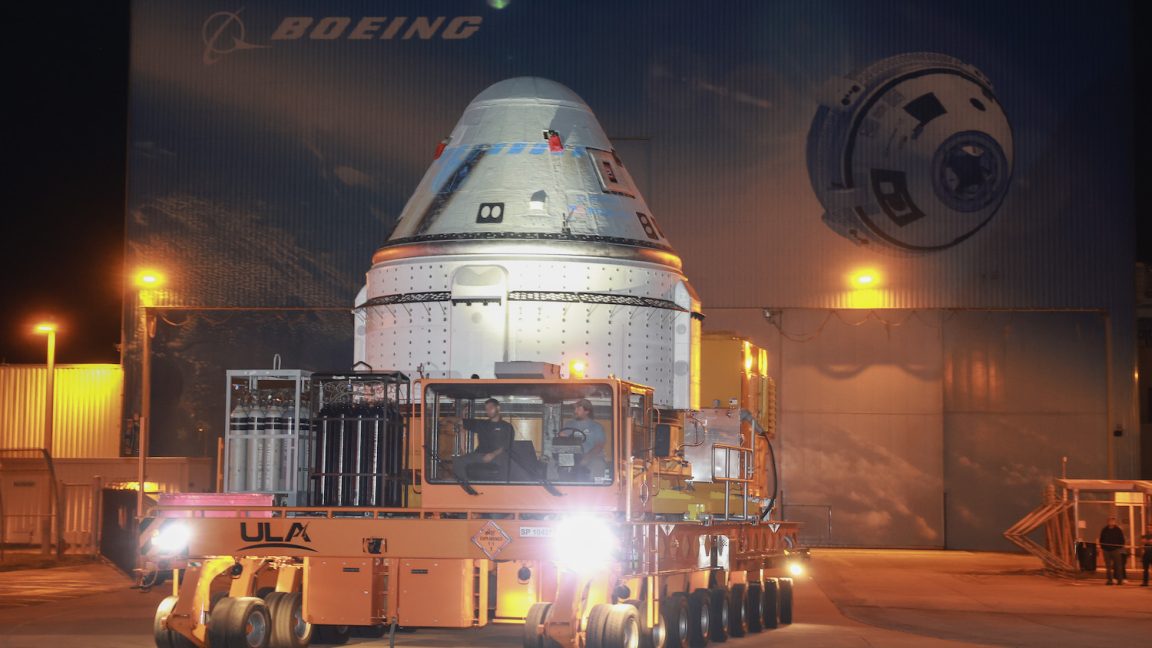
When we last checked in on Boeing’s Starliner spacecraft in February, NASA was announcing that it had formally classified the 2024 crewed flight of the Starliner spacecraft as a “Type A” mishap, an acknowledgement that the test flight was a serious failure.
At the time, NASA Administrator Jared Isaacman said the space agency was working with Boeing to “fully understand the risks associated” with the Starliner spacecraft, and to remediate them. Starliner would not fly its next mission, a cargo flight to the International Space Station, until those problems were identified and remediated. He declined to put a date on the test flight.
However, it now appears this work is proceeding apace.
During a quarterly earnings call on Tuesday, Boeing Chief Executive Officer Kelly Ortberg offered some encouraging remarks in response to an analyst’s question about Starliner and other space projects at the company.
“The redesign of the Starliner deficiencies is going quite well, and we’re feeling pretty good about that,” Ortberg said.
The deficiencies he referred to primarily involve the vehicle’s propulsion system, which imperiled the flight of NASA astronauts Butch Wilmore and Sunny Williams to the International Space Station during Starliner’s first crewed mission. The astronauts had to be returned to Earth on a Crew Dragon vehicle in early 2025.
During the earnings call Ortberg suggested much of that work was completed, and that the primary issue now is scheduling a launch date with NASA for Starliner to ferry cargo to the space station to ensure there was an open docking port and astronaut time to unload the vehicle.
“We’ve got to work with NASA to align on the launches,” Ortberg said. “I don’t at this time anticipate that’s going to create a cost problem for us, but we do have some uncertainty here that we’ve got to work with NASA to get that put to bed, and we are working with them right now.”
An official confirmed to Ars that this is indeed the case, that the primary factor now for when Starliner launches is port availability on the space station. It is therefore possible that Starliner launches this year. If this cargo test flight goes well, and modifications to Starliner address the vehicle’s propulsion concerns, a crewed mission is possible in late 2027.
Further delays, Ortberg indicated during the call, would only further put Boeing into the red on the fixed-price contract the company signed with NASA in 2014 under the Commercial Crew program. To date Boeing has taken approximately $2 billion in charges due to delays in Starliner’s development, and the need for additional test flights after various software and propulsion failures.
If Starliner were to come online in the next year or two, it would do so at an intriguing moment in crew access to low-Earth orbit.
As Ars previously reported, there are uncertainties about the availability of Crew Dragon in the 2030s, and more recently SpaceX has been telling industry officials that it plans to retire Crew Dragon (which flies on the Falcon 9 rocket) no later than 2030. This raises serious concerns for not just NASA, which may seek to fly to the International Space Station into the early 2030s, but also for planned private space stations intended to take its place. These companies are having difficulties negotiating crew transportation services as a result.
Crew Dragon is, for now at least, by far the preferred option. Not only has it proven to be reliable, the vehicle also offers the lowest cost due to its reusability and the fact that it flies on the Falcon 9 rocket.
Starliner, by contrast, has several disadvantages. Its Service Module, which houses all of the costly propulsion systems, does not return to Earth after each flight but rather burns up in the atmosphere. Sources said this expendable module costs tens of millions of dollars. There is also the fact that, after its initial run of NASA missions, Starliner will have no rocket following the retirement of the Atlas V vehicle. United Launch Alliance’s Vulcan rocket is an option, but there would be not-inconsiderable costs to human-rate the rocket, and it would be more expensive than a Falcon 9.
Could someone else acquire Starliner? Boeing did begin shopping some of its space assets, including Starliner, a year and a half ago. No sale has been closed however, and one person told Ars that it is because Boeing has been asking too high a price. One potential industry partner with deep pockets, Blue Origin, has instead decided to press on with development of its own in-house crew vehicle.
In a world where SpaceX seeks to retire Dragon in favor of Starship, and in which the space community is not yet comfortable launching humans on Starship, and in which Starliner is actually flying, things could get interesting.
One thing does seem clear. No matter what happens, the cost of human spaceflight into low-Earth orbit during the 2030s is going to be significantly more expensive than the cost in the 2020s, at least until Starship really takes off.