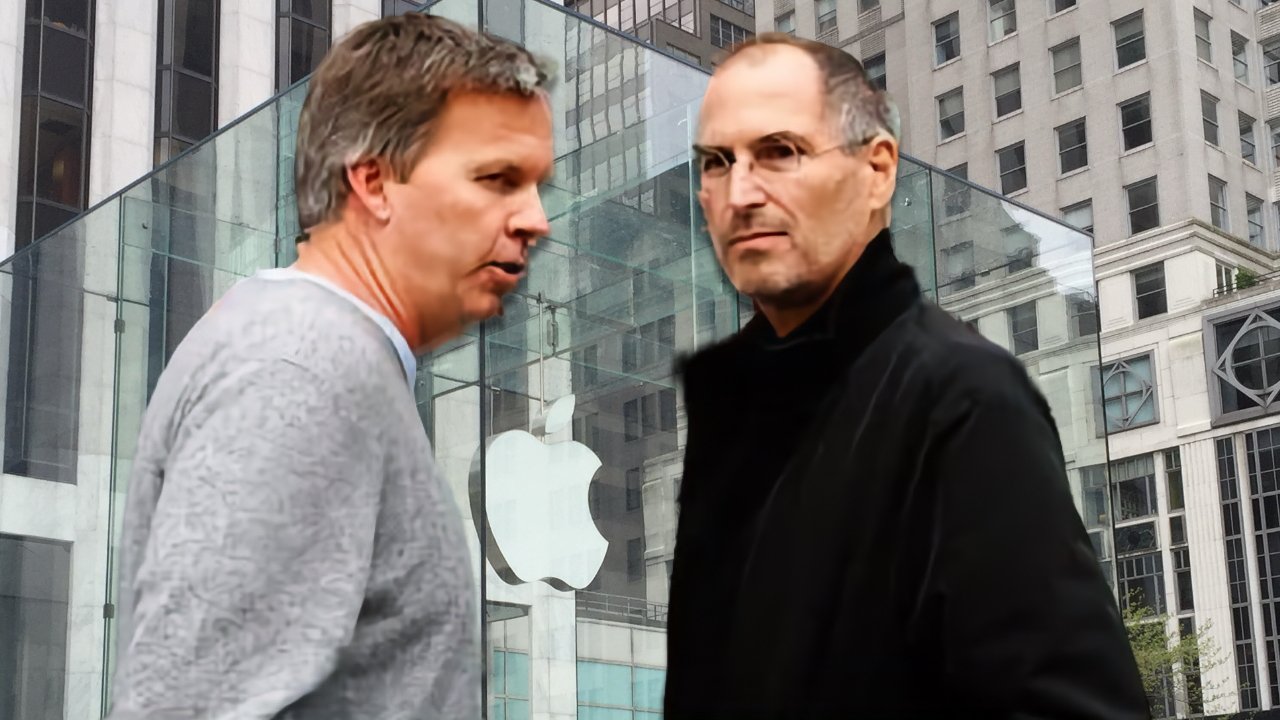
Steve Jobs and Ron Johnson were mocked by business and finance press over the Apple Store, and in an interview with AppleInsider, Johnson reveals that if they hadn't opened them, Apple itself would not have survived.
You've been in an Apple Store, or at least if you haven't, the odds are that there is one near you. These stores are everywhere, they are an unquestioned and unparalleled success, plus Apple has enough money that if a store fails, it isn't the end of the world.
Back in the late 1990s, though, Apple was only slowly climbing back away from what had seemed like a death spiral. It was close to bankruptcy when Steve Jobs returned to the company, and the stories that the iMac and the iPod saved Apple are true.
Yet as great as those devices were, Apple could not get customers to buy them. At that point, they were only really sold in big box retailers alongside PCs that couldn't match what the Mac could do, but invariably beat it on price.
What Jobs saw then was that Apple Stores could be the answer. It was a gamble costing many millions of dollars at a time when Apple couldn't really afford to lose that much.
So the story of the Apple Store is fantastic. It's a slice of Apple history, it's an example of invention and risk taking saving the day. And it's as much the story of how Apple makes products as any account of the iPhone or Mac is.
This is why Ron Johnson's new book, "Shop Different," is significant. There's so much to this story that you will be left wanting more, but the book is the inside man's account of what went right, and what went wrong.
Johnson spoke with William Gallagher for the AppleInsider podcast. Here's A lightly edited and condensed transcript of their conversation.
WILLIAM GALLAGHER: Actually, I would like, if you don't mind, to just forget everything you've done and leap forward to right now because just as your book is coming out, Apple has had this massive launch, yet we're not going to have queues outside Apple stores anymore. Do you think we're missing out on something now? Have we lost something?
RON JOHNSON: Well, I do. [But] I do think when the iPhone Duo comes out, the stores will be as busy as they've been in years. Because it's been since 2015, really when Apple Watch was announced, that you had a dramatically different form factor for people to check out.
But everyone uses an iPhone. And whether you're gonna buy this new duo or not, you're gonna want to check it out. And the stores will be packed.
Apple's done such a fabulous job since I left. But I loved lines, you know, and Apple got to a point where they just didn't like the idea of having lines outside, but, you know, customers chose to line up. They didn't have to. [It] was an event for them.
We used to see families gather outside and fathers and sons and grandparents and grandsons, and they would stay overnight and we'd bring them water and it was a beautiful thing. It was a beautiful thing, I thought, and the employees loved it. It got energy.
I remember line at our Ginza store in Tokyo went 10 subway stations long – in a typhoon warning. You know, those were the days. Those were the days.
Our very first store outside of the US, Apple Ginza is always such a special place. Thanks for a wonderful visit! pic.twitter.com/h1ZLMhIpA5
WG: I know from your book that you saw queues, but did you ever actually join the line to see what it was like?
RJ: Oh, I would walk. I love to go out in the lines. Every day when I was at an opening, I would go out and talk to people in the line, just to get to know them, to understand why they came. Right before the launch, I just walked the line with a couple of other employees to see how long it was and to thank people for coming.
I'll never forget, we opened a store at Shibuya-ku in Tokyo, and we went out. It was a super hot summer day. We walked the line, and then we realised we couldn't get back in time for the opening. So we had to run back and by the time I got there, I was sweating from just being outside in the warm heat. But those were moments that you never forget.
WG: You say in your book that Apple reached out to you, that Steve Jobs's recruiter was the first one to contact you. But as a retail man at that moment, did it seem sensible to you that Apple would want stores?
RJ: Well, I understood why Apple would want stores. In 2000 when I joined Apple, Apple had been a company for 25 years, and the perspective was that Microsoft had won. Microsoft had 95% market share.
Already a block down from the Tokyo Ginza Apple Store and the line for iphoneX is still going https://t.co/OJDIEbp2ZN
And arguably, Apple had beautiful products and great software and they were a little overpriced or higher price than the PCs, but the market here was way too [small]. And so if you looked at the go to market strategy where you could buy Macs.
Well, in the US, you couldn't buy them at Best Buy or Circuit City, they didn't carry the Mac, and they are the two most popular consumer electronics stores.
So if Apple was going to win, Steve concluded that it had to take the experience directly to the customer. So it had to do its own stores. And I believed it because I was a retail guy and I just brought design to all at Target.
And I figured if we could bring design to Target, we could figure out how to sell a great product like a Mac to customers.
WG: Yes, but Target is a more familiar, more typical retailer with shelves and shelves of products. As you say in the book, Apple had four products or something. So a lot of empty space to fit.
RJ: I was surprised, I honestly was surprised. The night I met Steve, that first interview, after about two hours of chatting, he said, well, do you want to see the product line? And I said, sure. And we walked down to another room, actually the boardroom.
And there were four products on a little credenza. Two [Mac] portables and two desktops. And we were going to build these big, beautiful stores.