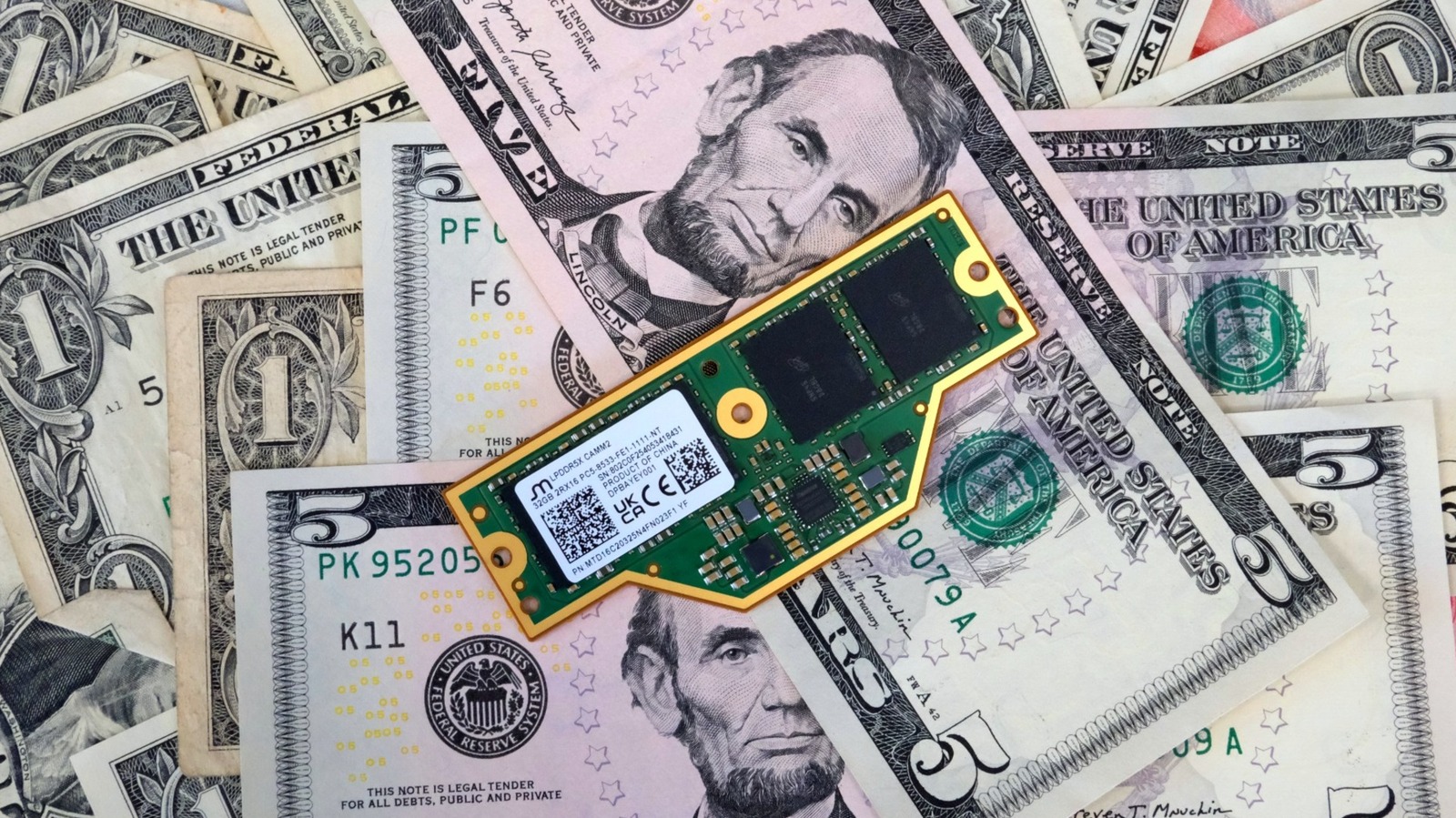
In the last 18 months, the price of RAM has skyrocketed, and is expected to continue rising for the rest of the year. For something that's gotten cheaper pretty consistently since the '60s, the dramatic spike now is all the more unprecedented. There's a reason everyone's calling this the RAMpocalypse, because what used to be a cheap commodity has become a luxury item. It's why you're left having to pay more for every new phone, PC and tablet from now and for a long while to come.
RAM, or Random Access Memory, is a crucial component of every computer, enabling it to read and execute data effectively. In order to work, your CPU needs a steady supply of information to process, information which is stored on its hard drive. But no matter how fast your hard drive is, it's still not going to be fast enough to feed data to the CPU quickly enough for it to do its job properly. RAM sits between the two, pulling files from storage and holding them ready for the CPU to do its job. The more RAM you have, the more data can sit, coiled like a spring ready to leap into action. If your PC is sluggish, this is why it's often better to invest in more RAM than a faster processor — or at least, it was before all of this kicked off.
There are essentially three companies making the majority of the world's RAM: Samsung, SK Hynix and Micron. Each one operates manufacturing plants worth billions of dollars, executing the sorts of precision engineering that even rocket scientists think is tough. RAM is the catch-all term for the technology, and aside from some hyper-specific uses like CPU caches, DRAM is what you'll find in consumer electronics. DRAM comes in many flavors, including DDR (Double Data Rate) for PCs and Low Power DDR (LPDDR) for mobile devices.
But there's another type of RAM called HBM (High Bandwidth Memory), which is designed for high end computing environments. HBM is more advanced, a lot faster than standard DDR and packs in far more memory than you'd find on a standard stick of DRAM. The speed and capacity advantages HBM has makes it ideal for intensive workloads, which is why it's found in data centers and used for AI training.
It's worth understanding that while DRAM and HBM aren't interchangeable, they are made from the same components. The same silicon wafers underpin both forms of RAM, but they're assembled in a very different way depending on the use case. Sadly, HBM requires a lot more of those resources. In 2024, Micron CEO Sanjay Mehrotra told investors that each unit of HBM "consumes approximately three times the wafer supply" as consumer-level DDR5 RAM. And for now, this is a zero-sum problem: For every single piece of HBM in the world, it's taken the parts and capacity that could have produced three DRAM modules.
Product database PCPartPicker has graphs tracking the prices of RAM over the last 18 months, and they make for sobering viewing. The price for a pair of 16GB DDR5-4800 sticks went from under $100 at the start of 2025 to more than $400 today. Right now, 32GB of high-end DDR5-6000, which was just under $250, has now risen to more than $1,200 — equivalent to the price of an entire MacBook Air.
The medium answer is: AI companies, flush with cash from investors, have bought up pretty much the whole world's supply of RAM.
The long answer is that, for the last two decades or so, the global RAM market has been pretty predictable. We may want more RAM in our devices over time, but the total volume of RAM modules required each year has been pretty stable. The industry knows how many phones and PCs people will buy each year and they know what the upgrade cycles look like. Mostly, the more dramatic changes are well-telegraphed: When, say, Microsoft launches a new OS with higher system requirements, PC makers have plenty of time to order extra supply. Even as things like cloud data centers have emerged, the industry was able to absorb the demand pretty well.
AI companies have convinced both the political and investor class writ large that their products are an existential requirement. Companies like OpenAI are on a war footing, given billions of dollars and told to outspend their rivals to build out as much computing power as it can. They used a lot of that largesse to buy out entire years' worth of hardware capacity from the factories. DigiTimes claims that every manufacturer's 2027 RAM capacity has already been sold out.
To understand how disruptive the AI bubble has been to the rest of the industry, it might help to look at the impact of just one data center. xAI's Colossus site in Memphis, according to infrastructure company Introl, has 555,000 NVIDIA GPUs worth $18 billion training Elon Musk's AI. Colossus reportedly is fitted out with:
It's likely xAI, like its rivals, equipped its servers with as much RAM as it could get its hands on. If that's the case, then this one facility could be using as much as 112,005,000 GB of RAM. And while the RAM in these facilities couldn't be put into consumer devices, it's using the same resources. If you'll forgive the inexact but telling comparison, that amount of RAM is equivalent to the RAM in 14,000,625 iPhones 17 or 9,333,750 Galaxy S26s. A Bloomberg report from March claims there are 831 of these sites currently under construction.
For more evidence that this is going to get worse, look at the deal OpenAI signed with AMD back in October 2025. The pair pledged to build out 6GW of AI data centers, with the first 1GW site using AMD's Instinct MI450 GPUs. That GPU has a maximum RAM capacity of 432GB. If we use the rule of thumb that around 450,000 GPUs shake out to around 1GW of capacity then this project alone could use up to 194,400,000 GB of RAM (or about 24.3 million iPhone 17 units). And that's just for one sixth of the total deal.
These days, nobody knows, and the price of RAM could sink dramatically if the AI bubble bursts ahead of schedule. If that doesn't happen, then the best people to ask are those who actually make the stuff, and they don't think it'll be quick. In an interview with Reuters, SK Hynix CEO Kwak Noh-jung says things are going to get worse in 2027. (If the DigiTimes report is accurate, then every piece of RAM may already be accounted for.) He also expects that demand will continue to outstrip supply beyond 2030. Speaking to investors in June, Micron CEO Sanjay Mehrotra said he expects to see "tight conditions to persist beyond calendar 2027 [2028]" High-minded finance types feel the same, and Deloitte says we shouldn't see any relief from the crisis until 2030 at the very earliest.
AI companies boast that they can spin up a data center in a matter of months, but building a new RAM factory is not quite as simple. It's expensive, time-consuming and requires plenty of precision tooling, training and equipment. Here's an example: Micron's facility in Boise, Idaho has a class one clean room, which has no more than one particle of dust in a cubic foot of air. A new RAM facility takes billions of dollars and years of development, so don't expect anyone to lash up a new production line in a warehouse somewhere. SK Hynix has committed to building two new memory factories in South Korea at a combined cost of $38.1 billion, with production expected to begin in June 2029 at the very earliest.
And then there's the rather less convenient fact that Micron, Samsung and SK Hynix aren't in too much of a hurry to see the end of this crisis. HBM is far more profitable than DRAM, and AI hyperscale companies will pay top dollar to secure what limited supplies are available. At the end of 2025, Micron killed off Crucial, its consumer-facing RAM business to follow the HBM money. "Micron has made the difficult decision to exit the Crucial consumer business in order to improve supply and support for our larger, strategic customers in faster-growing segments," Micron EVP Sumit Sadana said at the time.
But hey, it's working for them: In June, Micron posted a quarterly income of $28.86 billion and a gross margin of 84.9 percent. And in July, SK Hynix reported "record-breaking" revenues, with its operating profit increasing by 557% year-over-year. Samsung, too, reported an "all time high" for both revenue and profit in its memory division. According to the Wall Street Journal, Micron has also approached the White House directly, insisting that the US government intervenes to prevent its customers from sourcing RAM chips from elsewhere.
I'm of the opinion that nobody should be panic buying anything because, if you do, you'll create (or exacerbate) the crisis you're trying to avoid. But four years is a long time to wait, especially if prices keep rising for the next couple of years. I can easily imagine people kicking themselves for not buying RAM now, when it's only 500x more expensive, than in 2028, when it could be 1500x pricier.
If you have a genuine reason to buy RAM now and you expect that need to continue for the next four years, then grab it, pronto. If not, then I'd urge patience and make do with what you've got or hoping that we can see some second-hand RAM hit the market to help reduce the pressure. Unfortunately, it's not as if you're blessed with alternatives beyond eating the eye-watering costs now or hold your nerve and hope that RAM prices fall back to earth faster than expected. Just don't buy RAM in the hope of scalping it, because that's just rude.