
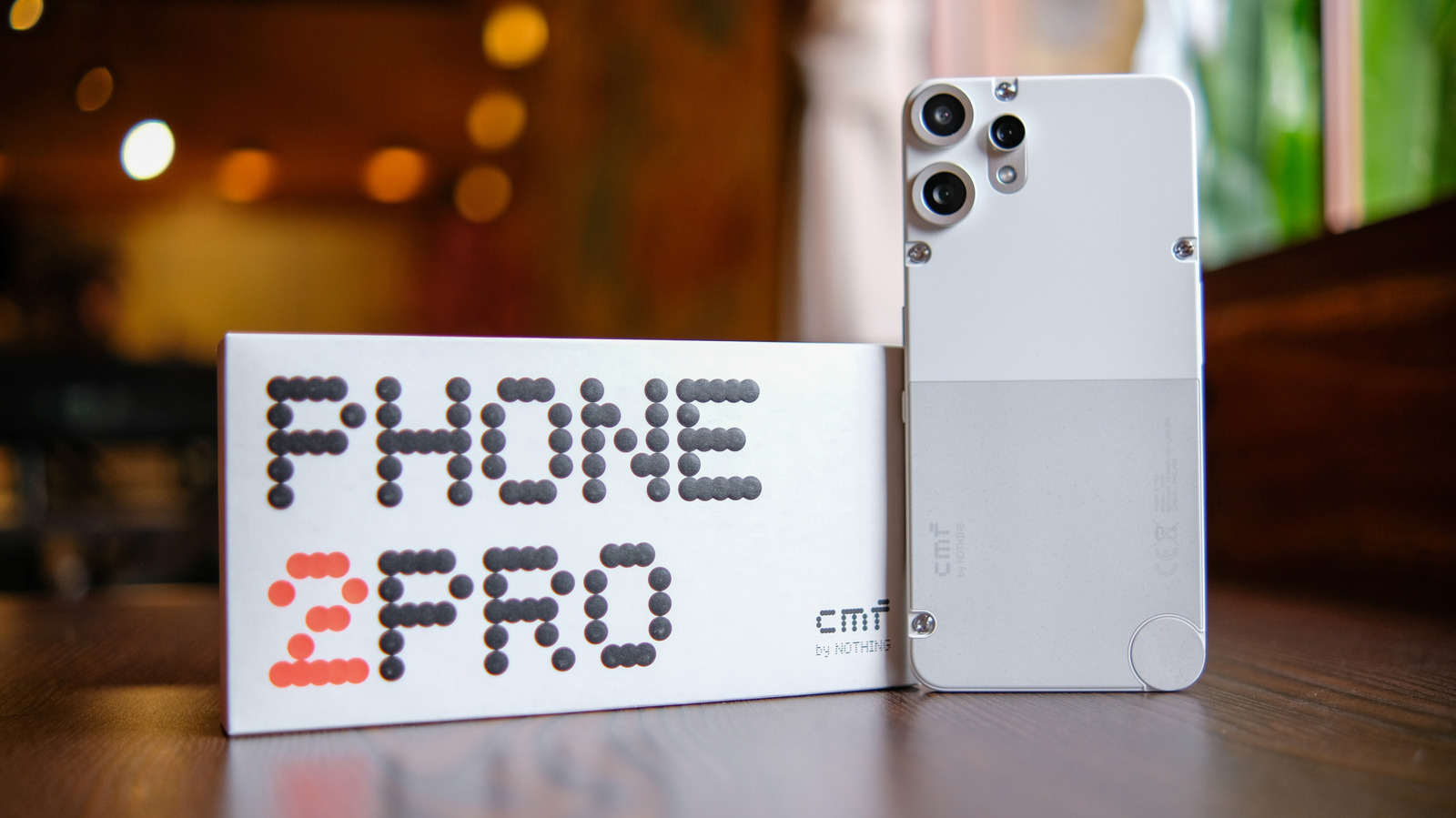
CMF kept the big screen and battery, but made compromises elsewhere.
Nothing created its CMF sub-brand to pursue the budget end of the phone market, where every additional dollar must be justified. The CMF Phone 2 Pro really leaned into that concept. Through Nothing's now-ended US Beta Program, the base model cost $279, compared to the $379 Nothing Phone 3a.
It's not hard to imagine that $100 difference would be obvious the minute you turned on the screen. But it wasn't. Both phones feature 6.77-inch FHD+ AMOLED displays with 120Hz refresh rates and 5,000mAh batteries, and CMF still managed to fit a 50MP main camera, 50MP 2x telephoto and 8MP ultrawide inside the Phone 2 Pro.
Nothing hasn't published a part-by-part bill of materials for the Phone 2 Pro, so it's impossible to determine exactly how much each compromise shaved off the price. But component compromises show up elsewhere: in the processor, camera stabilization, charging speeds, water resistance and some less premium hardware.
The Phone 2 Pro uses MediaTek's Dimensity 7300 Pro, while the Nothing Phone 3a uses Qualcomm's Snapdragon 7s Gen 3 — those are notably different processors. That gap matters more when you're pushing the phones than when you're reading messages or browsing apps. CMF's phone is generally responsive for daily use, but its limits show when you run games and other demanding workloads. In other words, the CMF has enough processing power for extended web browsing and social media sessions, but it will struggle with extended Genshin Impact playtime at high graphical settings.
The cameras take a similar approach. The Phone 2 Pro has three useful focal lengths, but the main and telephoto cameras use electronic image stabilization rather than optical image stabilization (OIS). Meanwhile, the Nothing Phone 3a's main camera gets true OIS. While the cheaper phone can take decent photos, it may struggle to take strong shots in shaky hands or poor lighting.
There are also the less glamorous cuts. One of the Phone 2 Pro's weaker points is its single speaker. Meanwhile, charging speed peaks at 33W, versus 50W on the Nothing Phone 3a. CMF's Phone 2 Pro has an IP54 rating, falling short of the Phone 3a's IP64.
None of those compromises feel like dealbreakers, however, and together they explain a lot.
CMF chose some features that make those concessions more palatable. The Phone 2 Pro supports microSD cards up to 2TB, so you don't need to buy a higher-capacity variant to add storage. It also supports NFC in certain regions and offers three years of Android updates and six years of security updates.
If you mostly use your phone for messaging apps, maps, social media, video and casual photography, the bright display and battery life may matter more day to day than the lack of true image stabilization or slower charging. That's pretty much the trick: CMF compromised in areas many buyers may notice only once in a while, if at all.
However, doing it again is proving harder. Nothing co-founder Akis Evangelidis said in a post on X that CMF had been working on a successor, but that the team "can't build a phone that feels like a genuine step forward at a price that makes sense for CMF," specifically citing memory cost increases.
TrendForce estimated in February 2026 that memory accounted for roughly 30 to 40 percent of a smartphone's bill of materials. Nothing didn't say when or if another similarly priced CMF phone will replace it, but it won't release a Phone 2 Pro successor in 2026.