A leading US distributor of China’s most popular humanoid robots and robot dogs now plans to produce its own robots at a facility on Long Island, New York. The business pivot comes amid the US government’s growing crackdown on foreign-made robots.
The company RoboStore had previously become the main North American distributor for humanoid robots and quadruped robots from Unitree Robotics, a Chinese robotics company that produces some of the most affordable and popular humanoid robot models. Universities such as Harvard and MIT, along with tech companies like Amazon and Nvidia, purchased such robots made in China through RoboStore for their own research and development purposes.
“We’ve sold over 1,500 robots and deployed them and worked with customers like Cisco, OpenAI, Nvidia, and over 150 universities,” Teddy Haggerty, founder and CEO of RoboStore, told Ars.
But on August 10, RoboStore announced a major shift in its business strategy with plans to fully open a 66,000-square-foot facility for manufacturing commercial robots by the first fiscal quarter of 2027. It also launched a new company called Robo Inc. to oversee the new robotics manufacturing and systems integration business.
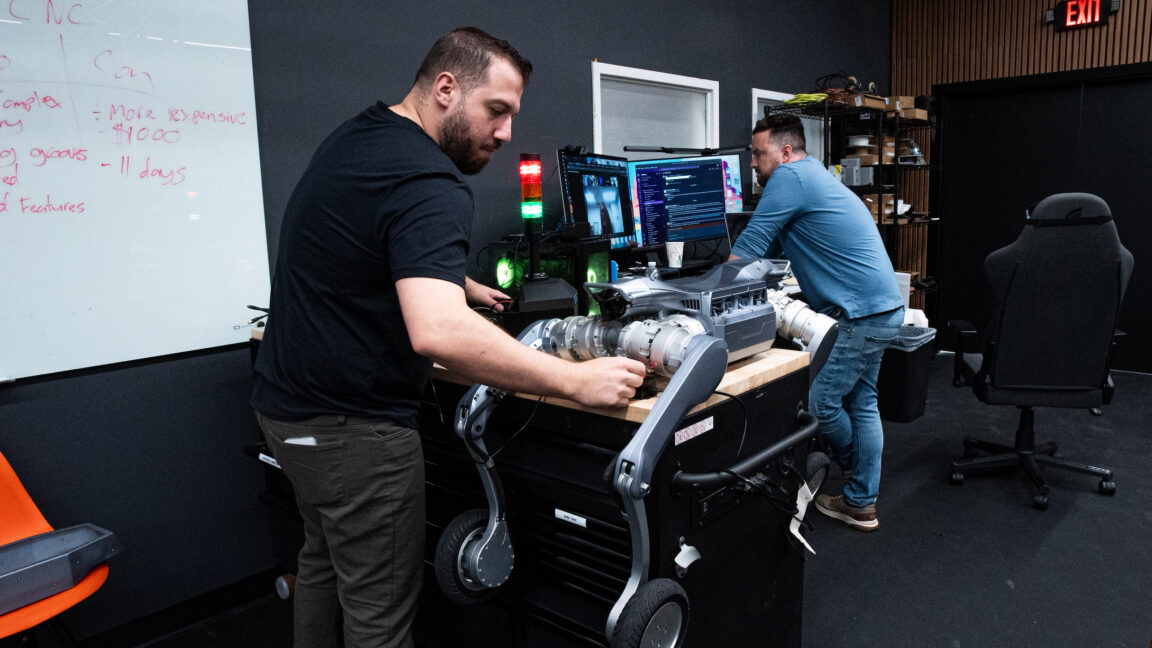
Haggerty and his team had already started thinking about the possibility of starting up their own robotics manufacturing business about a year ago. While supporting customers’ deployment and integration requests, they had gained insights into how customers were thinking about using robots for specific applications.
They also believed they could help more companies integrate industry-specific robots in ways that made sense for their businesses, rather than simply trying one of the many humanoid robots being pitched as a general-purpose solution for everything.
“Companies like Standard Bots and Universal Robots have a robotic arm for specific use cases,” Haggerty told Ars. “And I will tell anyone that that product is better suited for most businesses, for what they want to achieve, than a humanoid robot.”
The team accelerated plans to open a robotics manufacturing facility as the US government moved toward restricting or banning foreign-made robots. US lawmakers introduced legislation such as the American Security Robotics Act in the Senate in March, followed by the GUARD Act in the House of Representatives in June.
The biggest development so far came in July, when the US Federal Communications Commission banned the imports of new models of foreign-made robots, including popular robot vacuum cleaners and Unitree’s humanoid robots and robot dogs. The move was justified along national security lines because of potential cybersecurity vulnerabilities, but also clearly geared toward encouraging companies to produce more robots in the United States.
By that time, RoboStore had already shut down its distribution business while still promising to continue supporting customers needing parts, repairs, and upgrades for their existing robot models. The team’s focus shifted to developing robots and building out manufacturing capacity.
Under the Robo Inc. banner, the team is developing and testing several different robotic products. Those include a humanoid torso on top of a chassis with wheels that is designed for the healthcare industry and concierge services. Such a robot would come equipped with cameras and sensors to help take a patient’s standard vital signs, such as temperature and blood oxygen level.
Other initial products include a specialized quadruped for security applications and a humanoid robot platform for educators and researchers. “Universities are looking for a US-compliant product,” Haggerty said. “So we’ve taken everything we’ve learned from being easily the largest distribution channel for education for robotics.”
The team’s engineers have already used 3D printing to help build robot prototypes that are being tested by certain customers. They expect to be able to produce commercial versions of such robots from their new dedicated facility by early 2027.
Commercialization and manufacturing scaling challenges lie ahead. But before then, Robo Inc. is also looking to do its first big round of raising funding after having spent years as a bootstrapped business without outside investor money.
“We’ve reached out to all these customers, and we have an incredible interest now as we’re going through the process of raising money,” Haggerty said. “It definitely helps, 100 percent.”