
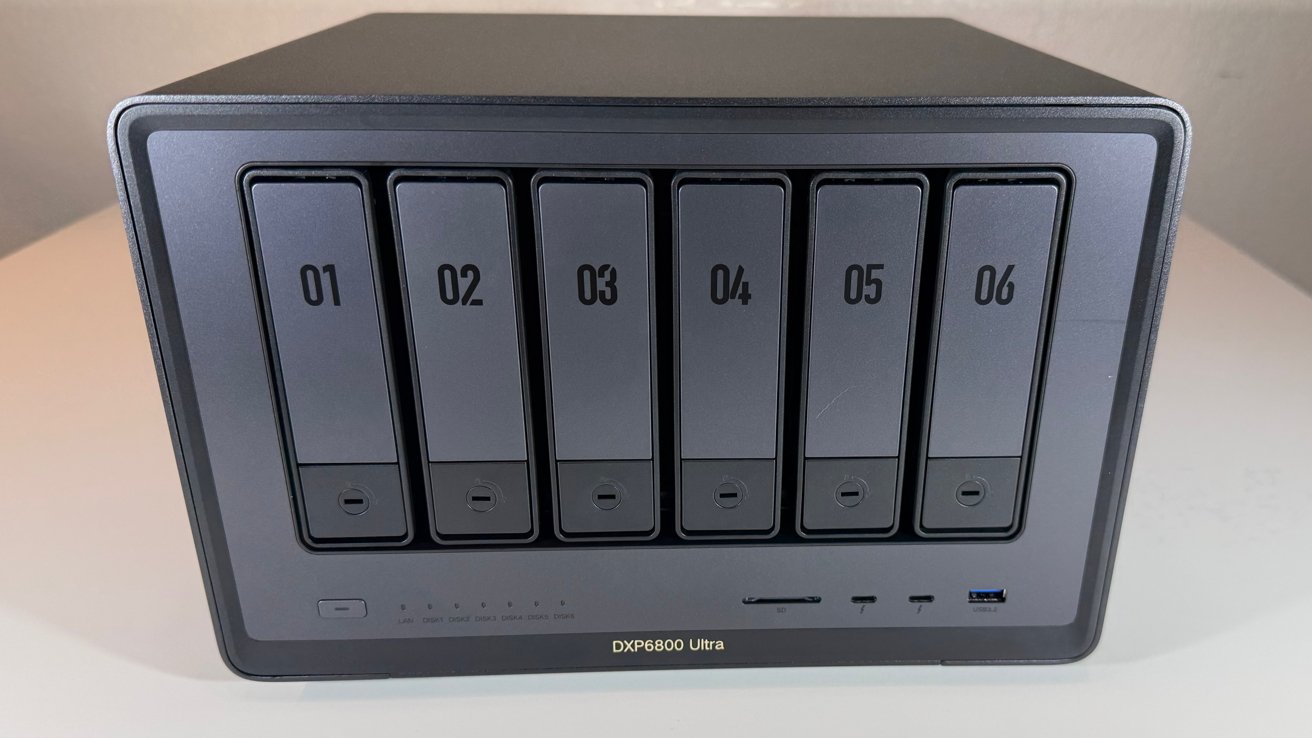
At $1,449.99, six hard drive bays in the uGreen NASync DXP6800 Ultra, coupled with dual 10GbE and Thunderbolt are the real draw, not its AI billing.
A NAS lives or dies on two things. One is how much it can contain, the other is how fast you can move it.
uGreen's DXP6800 Ultra bets hard on the second. It piles on connectivity that pricier rivals often charge extra for.
The "Ultra" name and uGreen's AI marketing invite scrutiny. The chip inside tells a more modest story.
So the real draw here is input and output. This is a fast, expandable box, not an AI powerhouse. Fortunately, it's not priced badly based on marketing buzzwords.
A six-bay NAS cannot hide what it is. This is a boxy metal tower built to hold drives.
Six lockable bays load from the front. Two M.2 slots sit inside for cache or SSD pools.
It measures about 11.6 by 10.2 by 7.4 inches. This is a device for a shelf, not a desk.
uGreen NASync DXP6800 Ultra review: The rear has a dust guard for the fans.
Power draw is modest for the class. uGreen rates it at 43 watts during drive access. We saw a bit more at 60W when the unit was under load, and getting slammed with I/O requests at the same time.
For the testing suite, we tested the unit with six 2TB Seagate Red drives provided by Ugreen. We also used four 24TB WD Red Pro, that retail for $1059 per drive on Amazon.
SSDs used for testing included a pair of Samsung 990 Evo Plus drives, and a pair of Samsung SSD 9100 Pro 1TB drives. You don't need to use drives this fast. Stick with PCI-E 3.0 drives if you have them, as they're cheaper, and still provide more than enough speed.
Here is where the "Ultra" badge needs a closer look. The chip is an Intel Core 5 120U.
It has 10 cores and 12 threads, up to 5.0GHz. That is capable, but not cutting-edge.
The part is based on Intel's older Raptor Lake design. Crucially, it has no dedicated NPU.
That matters, because uGreen markets this line on AI. On-device AI runs on the CPU here, not a Neural Engine.
uGreen NASync DXP6800 Ultra review: The front port selection
For photo tagging and search, it still works fine. It just will not fly like the uGreen NASync iDX6011 does, and heavy AI is a stretch. That's fine, though.
For normal NAS duties, the chip more than beefy enough. File serving, Docker, and streaming are easy work.
As a reference, the older Geekbench 6 benchmarking suite puts it near 1,750 single-core. Multi-core lands around 6,200. For reference the M1 Mac mini has a 2191 single-core score, and a 8576 multi-core.
This is not really a handicap for the hardware class, though. Beyond file sharing, combined with 8GB of ECC RAM, as shipped, this still is a good machine for Docker, and apps natively running on the hardware.
ECC support is rare at this price. We're not going to get into it, but the longer something runs, the more likely it is to get a bit flipped now and again from ionizing radiation, or just a random error. ECC guards against that.
Memory can be expanded to 96GB for heavier work, assuming you have the budget for it. What it ships with is ample for most SOHO Docker and virtual machine needs.
The six bays are the whole point of a six-bay NAS. Each takes a SATA drive up to 32TB.
Two M.2 NVMe slots add fast storage. I think they're best used for cache, but uGreen allows that, or for or a separate SSD storage pool.
uGreen NASync DXP6800 Ultra review: The front-accessible drive bays
uGreen lists a maximum capacity of 208TB. That combines six 32TB drives with two NVMe sticks.
RAID spans JBOD, Basic, and RAID 0, 1, 5, 6, and 10. That covers speed and redundancy alike.