Photographs showing the inside of an Apple Silicon AI server have surfaced online, giving a glimpse of how Apple designed its Private Cloud Compute hardware.
Apple's efforts to catch up in the field of AI have already led to the creation of Private Cloud Compute, namely Apple's own brand of secure AI cloud computing.
While it has started to ship its own servers from its facility in Houston, Texas, there hasn't been much coverage about the server hardware itself. While we still don't know about the hardware, we now have a closer look of how it's all laid out internally.
The shots, posted by @hsuchingpo to X on August 24, are listed as being an "Apple M5 Server." When asked by another user if it was Apple Private Cloud Compute, the account responded it was "Most likely" the case.
Based on other reporting, we can say with certainty that it is an Apple-produced server.
Four photos are supplied by the account, with the first showing an overhead view of what looks like to be a custom 2U rack-mountable chassis.
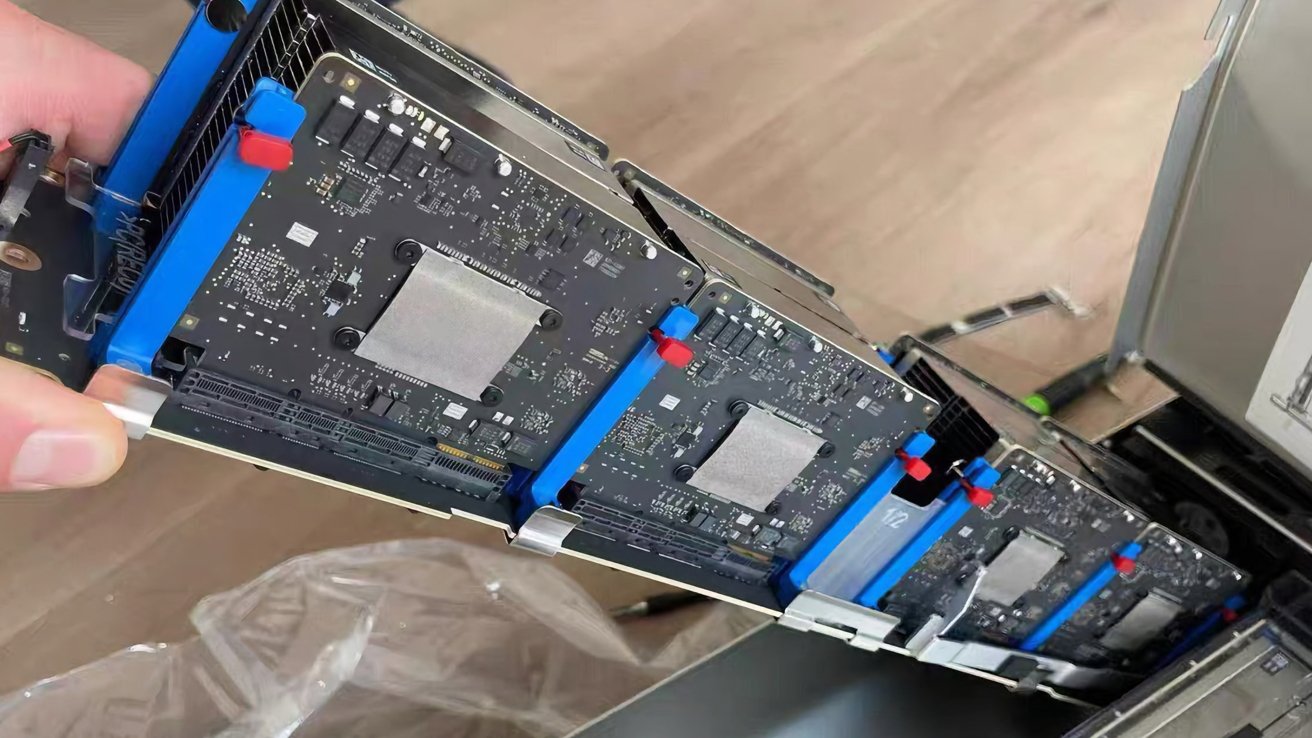
The server has four columns of hardware, with each consisting of eight smaller computer elements. Each board is on the outside edge of the column, with the heatsinks in the middle.
The boards seem to have a main processing chip element in the middle. To the sides are brackets to quickly remove or replace the boards.
Based on eight processors per column, that would mean each server contains 32 of them.
Later shots show those side boards, sans heatsink. A fourth image with the thermal paste cleaned off clearly shows the Apple logo on top of one of the chips.
We can only guess that the chips in use are M5 Ultra-equivalents to maximize performance.
A middle connector bridges the gap in the middle. A main control board runs the full column length, which those smaller boards connect into.
All four of the columns are identical in construction, with one slightly disassembled for the photographs.
In the middle of the unit are connector cables, that lead from the middle of the base board to the center, then to one end of the case. It is unclear if that is for providing power to each column, handling data, or both tasks.
One thing about the server that the account shares is that it's not really in control of what it processes. Another device is used to manage the hardware, which can be the case when creating server clusters.
In this instance, the account says it requires the use of a Mac Studio for "software control."
This may seem a bit unlikely unless the Mac Studio is in another part of the same rack setup. This isn't entirely out of the question, as Mac minis have commonly been rack-mounted for commercial purposes.
The arrangement is designed to allow as much airflow to pass through the column as efficiently as possible, from front to back. At one end of each column is a single fan, drawing air through.
This is quite a common concept for rack-mounted servers, as they are designed to maximize the use of hardware while keeping them cool enough to work in very confined spaces.
The heatsinks are in the middle of each column, with the fins arranged so air can flow from one end to the other directly. The sides and baseboard are also joined by a clear plastic cover on the top, enclosing the column and forcing air through the passage.
Back in February, Apple announced that its Houston facility was producing AI servers ahead of schedule. As part of that launch, it released some promotional shots from inside the facility.
An Apple employee on an AI server production line – Image Credit: Apple
One of those shots gives a side-on view of one of the AI servers, without its top cover. The main plastic-covered section matches the just-surfaced photographs, and it's not hard to imagine the other section being hidden by the cover in the new shots.
The main takeaway of the images is that Apple is clever and meticulous about the insides of its servers.
It may not be on the same level of hardware-stuffing as an iPhone, or a return to the xServe for consumers, but it still puts a lot of thought into what it uses to serve Siri AI queries.