Affiliate links on Android Authority may earn us a commission. Learn more.
A lot has been said about the Pixel 11 Pro and 11 Pro XL since their unveiling on August 12 — much of it not very good. Pixel phones always come with an extra heaping of criticism, warranted or not, but there are real concerns about this year’s Pro phones. They have less RAM than last year’s models, HiLight has already proven disappointing, the Tensor G6 chip isn’t a particularly big performance upgrade, and the phones are more expensive than ever before.
Considering all that, it would be safe to assume the Pixel 11 Pro ($1099 at Amazon) and Pixel 11 Pro XL ($1299 at Amazon) aren’t good phones. However, after spending about three weeks with both of them, I don’t think that could be further from the truth.
In typical Google fashion, the Pixel 11 Pro and its XL sibling aren’t chasing the biggest specs, and some of the hallmark new features aren’t as amazing as Google wants you to think. But the day-to-day experience of using the phones still ignites that unmistakable Pixel magic, and imperfections aside, I plan to keep using the Pixel 11 Pro long after this review is finished.
There are some genuine complaints I have with the Pixel 11 Pro, despite how much I like it, so let’s get those out of the way first. There are three main things to talk about: HiLight, Proactive Assistance, and charging.
HiLight is the glowing light on the back of the 11 Pro and 11 Pro XL, and as you’ve probably heard by now, it barely does anything. You can assign colors to specific favorite contacts, and when you do, HiLight will light up when they call you. Additionally, if your Pixel is face down, HiLight pulses and swirls when you interact with Gemini. Neat!
These are both fine features, but the problem is that they’re quite literally all HiLight does right now. Third-party apps have already unlocked more functionality, letting you use HiLight as a proper notification light for text messages and other apps, but the fact that this isn’t available out of the box is truly embarrassing. HiLight could be a great feature after ample updates, but right now, it’s not worth buying the Pixel 11 Pro for.
Proactive Assistance is equally disappointing. The pitch here is that your phone can proactively surface relevant info and actions based on what you’re doing. For example, if a friend texts you asking about an upcoming flight, Proactive Assistance can find your flight info and offer a shortcut to share it with them. Or, if you get a text asking if you’ve made a reservation at a restaurant for a certain time, you’ll get a shortcut in Google Messages to do it right there.
That sounds cool on paper, but after almost a month with the Pixel 11 Pro, Proactive Assistance has proven genuinely useful not once.
There are a couple of reasons for this. First, you have to be very specific about how you use your phone to prompt Proactive Assistance. Many of its actions only work in Google Messages or the Phone app, and if your text threads don’t contain very specific dates and times, you’ll never see these pop-ups. Secondly, the handful of times Proactive Assistance has appeared on my Pixel 11 Pro, the suggestions haven’t been helpful. I know what restaurant my partner and I are going to — I don’t need or want a Gemini summary of it.
The good news is that Proactive Assistance is easy enough to ignore if you don’t care about it, and like HiLight, it should get better over time. But three weeks in, it’s a dud.
What won’t get better over time is the charging performance of the Pixel 11 Pro and 11 Pro XL. Both phones are rated for the same maximum wired charging speeds as their predecessors, at 30W and 45W, respectively. The big thing this year is a new “Extreme Charging Mode” that reduces background tasks to deliver faster charging when your phone is below 50%.
In reality, this doesn’t seem to make much of a difference at all. The Pixel 11 Pro matches the Pixel 10 Pro almost exactly in our charging tests, with the 11 Pro taking 86 minutes to charge from 0-100% compared to 87 minutes for the 10 Pro. The Pixel 11 Pro XL’s faster 45W is a real benefit, taking just 64 minutes for a full charge, and topping up slightly faster than the 10 Pro XL. However, it’s still significantly slower than the Galaxy S26 Ultra’s 60W charging, which goes from dead to full in only 42 minutes.
Not only are these relatively slow charge rates, but Google’s charging standards remain as confusing as ever. You still need a very specific 21V PPS charger to achieve full charging throughput. I initially tried charging the 11 Pro XL with a 67W Anker charger, but since it doesn’t have 21V PPS, it topped out at 25W. Even more concerning is the amount of heat the Pixel 11 Pro XL produces during Extreme Charging.
These charge speeds are serviceable, and for overnight charging, you won’t have any issues. But in a world where even Samsung is finally getting on the fast-charging bandwagon, Google’s unwillingness to make any meaningful progress here is more grating than ever. Especially since the Pixel 11 Pro now starts at $1,099 and the 11 Pro XL will set you back at least $1,299, Google really should have done better.
With that out of the way, there is one more thing we should talk about before I really start gushing about the Pixel 11 Pro: the Tensor G6 chip.
Right off the bat, I’ll say this. Day-to-day performance from the G6 on the Pixel 11 Pro is outstanding. The phone is extremely snappy, animations are as fluid as you could ask for, and my go-to mobile game (Call of Duty: Mobile) runs really well at High graphics and Max frame rate. For the way I use my phone, the Tensor G6 hasn’t given me any issues — and I’ve not noticed the Pixel 11 Pro heating up either. It’s been a really good experience.
That said, it has to be mentioned that the Tensor G6 still lacks significant raw horsepower versus the competition. Compared to the Snapdragon 8 Elite Gen 5 powering the Galaxy S26 and S26 Ultra, the Tensor G6 is worse in nearly every metric — delivering lower single-core and multi-core CPU speeds and significantly worse GPU performance (up to 58% slower in Wild Life Extreme 3DMark stress tests). The Tensor G6 delivers improved CPU performance compared to the Tensor G5 in the Pixel 10 Pro models, but I haven’t noticed any meaningful year-over-year difference.
Benchmarks certainly aren’t everything, and as I said above, I’ve not had any real-world performance complaints with the Pixel 11 Pro after three weeks of regular use. I imagine most people who buy the 11 Pro or 11 Pro XL will find themselves in a similar boat. But if you want the absolute most performance from your next Android phone, you won’t find that here. That’s never been the point of Pixels, and I think that’s OK, but it’s still worth noting.
One aspect of the Tensor G6 that’s unquestionably better is efficiency. The 4,850mAh battery in the Pixel 11 Pro and the 5,115mAh battery in Pixel 11 Pro XL are actually smaller than batteries in the Pixel 10 Pro and Pixel 10 Pro XL (4,870mAh and 5,200mAh, respectively), but this year’s phones still manage to last longer — and that’s all thanks to a more efficient chipset.
I’ve primarily been using the small Pixel 11 Pro, and depending on what apps I’m using and how much of my time is spent on 5G, I’m seeing anywhere from four and a half to well over six hours of screen-on time, usually with around 20% battery still left in the tank. On the Pixel 10 Pro last year, I was topping out around five hours and hitting some days with just three hours of screen time. Beyond my real-world experience, the Pixel 11 Pro XL beats the Pixel 10 Pro XL in all but one of our five battery benchmarks.
To be clear, the Pixel 11 Pro and Pixel 11 Pro XL are still very much one-day smartphones, but I’m getting through a full day more comfortably than last year. It makes you wonder what Google could have achieved with this level of efficiency and a much denser silicon-carbon battery, but hopefully we’ll find that out with the Pixel 12 Pro.
The final thing worth mentioning about the Tensor G6 is its new modem. The G6 is the first Tensor chipset to not use Exynos modem technology, instead opting for a MediaTek M90 modem. And after years of Pixel connectivity complaints, it seems to have done the trick. In our testing compared to the Pixel 10 Pro, the Pixel 11 Pro holds onto 5G connections longer, delivers faster download speeds, and uses slightly less battery when on 5G, too. Anecdotally, I’ve not noticed any connection issues, and my colleague Zac has been very pleased with the new modem, too.
We’re about 1,500 words into this review, and I’ve only talked about three fairly large letdowns for the Pixel 11 Pro series, plus some good (but not groundbreaking) chipset improvements. If that’s all true, why do I like the Pixel 11 Pro so much? For everything else I’m about to talk about.
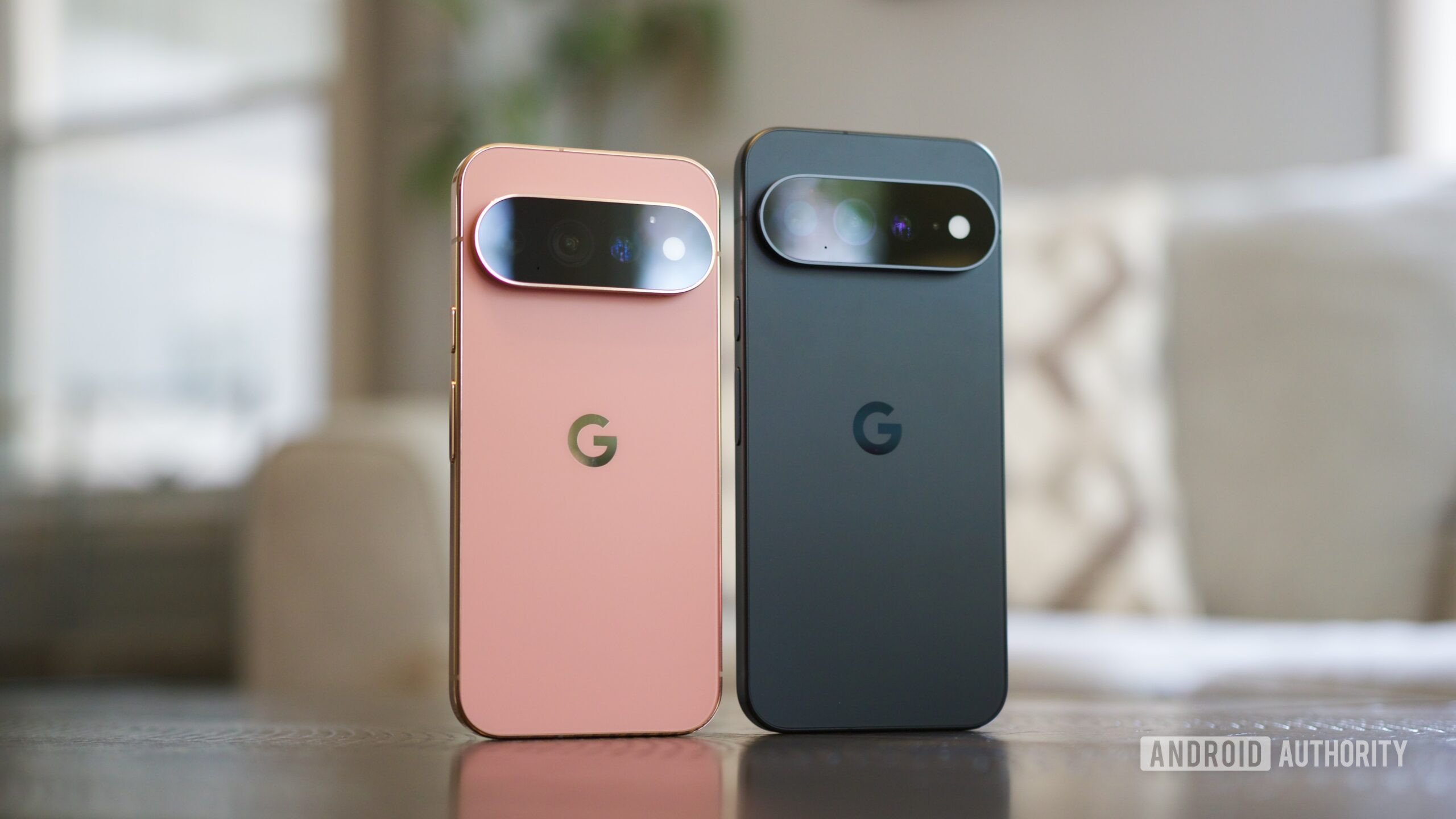
We might be on the third generation of this design, but I’m such a big fan of how the Pixel 11 Pro looks and feels — and a lot of that has to do with a lot of excellent refinements Google made this year.
First, the colors. The Canyon colorway for my Pixel 11 Pro is absolutely stunning and a strong contender for one of my all-time favorite Pixel colors. It’s not quite as saturated as it looks online, but the soft pink back paired with the gold frame and the new all-black camera visor is such a striking combination. The Obsidian color of my Pixel 11 Pro XL is less visually interesting, but I love how it introduces a matte frame on a Pro model Pixel for the first time — hopefully something we’ll see more of next year.
I’m also surprised by how comfortable I’ve found the smaller Pixel 11 Pro to be. Google didn’t make nearly as drastic a weight reduction as I had hoped (the Pixel 11 Pro weighs 204 grams, down slightly from the 207-gram Pixel 10 Pro). Even so, when held side by side, the 11 Pro doesn’t feel nearly as top-heavy as the 10 Pro, which was one of my biggest complaints.
Another issue that seems to be fixed? Screen durability. My Pixel 10 Pro acquired some pretty gnarly scratches over the last year — as have most Pixels I’ve spent any prolonged time with. I was curious about Google’s claim that the Pixel 11 Pro/11 Pro XL have “more than twice” as much scratch resistance as previous models, and so far, that claim is holding true. After three weeks of using the Pixel 11 Pro as my primary smartphone without a case or screen protector, I can’t find a single blemish on its display glass. I’ll have to see if that holds true after more weeks and months of use, but this is a very good start.