Affiliate links on Android Authority may earn us a commission. Learn more.
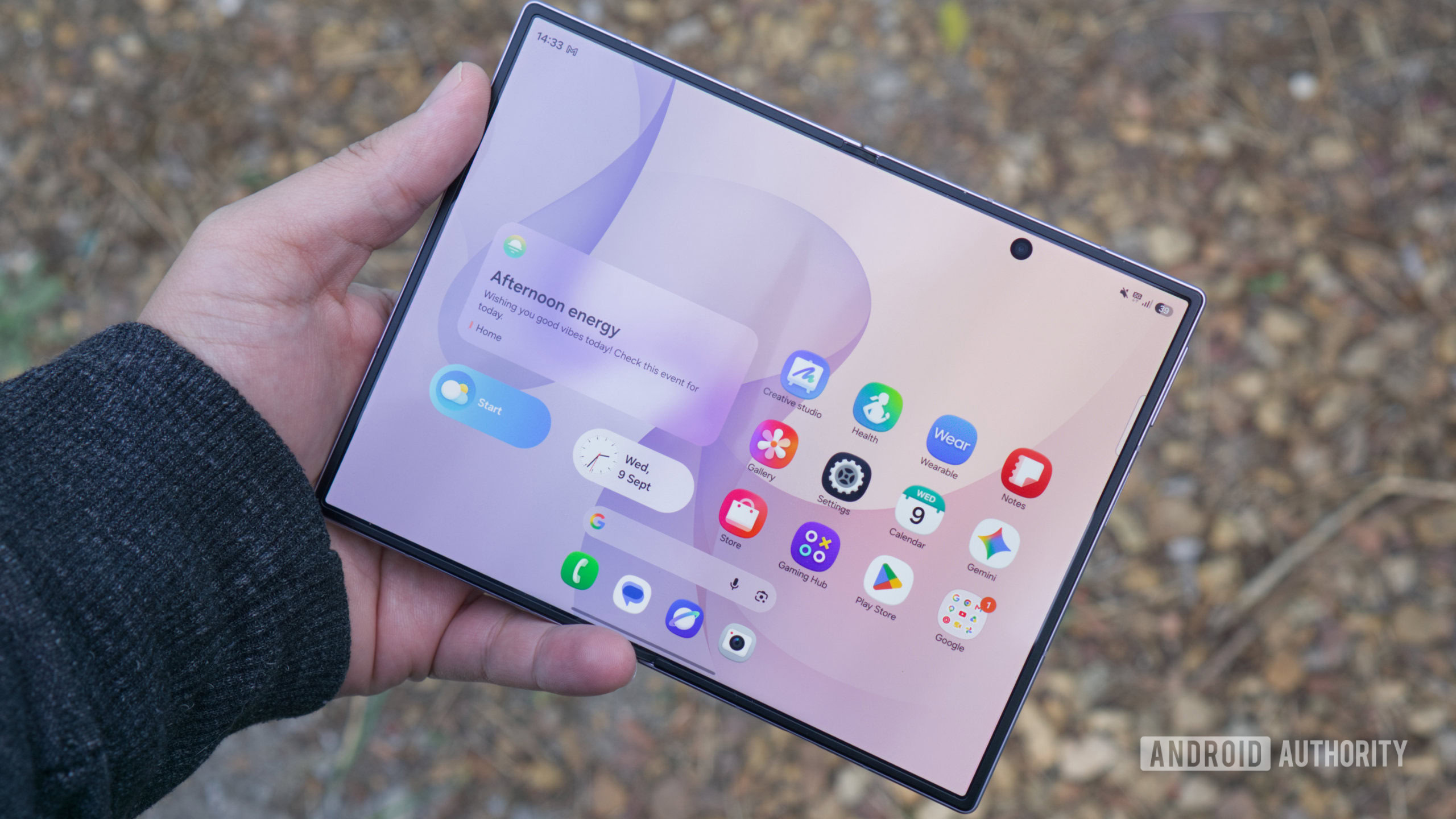
Samsung launched three foldable phones at its Unpacked event in July, but the Galaxy Z Fold 8 caught my eye and commanded my attention at the company’s pre-briefing. The new foldable differed from the Galaxy Z Fold 8 Ultra and previous Galaxy Folds thanks to its short yet wide form factor. It’s not the first wide foldable phone on the market, as Google, OPPO, and HUAWEI have all offered them before. But Samsung’s is clearly the most popular one running Android, and it comes just as Apple is getting in on the scene, too, with its first-ever foldable and the Galaxy Fold’s de facto biggest rival, the iPhone Duo.
I came extremely close to pre-ordering the Z Fold 8, but couldn’t bring myself to hit the checkout button. Now, after two weeks with Samsung’s long-rumored “Wide Fold,” did I make a mistake by not buying the device? It’s time to find out in our Samsung Galaxy Z Fold 8 review.
My initial thought after seeing the Galaxy Z Fold 8 is just how small it is. At 123.9mm tall, it’s much shorter than even “small” Android phones like the Galaxy S26 and Google Pixel 11. It’s even shorter than the iPhone 13 Mini. The phone is thin for a foldable too, at 9.7mm when folded and 4.5mm unfurled. It’s a little thicker than my Galaxy S23 Ultra, but the fact that I had to reach for my old phone in the first place to make the comparison says a lot about where we are with foldables in 2026. I also appreciate the 201-gram weight, which makes it lighter than the Galaxy Z Fold 8 Ultra and significantly lighter than the iPhone Duo.
Moving away from the dimensions, the Galaxy Z Fold 8 packs a reassuring aluminum frame with thin, flat frames. Samsung adds that the phone has a Flex Titanium hinge for improved crease control and impact resistance, along with Gorilla Glass Victus 2 on the back. For what it’s worth, I accidentally dropped the unfolded and unprotected phone onto the tiled kitchen floor while I was cooking (a 1.2-meter drop). Thankfully, it seemed to have suffered no damage at all and continued to work just fine. That’s just an anecdote, but it bodes well for accidental damage.
I can’t say I’m a fan of the sharp corners. It’s not as bad as on older Ultra phones, and it doesn’t dig into my palm as some Samsung phones have in the past, but I would’ve liked to see more rounded corners here. I do prefer this approach to the iPhone Duo and Xiaomi 18 Fold, which have sharp corners on the left and rounded corners on the right when folded. The location of the Z Fold 8’s camera bump also means this is an extremely wobbly device when you tap either screen while the phone is on a table. I would’ve liked to see a Pixel-style camera bar instead to keep this wobble at bay.
Easily the biggest hardware issue is the IP48 rating. This means the phone can be immersed in fresh water, but isn’t rated for dust resistance at all. That’s a real shame when Samsung’s rivals are all offering IP58 or even IP68 ratings for full water and dust resistance. It’s particularly disappointing because it means I wouldn’t feel confident taking this phone to the beach (let alone using it there). I’d also be questioning long-term reliability as your phone slowly accrues dust from your environment.
I was extremely excited to try the Galaxy Z Fold 8 due to its 7.6-inch folding screen. Samsung has stuck with a square-like aspect ratio for years now. That’s handy for split-view multitasking, but also means you’re left with letterboxing when watching 16:9 and 4:3 videos. In fact, you’re not getting much more (if any more) screen real estate for videos than on a conventional smartphone.
The Galaxy Z Fold 8 switches things up with a 4:3 aspect ratio, making it ideal for older videos and non-widescreen content in general. Sure enough, episodes of Buffy the Vampire Slayer and Columbo filled up the screen completely. We also see much smaller letterboxing when watching 16:9 content on the Fold 8 compared to a conventional Fold, although the actual video window size is roughly comparable.
I’m also thankful to see that, much like the original Pixel Fold and OPPO’s first couple of foldables, the Amazon Kindle app uses a two-column view by default for the Galaxy Z Fold 8. That means your ebooks look just like physical books, giving you a more immersive experience. There’s really no reason why the Kindle app shouldn’t default to this view on other foldables, though.
I’ve also found myself enjoying Nintendo DS emulation on the Z Fold 8’s inner screen. Holding the device in portrait orientation results in one screen on the top half and another on the bottom half, just like the real console. It doesn’t feel like a cramped experience, either. Games that require button inputs don’t work as well here, but titles like Advance Wars: Dual Strike and Trauma Surgeon felt at home on the wide Fold.
Samsung has also done a good job with the display crease. I can just about feel the indent when dragging my finger across it, so it’s not quite on par with OPPO’s zero-feel crease. I wasn’t able to directly compare this with the Galaxy Z Fold 7, but it’s absolutely less prominent than something like the vivo X Fold 5. I can still see the crease when looking at the screen from the side or when the display is off. In other words, the crease isn’t a solved issue just yet, but we’re getting close. And for many people, we’re now at the “good enough” stage. It says a lot that Apple hasn’t been able to ditch the crease either.
The folding screen isn’t without issues, though. I still found that the screen stubbornly held onto my fingerprint grease. The combo of a bright screen and an anti-glare layer does help cut down on reflections, but the grease becomes undeniable in dark mode or when the battery is extremely low. It’s just another reminder that you’ve still got a plastic display, along with the initial warning that even a fingernail can damage the panel. The vast majority of apps also look just fine here, but I did find that apps like Instagram and Slack require holding the device in portrait orientation if you don’t want a lot of white space.
Samsung has also made a major compromise by ditching Flex Mode, which allowed the device to be partially folded like a laptop. I thought this was a significant omission for scenarios like video playback, forcing me to use tent mode or lean the device against something instead. I also felt the lack of a Flex Mode when emulating DS games, as I would’ve liked to play some games with my Xbox controller while the device propped itself up. I also imagine this will be sorely missed when trying to take group pictures on a timer. Nevertheless, my colleague Brady Snyder reckons the ease of opening the Fold 8 makes this a worthwhile sacrifice. I’m inclined to agree, but the retro phone enthusiast in me would’ve loved a spring-loaded hinge, reliability concerns be damned.
Of course, the inner screen won’t be the primary display for most people. That honor goes to the 5.5-inch cover screen, which features a rather wide 16:10 aspect ratio. Long-term phone nerds will remember the LG Optimus Vu, which had a 4:3 aspect ratio, and that’s what this reminded me of.
The Galaxy Z Fold 8’s cover screen was less awkward than I thought it’d be, primarily because it’s so stubby. However, I needed to perform a lot of hand shuffling to reach the corners of the screen. This shuffling isn’t necessarily worse than on conventional large phones, but it’s still the price to pay for a wide phone. The venerable one-handed mode is still available, but I would’ve liked to see some Apple or HUAWEI-inspired software tweaks for one-handed use. I’m also pleased to see that most apps adapted very well to the cover display, although I noticed that Instagram showed less content at once and frequently had letterboxing for Stories.
The Galaxy Z Fold 8 ships with the Snapdragon 8 Elite Gen 5 for Galaxy chipset, along with 12GB to 16GB of RAM, and 256GB to 1TB of storage. In other words, you should have no problems with performance on paper. We know that foldables tend to suffer under sustained load due to the constrained form factor, so what does this mean for the Z Fold 8 and its compact design?
Geekbench 7 is already out, but Geekbench 6 allows us to compare the Galaxy Z Fold 8 to last year’s Galaxy Z Fold 7 and the more recent Galaxy S26. Our Galaxy S26 and the Z Fold 8 both use the same chipset, so it’s not surprising to see virtually identical single-core CPU scores. However, the Galaxy S26 edges ahead in the multi-core leg of the test. Nevertheless, the Z Fold 8 still emerges ahead of the Z Fold 7.
I expected the Galaxy Z Fold 8 to buckle in our GPU stress tests, as the form factor isn’t conducive to heat dissipation. Unsurprisingly, Samsung’s wide foldable achieved stability of 46 to 49% across all three tests. This means the phone lost more than half of its performance, not a good sign for demanding workloads like 8K video capture, emulation, or bleeding-edge games. On the upside, the Z Fold 8 generally ran cooler than the Galaxy S26 and never got uncomfortably hot.
Real-world performance is another matter altogether, but I’m glad to report that the phone ran smoothly. I saw no issues when launching apps, multitasking, or using the camera app. I was also able to play more demanding games like War Thunder with fluid performance out of the box, while still having headroom to crank things up. GRID Legends is another demanding title, but I enjoyed smooth performance with the “graphics” quality preset.
The Galaxy Z Fold 8 ships with a 4,800mAh battery, which isn’t huge in 2026 but is large for a Samsung foldable. It’s still a welcome upgrade over the Galaxy Z Fold 7’s 4,400mAh capacity, although our battery life benchmark reveals some interesting results.
Last year’s Z Fold 7 beat the Z Fold 8 in most workloads, bar 4K recording. You’d think the Z Fold 8’s larger battery and newer chipset would help it come out on top. I can only speculate that the Fold 8’s more pixel-dense inner screen might be sipping more juice, or that the software needs a bit of tuning. The good news is that Samsung’s wide Fold trounced the Pixel 11 Pro Fold in every category and beat the Razr Fold in most segments. It’s worth noting that the Pixel 11 Pro Fold has a 4,806mAh battery and the Tensor G6 chipset. However, the Razr Fold has a virtually identical processor and a much larger, 6,000mAh battery. Evidently, Samsung’s software optimizations continue to pay dividends here.
I was pleasantly surprised by real-world battery life, as I was generally able to record eight to ten hours of screen-on time. This usage consisted of WhatsApp, Instagram, Reddit, YouTube, and local video playback. I spent roughly 90% of my time on the cover display, although I used the inner screen for videos while doing chores and occasionally reading or playing games. This usage translated into just under two days of battery life. Heavier usage and more time with the inner screen will undoubtedly result in faster battery drain, but you’re still looking at all-day endurance in most scenarios.
Once you’ve run out of juice, you can top up via 45W wired or 20W wireless charging. The phone took 67 minutes to charge from 2% to 100% in our charging benchmark, with a peak wattage of ~38W. That’s a fair way off the 45W claim. Anecdotally, I also found that the phone took 64 minutes to hit 100% from empty. Either way, these aren’t speedy charging times for a foldable, but it’s solid in 2026 and great for a Samsung phone. Furthermore, it handily beats the Pixel 11 Pro Fold, which took 102 minutes to reach 100%. I also noticed that the Samsung device got very warm at first, but it quickly cooled down.
Samsung’s wide Fold doesn’t have great camera hardware, even for a foldable phone, featuring a 50MP 1/1.56-inch main camera and a 50MP ultrawide shooter. The good news is that the main camera generally delivers pleasant, detailed shots. It’s not always great, as we sometimes see fringing and splotchiness in some scenes along with neon colors (see the selfie image). The ultrawide snapper doesn’t fare badly, although there is some corner softness. Furthermore, the 1x camera takes notably brighter shots in low-light situations.
Unsurprisingly, zoom is the Fold 8’s Achilles’ heel given the lack of a dedicated telephoto camera. I found that switching to 2x could still yield solid-to-good pictures. Zooming past 3x or 4x was often a waste of time, although I was surprised by the 4x mountain image above. Zooming to 10x is usually a fool’s errand. The lack of a tele camera is a shame, because even 2021’s OPPO Find N, the original wide-style fold, offered one. At least the portrait mode delivers pleasant, mostly accurate bokeh at 2x.
On the plus side, the Galaxy Z Fold 8 delivers smooth video capture with little judder when tilting and panning. It also covers the gamut of 4K/60fps, 8K/30fps, and 4K/120fps video output. There’s LOG and APV codec support, too, for more professional video capture in a pinch.
One new video-related feature this year is the My FanCam feature in the Gallery. This identifies a subject in a previously recorded clip and crops the video after the fact to focus on your desired subject. For example, if you filmed a school play at 1x or 2x, you can use this mode to identify your child and then spit out a cropped video only featuring them.