
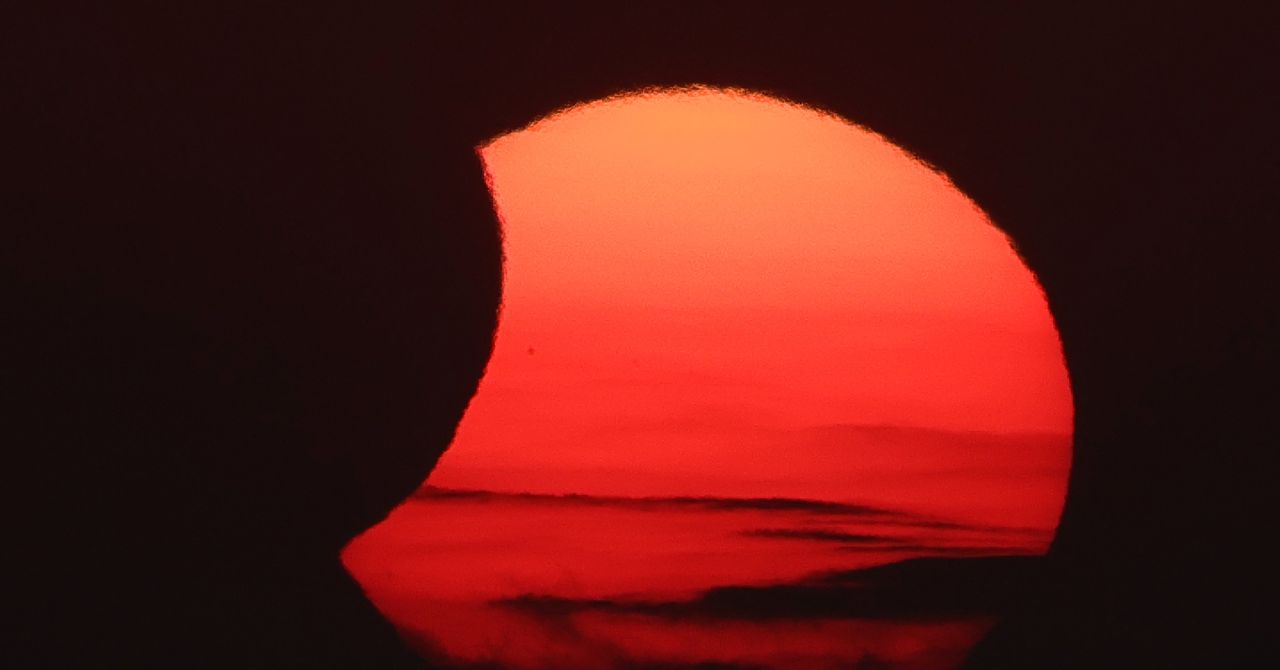
For the first time in more than a century, Spain witnessed a total solar eclipse. The astronomical phenomenon, which was also partially visible in some regions of northern North America, much of Europe, and western Africa, offered an unusual and particularly photogenic sight due to the sun’s position just above the horizon.
The solar corona glows as the moon completely obscures the sun during the total solar eclipse on Arenal Beach in Llucmajor, Mallorca.
The path of totality traversed the northern hemisphere from west to east. Its path began in the Arctic Ocean, north of Greenland, continued west of Iceland, and crossed the North Atlantic. Later, at exactly 8:30 pm central European summer time, the shadow cast by the moon reached the Iberian Peninsula.
People gathered at El Cerro del Tío Pío Park in Madrid to observe the total solar eclipse.
Regions such as Galicia, Asturias, Castile and León, Madrid, Aragon, Catalonia, the Valencian Community, and the Balearic Islands experienced the path of totality, while the rest of the country saw a partial eclipse.
The solar corona glows as the moon completely blocks the sun during the totality phase, as seen from San Asensio in the La Rioja region.
The event lasted about four and a half hours, while the total darkening of the sky lasted just under two minutes, allowing various space agencies to conduct scientific experiments along the path of totality.
Fans of Real Madrid watch the solar eclipse through special glasses before the Teresa Herrera Trophy match between RC Deportivo A Coruña and Real Madrid at Riazor Stadium.
One of the most notable projects involved a NASA mission tracking the moon’s shadow using a WB-57 high-altitude research aircraft that flew at 50,000 feet. A team of scientists sought to gather new data on the dynamics of the solar corona—the sun’s outermost atmosphere—which can only be studied in detail during total eclipses.
The total solar eclipse as observed from Palencia, Spain.
The space agency also brought students from various universities in the US to Iceland and Spain to launch scientific balloons before, during, and after the event. The goal was to analyze how the temporary darkening of the sky caused by the eclipse alters conditions in Earth’s atmosphere, gathering information that will help better understand the effects of these astronomical events on the environment.
Beachgoers view the eclipse in Llucmajor, Mallorca.
Later this month, a partial lunar eclipse will be visible across the Americas, offering new opportunities for researching the cosmos. In the meantime, we have the images of Wednesday’s solar spectacle to gawk at.
The moment following totality of the solar eclipse over the coastal lagoon of La Albufera in Valencia.
Several people watch the total solar eclipse from Arenal Beach in Llucmajor, Mallorca.
People prepare to watch the total solar eclipse from Arenal Beach in Llucmajor, Mallorca.
A man watches the total solar eclipse from the port of Tarragona, in eastern Spain.
A view of the solar eclipse from Segur de Calafell, Spain.
A girl watches the total solar eclipse in the port of Tarragona, in eastern Spain.
The eclipse in the moments following totality, as seen from La Zurriola Beach in San Sebastián.
This story originally appeared on WIRED en Español and has been translated from Spanish.