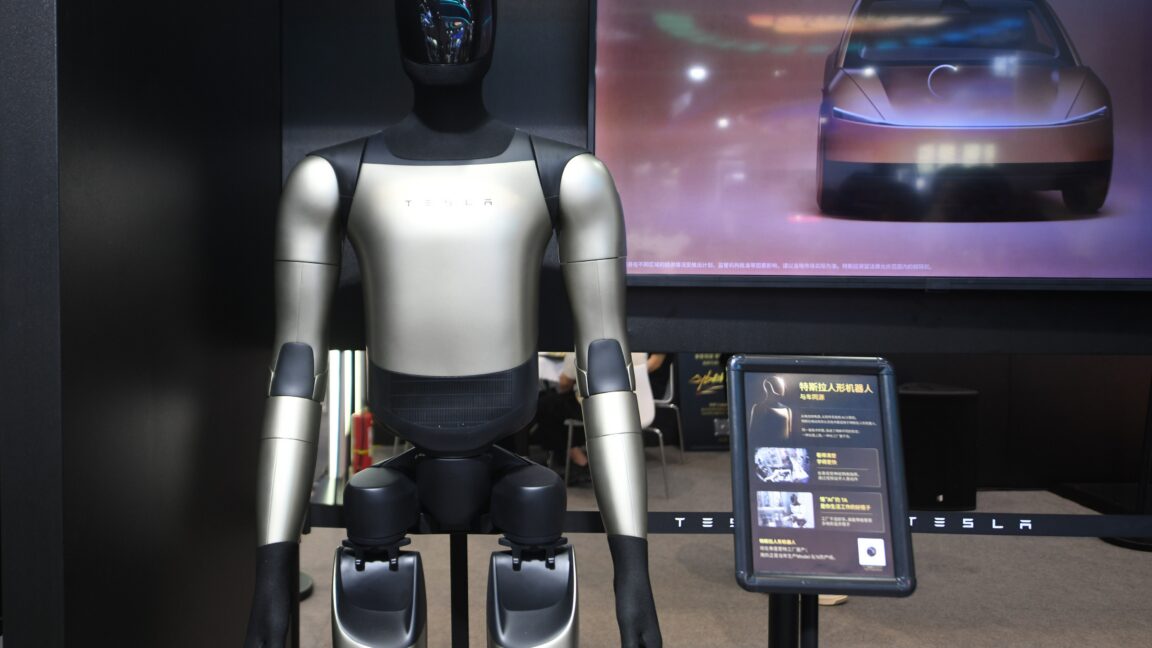
Tesla’s pivot from making electric cars to humanoid robots is facing challenges because of complex robot hands and disgruntled employees pushing back against training their robotic replacements. The struggle to scale up production comes as Tesla CEO Elon Musk has bet the company’s future on AI and robotics.
As someone who frequently makes claims that fail to materialize, Musk has described the Optimus humanoid robot as potentially “the biggest product ever” during Tesla’s second-quarter 2026 earnings call. But he also acknowledged that making an autonomous humanoid robot capable of handling many different tasks is “one of the hardest things to solve”—and now extensive reporting by The Information has revealed multiple complications that Tesla is trying to tackle while developing general-purpose robots and scaling up for mass production.
Tesla’s Fremont factory in California has already stopped making the Model S sedan and Model X SUV as of May 2026, with the company switching both line workers and engineers over to working on Optimus, according to The Information.
But the newest version of Optimus, called Optimus V3, has proven challenging from a development and manufacturing standpoint. The Information’s reporting describes troubles with getting production line equipment to precisely line up components, along with limitations in running the production line too fast. Tesla has reportedly scaled up production to hundreds of robots per week—but the company is targeting production numbers surpassing 1,000 robots per week by the end of 2026.
The automotive industry and other industries have already been using specialized industrial robots, such as robotic arms, for decades. Tesla and many other automakers and robotics companies are betting that humanoid robots coupled with advances in AI models could eventually unlock general-purpose robots that can handle a diverse array of tasks while fitting more seamlessly into human workplaces.
It’s no secret that making robotic hands capable of doing delicate manipulation tasks on par with human hands is a huge engineering challenge. The complexity of such robotic hands has translated into more production headaches for Tesla as human workers must manually assemble Optimus hands and forearms that together have more than 100 small components such as screws.
The imperfect and manually intensive manufacturing process has led to newly produced robots that require immediate fixes. Touch sensors for the robot’s hands have also proven unreliable enough so that Tesla has now developed a glove-like layer of sensors that can be replaced without replacing the entire robot hand.
The robot’s AI capabilities are also reportedly still insufficient for general-purpose operations, which is unsurprising given the challenges facing every robotics company on that front. Instead, one of The Information’s sources described Tesla’s Optimus robots as currently requiring programming to do specific tasks in carefully controlled environments.
One of the biggest challenges facing all robotics companies is getting enough training data to help robots visually learn a wide variety of manual tasks. The heavy reliance on imitation learning prompted Tesla to have factory workers in Texas and California wear special suits designed to record their physical movements while working.
However, The Information described some workers complaining because they “knew the robots were designed to eventually replace them.” So Tesla has apparently shifted that data collection responsibility to dedicated teams and has also set up “training hubs” for such teams.
The Information also makes a point of highlighting Tesla’s continued reliance on Chinese suppliers to make various robot components. The Information previously reported on Silicon Valley startups bringing robotic parts from China to the United States in their luggage.
The US robotics industry’s supply chain reliance on China has persisted despite the Trump administration trying to boost domestic supply chains and robotic production. In July, the Federal Communications Commission banned new foreign-made robots such as humanoid robots and four-legged robot dogs, along with robot vacuum cleaners.
Many of Tesla’s reported challenges in making humanoid robots are not unique. But that may be little comfort when Tesla also faces stiff competition on multiple fronts, as automakers in China, Japan, and South Korea are also developing humanoid robots, not to mention dedicated robotics companies pursuing humanoids. Toyota plans to invest billions of dollars in upgrading factories with robots, including some humanoids, while Hyundai is planning to deploy up to 25,000 Atlas humanoid robots developed by US subsidiary Boston Dynamics over the next several years.
One of the companies furthest along in commercial deployment of humanoid robots is Oregon-based Agility Robotics, which first put them to work at an Atlanta-area warehouse owned by GXO Logistics in 2024. But the overall business case for humanoid robots still has to be proven through more sustained and cost-effective deployments—not to mention showing that such robots can work safely around humans.