
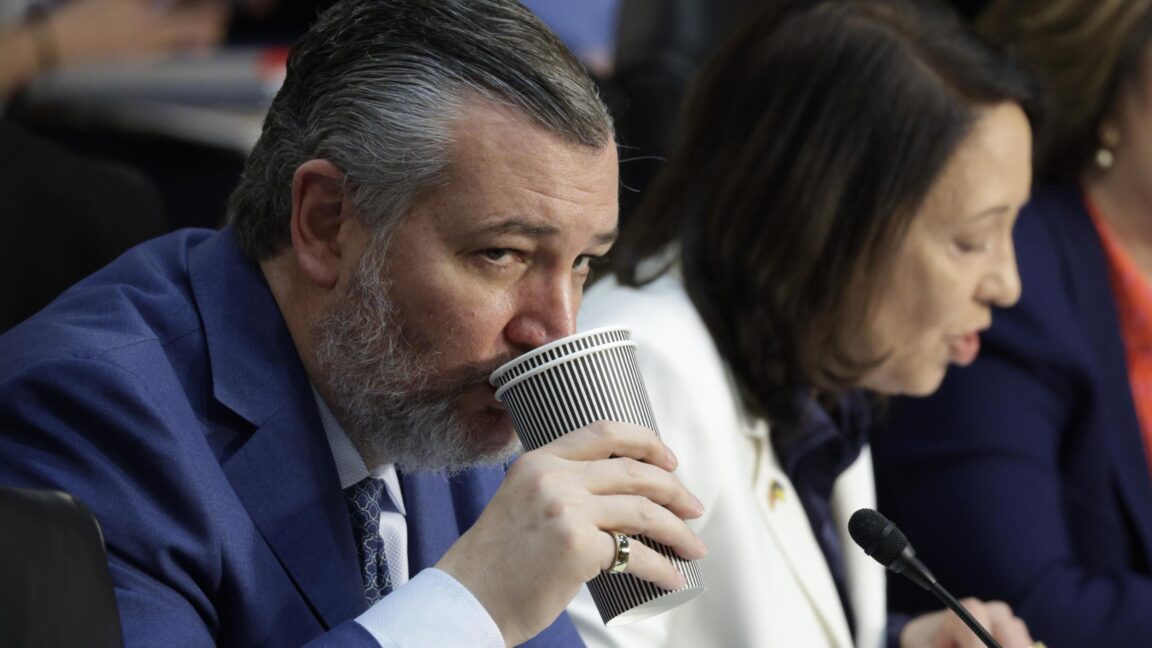
Senator Ted Cruz (R-Texas) is aiming to widen the Republican majority on the Federal Communications Commission before Democrats take over control of the Senate in January 2027.
Just before the Republicans’ midterm loss, Cruz yesterday announced a November 10 nomination hearing for Trump’s FCC nominee, Danielle Thumann Severs. In his final two months as chairman of the Senate Commerce Committee, Cruz seems set on moving the Thumann Severs nomination to a full vote of the Senate.
Confirming Thumann Severs would give Republicans an unusual 3-1 advantage on the FCC. That could become a 3-0 advantage at the end of 2027 because FCC Democrat Anna Gomez would have to leave the commission at that time if Trump does not agree to renominate her.
Senator Ron Wyden (D-Ore.) recently warned that federal law prohibits an all-Republican FCC and that “any action taken by a partisan FCC could be overturned in court, based on the statutory history of the Communications Act.” Wyden wrote in a September 24 letter to Gomez, “Because the Communications Act sets a quorum at three members, there is speculation that the President intends to fire you once [Thumann Severs] is confirmed, attempting to run the agency with an all-Republican 3-0 panel.”
“Under an all-Republican commission, every single license renewal, equipment certification, spectrum transfer, or other delegated action would be legally defective, casting a cloud of crippling legal uncertainty over the entire communications industry,” Wyden wrote.
Every FCC commissioner must be nominated by the president and confirmed by the Senate. By tradition, the president nominates opposing-party commissioners based on recommendations from the opposing party’s Senate leaders.
The bipartisan process has ensured that the FCC’s makeup complies with US law, but Trump hasn’t followed the tradition in his second term. He has failed to nominate a Democrat to the other empty FCC seat and has not renominated Gomez so she can continue past 2027.
Gomez today issued a statement calling on Congress to fill the empty FCC seats in a bipartisan manner.
“We must rebuild public trust in the FCC by returning the public interest standard to its original meaning as an obligation to communities rather than a tool for political pressure,” Gomez said. “That means defending the First Amendment and a free press from government interference, advancing competitive innovation that smartly protects our communications networks, and delivering real results for consumers.”
Thumann Severs is an attorney and senior counsel to FCC Chairman Brendan Carr. Trump nominated Thumann Severs in August, but a Senate nomination hearing originally scheduled in September was postponed to accommodate her maternity leave. We asked Cruz’s office about plans for Thumann Severs’ confirmation vote and will update this article if we get a response.
The Communications Act requires the FCC to have three members for a quorum. The US law also forbids supermajorities on the FCC by specifying that “the maximum number of commissioners who may be members of the same political party shall be a number equal to the least number of commissioners which constitutes a majority of the full membership of the Commission.”
In previous administrations, the president and Senate agreed on paired nominations to ensure that the president’s party maintained a 3-2 advantage. Senate Democrats have been pushing for the Thumann Severs nomination to be paired with a new Democratic nominee so the commission can have a full slate of five members. When it became clear that wouldn’t happen, Democrats asked Trump to at least renominate Gomez in order to maintain a 3-1 split.
Twenty-one Democratic lawmakers on the House Commerce Committee wrote a letter last week to Cruz and Senate Majority Leader John Thune (R-S.D.), urging “that any new Republican nominee to the commission be paired with the nomination of a qualified Democratic commissioner, including the renomination of Commissioner Anna M. Gomez to a full term.”
The Communications Act limits how many commissioners may belong to one political party, ensuring that decisions on broadband, media ownership, and network security are tested by more than one point of view… Robust disagreement, independent judgment, and deliberation strengthen the commission’s decision-making and provide an important check when the FCC considers policies with far-reaching implications for consumers, competition, and constitutional freedoms.
Gomez can’t prevent any major regulatory actions that Carr’s majority is set on taking, but she has been a consistent voice opposing Carr’s attacks on Trump’s least favorite news organizations and attempts to police speech on broadcast TV. She also has occasionally convinced Carr to make changes to rulemakings that she argued would harm telecom consumers.
The Democrats’ letter said Gomez has been a strong advocate for telecom consumer protections, competition, network security, and access to affordable high-speed broadband. “Additionally, the FCC’s licensing and enforcement authority over broadcasters carries real constitutional limits, and Commissioner Gomez has taken that seriously, defending editorial independence and speaking out when she believed that authority was being stretched beyond its proper role,” Democrats wrote.
Gomez’s term technically expired on June 30. US law allows her to serve until the end of 2027 or until the Senate confirms a replacement, whichever comes first. Severs would not replace Gomez because Trump nominated Thumann Severs to fill a different seat in a term expiring in 2029.
If the Senate confirms Thumann Severs during the lame-duck session, it would be reminiscent of the December 2020 confirmation of Trump nominee Nathan Simington. The vote, taken shortly after Biden’s 2020 election win over Trump, resulted in a 2-2 deadlock at the start of Biden’s term. The Biden-era FCC remained deadlocked at 2-2 until Gomez was confirmed by the Senate in September 2023.