As Apple’s Tim Cook era draws to a close, we’re seeing more experimentation with the iPhone’s design than we’ve seen in a long time, but you wouldn’t know it from the iPhone 18 Pro. This absurdly fast, full-featured handset might be eclipsed by the hype around the iPhone Duo this year, but it’s still just as good as its immediate predecessor.
Of course, not too much has changed since the iPhone 17 Pro. There’s the new variable aperture and other camera controls for those who want to get granular with their mobile photography, a welcome addition given the iPhone’s reputation for inflexibly opinionated computational photography.
Beyond that, though, all the most important changes are under the hood: a new chip, better battery life, and much-improved thermals that both give the phone better sustained performance and make it cooler to the touch in many situations.
I think we’re seeing something of a transition for the “Pro” iPhones. They may still be the flagships in a sense, but Apple is at least for now saving its flashier design ideas for new products like last year’s iPhone Air or this year’s iPhone Duo.
The Pro phones aren’t the sexy, cool ones right now; they’re the everything-and-the-kitchen-sink, cover-for-every-kind-of-obsessive-user workhorses. I think that’s a great space for them to occupy, and this year’s iteration is no exception.
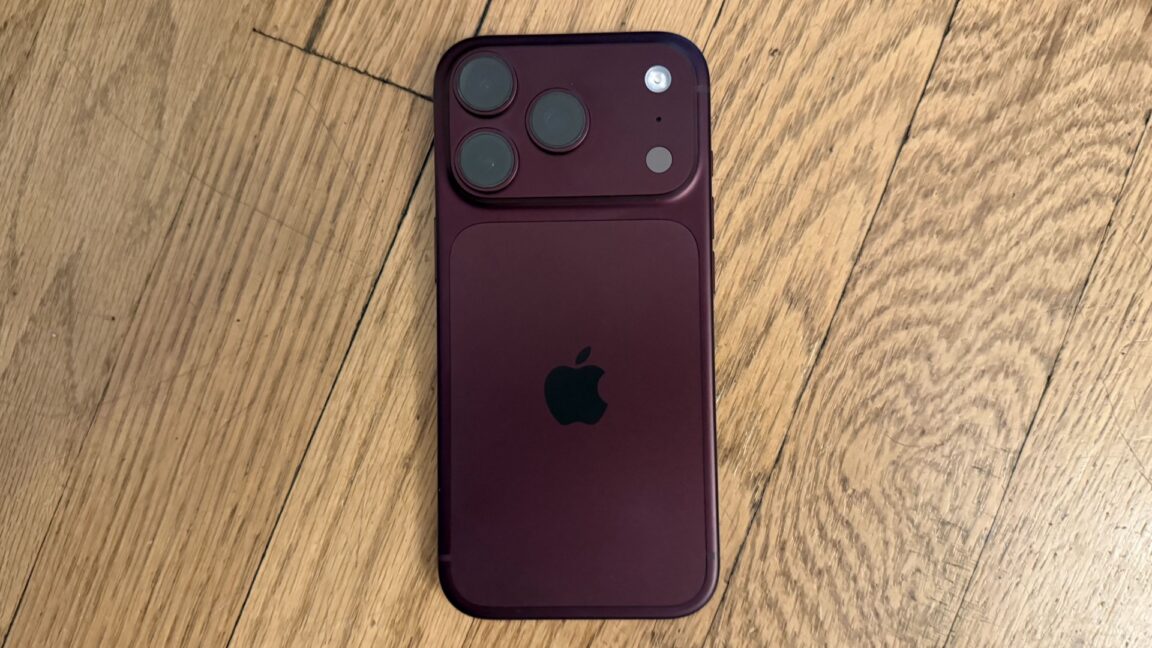
The iPhone 18 Pro mostly looks and feels like last year’s flagship. It’s a function-over-form design (at least compared to something like the iPhone Air) with good materials.
I’m not normally one to care too much about color in these phones. For my personal phone, I’ve always just grabbed whatever was closest to black. (Apple says this year’s black is the blackest yet, of course.) But I have to admit the new burgundy color of my review unit is appealing, even though it’s quite the fingerprint magnet, in a long tradition for iPhones.
The main design difference this time around is a smaller Dynamic Island, that cut-out at the top of the screen that houses the front-facing camera and sensors. Apple has achieved this by moving the IR camera underneath the OLED panel, now in the top-left corner of the screen.
A new pixel arrangement allows infrared light to pass through in that spot, while the pixels in this region operate at twice the brightness to compensate for lower density, so there’s little visible effect on the image on the display. You can tell there’s something subtly going on in that corner if you know what to look for and look closely, but I don’t think most people will notice.
As I wrote when the Dynamic Island was first introduced, the way Apple combines the per-pixel brightness and absolute blacks of the OLED panel with creative software to turn what should be something of an albatross—a big, chunky hole in the screen—into an appealing feature by displaying live activities and other information around the sensors is one of the company’s more impressive design ideas in recent years. The execution is excellent and remains so.
Now, that hole is less big and chunky, making it sensible for Apple to now show up to three live activities at once in the region, not just one. The middle one has more information, while those on the left and right are basically dots with just enough to tell you something useful.
It’s also now possible to show more information on a second live activity when there are just two being displayed; I found this even more appealing than showing three live activities.
This isn’t enough of a reason to upgrade from an earlier Dynamic Island phone, of course, but it has made a good feature a little bit better.
Let’s talk specs, performance, and the main story with this phone—heat management. For most specs, this is last year’s iPhone 17 Pro. But the A20 Pro chip has some improvements that make this one of the more notable performance steps in a while.
First up is the new A20 Pro chip. Apple has gone from a 3-nanometer process node in the A19 Pro to 2 nm here. It has a 6-core CPU with four efficiency cores and two performance cores—nothing new there. The GPU has seven cores, each with a Neural Accelerator that Apple says helps improve GPU-based AI workloads. (There’s hardware-accelerated ray-tracing support, too, though few games or apps utilize it.)
Also for local AI features (which are a big emphasis for this year’s iOS 27), there’s the dual 16-core Neural Engine.
Apple also says the A20 Pro has “the widest memory interface ever shipped in an iPhone” (naturally) with 50 percent more bandwidth. Based on what Apple has said so far about it, that seems to be mainly to improve AI performance. I’m speculating here, but given that Apple Intelligence and Siri AI features work fine on other recent iPhones, I imagine that’s a bit of padding to enable support for future AI features that won’t work on the 16 Pro or 17 Pro.
Unsurprisingly, and as the 3DMark benchmark chart below shows, that could make a big difference in graphics performance, too. It’s not like many people were complaining about the 17 Pro’s frame rates in Genshin Impact or Diablo Immortal, but hey, they definitely won’t be now.
The chip has been re-architected in a couple of ways. New chip packaging promises improved heat management, thanks in part to a design that puts the system-on-a-chip next to the memory instead of stacked on top of it.
The most notable improvement is arguably a larger vapor chamber. Last year’s iPhone 17 Pro introduced the vapor chamber as an additional cooling measure, meant to help the phone sustain good performance for longer and distribute heat more sensibly. A copper material on the display plate helps keep the display cooler, too.
Apple promises up to 40 percent better sustained performance compared to last year’s Pro and up to 100 percent better than the iPhone 16 Pro before that. That’s neat, but sustained performance wasn’t a big problem for most users before. The main benefit is that the phone feels cooler and is less likely to overheat.
In my view, the better thermals are the most welcome addition to the iPhone 18 Pro. Many of us who have tried to use our phone as a GPS on the car dashboard on a hot summer day know the frustration of features shutting down when the phone goes into crisis heat-management mode. And even in normal use, like during online gaming or web browsing while streaming video, iPhones from a couple of years ago or earlier tended to get quite hot.
It’s been quite cool and overcast in Chicago this week—fall is here at last—so I haven’t been able to test the former of those extreme cases, but I’ve used the phone enough to be able to report that there is noticeable improvement in the more day-to-day scenarios. It still gets warm in some situations, like when I read the 3DMark benchmarks, but most of the time, it subjectively seems better than a couple of generations ago.
It’s normally hard to notice the absence of a problem, but my own iPhone 16 Pro has gotten hot frequently enough over the past couple of years that the contrast has been real and felt.
We’ll leave the camera specs to the cameras section of the review, but there are a couple of other spec changes worth noting.
First off, there are further battery life improvements. Apple has long used offline video playback as one of its measures, and it says the iPhone 18 Pro can offer up to 36 hours of that on a single charge, compared to 33 for its predecessor. (It’s up to 45 for the 18 Pro Max and 39 for the 17 Pro Max.)
Subjectively, I’m impressed by the battery performance. My personal daily driver is an iPhone 16 Pro Max, which is currently sitting at 86 percent maximum capacity per Apple’s battery health panel in the Settings app.
I have no complaints; I charge it for about an hour in the morning, then do whatever I want with it (other than maybe intensive 3D gaming) with the brightness cranked up until the next morning, when I charge again.