Affiliate links on Android Authority may earn us a commission. Learn more.
It’s the end of an era as OPPO has announced that OnePlus is officially leaving North America and Europe. The news has been brewing for months now, but it still stings for US customers in particular, who are now deprived of a trailblazing flagship phone brand.
This news got us thinking about the best OnePlus handsets of bygone years. So we decided to choose and rank the top five OnePlus phones of all time. How did we do? Let us know via the poll and comments below.
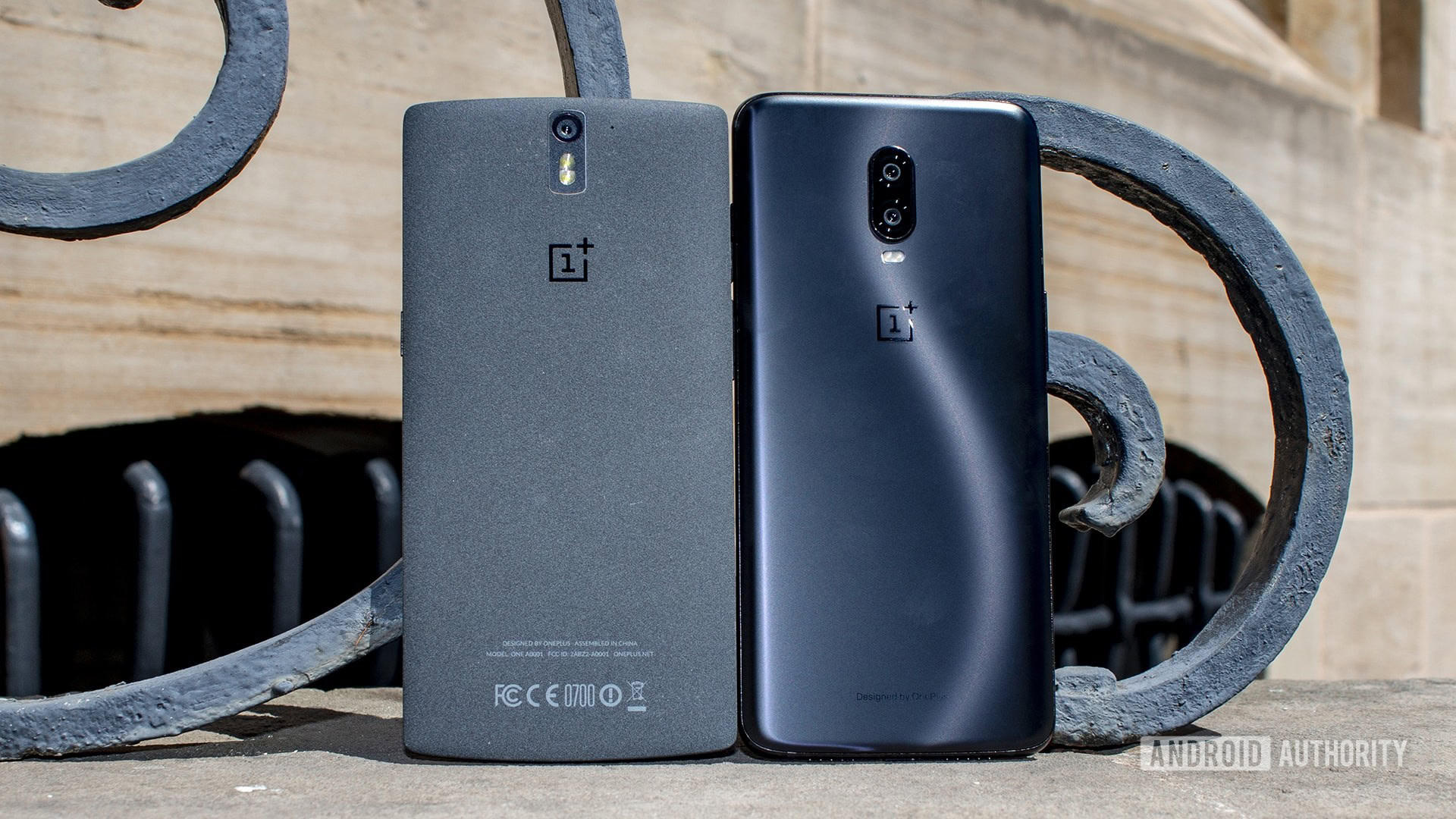
You can’t make a list like this without the OnePlus One, can you? This is the phone that immediately established OnePlus as a brand to watch. The OnePlus One coined the “flagship killer” moniker in 2014, bringing some high-end specs for just $300. This was a rarity back then, as only Xiaomi’s early Mi phones offered a similar level of bang for the buck.
The phone even came with the CyanogenMod software, delivering a bloat-free experience at a time when many Android phones were bogged down by unnecessary software. While that CyanogenMod partnership wouldn’t last, that legacy of clean, performant Android would endure for a while.
Yes, the invite system was annoying and felt like a marketing gimmick. Sure, there was the cringeworthy Ladies First contest. But when was the last time that a company’s first Android phone made such a gigantic splash? Even the original Galaxy S failed to make the same impact as the OnePlus One in terms of its influence and critical reception.
OnePlus followed up the OnePlus One with the OnePlus 2, and it makes a strong argument for being the weakest flagship in the brand’s history. That’s largely due to the notorious Snapdragon 810 chip and the lack of NFC. Thankfully, the company bounced back from this phone with the OnePlus 3 and OnePlus 3T.
The OnePlus 3 marked the debut of Dash Charge tech, which eventually gained the Warp Charge and then SuperVOOC charge monikers. This fast-charging tech, which delivered a 60% charge in 30 minutes, was a revelation at a time when most other high-end phones took ages to gain a meaningful charge. But the phone also offered a powerful Snapdragon 820 chip, plenty of RAM, a sleek aluminum design, and a handy fingerprint scanner.
The company would follow up with the OnePlus 3T roughly six months later, marking the brand’s first mid-year refresh. It delivered an incrementally improved processor, a larger battery, and a better selfie camera for $40 extra. Either way, these phones went some way towards popularizing fast charging in North America, while banishing memories of the OnePlus 2.
2019 was a stellar year for smartphones, thanks to devices like the HUAWEI P30 Pro, Samsung Galaxy S10 series, and the Xiaomi Mi 9T series. We can also add the OnePlus 7 Pro to the list, for several reasons.
Easily the coolest thing about the OnePlus 7 Pro was its pop-up selfie camera, a design trend that I still miss in 2026. This enabled a truly uninterrupted screen, free of notches and punch-hole cutouts. Furthermore, it didn’t seriously compromise image quality as we’ve seen with under-display selfie cameras. OnePlus wasn’t the first company to adopt this technology, but it was still a refreshing solution in a US market that had become stagnant.
There was more to the OnePlus 7 Pro than the cool design, though. The phone also offered a 90Hz OLED screen as a key selling point. This wasn’t the first phone with a high refresh rate panel, but it was certainly among the first to combine it with an OLED screen. It also offered a truly flexible triple camera setup for the first time, along with key strengths like fast charging, a relatively large battery, and plenty of horsepower. The OnePlus 7 Pro wasn’t perfect, due to the lack of an IP rating and wireless charging, but these omissions were understandable for the $669 price tag.
Sure, the first (and only) OnePlus foldable phone is actually a rebranded OPPO device, but that didn’t stop it from being one of the best OnePlus phones to date. The OnePlus Open frankly embarrassed the Samsung Galaxy Z Fold 5 due to its relatively slim design and shallow display crease. But the upsides didn’t end here.
The OnePlus foldable also offered more capable camera hardware, great battery life for a foldable, fast wired charging, and the trademark alert slider. Perhaps the most influential inclusion might be the Open Canvas multitasking system, which lets one app occupy 90% of the screen while another app occupies the remaining 10% for easy switching. It was a smart addition and it’s no wonder that Google copied this concept for Android 16.
This foldable wasn’t without its flaws, though. The phone lacked wireless charging, the IPX4 rating paled in comparison to Samsung and Motorola’s ratings, and OxygenOS lacked a few features we took for granted on other foldables. Furthermore, the Open wasn’t sold via carriers in the US. But it says a lot that the device is still worth buying today.
Is it recency bias? Maybe. But I’d fiercely argue that the OnePlus 13 marked the high point for the brand, at least from an actual product perspective. OnePlus historically struggled to deliver a world-class camera experience, as previous devices usually offered good to great cameras but nothing truly excellent. However, the OnePlus 13 absolutely nailed this category, and colleague Ryan Haines noted in his review that the triple 50MP cameras delivered “incredible” camera zoom and overall photography.
There’s more to the OnePlus 13 than amazing cameras, though. It also addressed a long-running weakness by delivering an IP68 rating across every model. By contrast, the OnePlus 12 only offered an IP65 rating, while several other models only offered IP68 ratings for carrier variants.
Then there are the long-standing strengths. You’ve got 100W or 80W wired charging, fast wireless charging, a hefty 6,000mAh battery, plenty of RAM/storage, and the slick OxygenOS skin. Throw in that gorgeous Blue variant and the respectable update policy, and it’s phones like these that will make us miss OnePlus.
This list wasn’t easy to put together, as the company delivered its fair share of high-quality releases throughout its lifetime. So we’ve got a few honorable mentions worth knowing.
The OnePlus X earns honorable mention status as it blew many other mid-range phones out of the water at the time of its release. A Snapdragon 801 chip, OLED screen, premium design, 16GB of expandable storage, and decent cameras back in 2015? For $250? Sign us up. It’s just a pity that it skipped NFC.
The OnePlus 7T was another serious contender that just missed out on our list. It was basically the OnePlus 7 Pro without the cool pop-up camera, featuring slightly more RAM, a marginally improved chipset, and a slightly smaller battery.
Finally, the OnePlus 10T was another phone that missed the cut. This was a return to the company’s affordable flagship roots after a few years of standard and Pro phones. Your $650 got you plenty of performance, 150W or 125W wired charging, good battery life, and a great screen. But the aggressive price resulted in a plastic frame, an IP54 rating, no wireless charging, disappointing cameras, and (worst of all for OnePlus fans) no alert slider.
Thank you for being part of our community. Read our Comment Policy before posting.