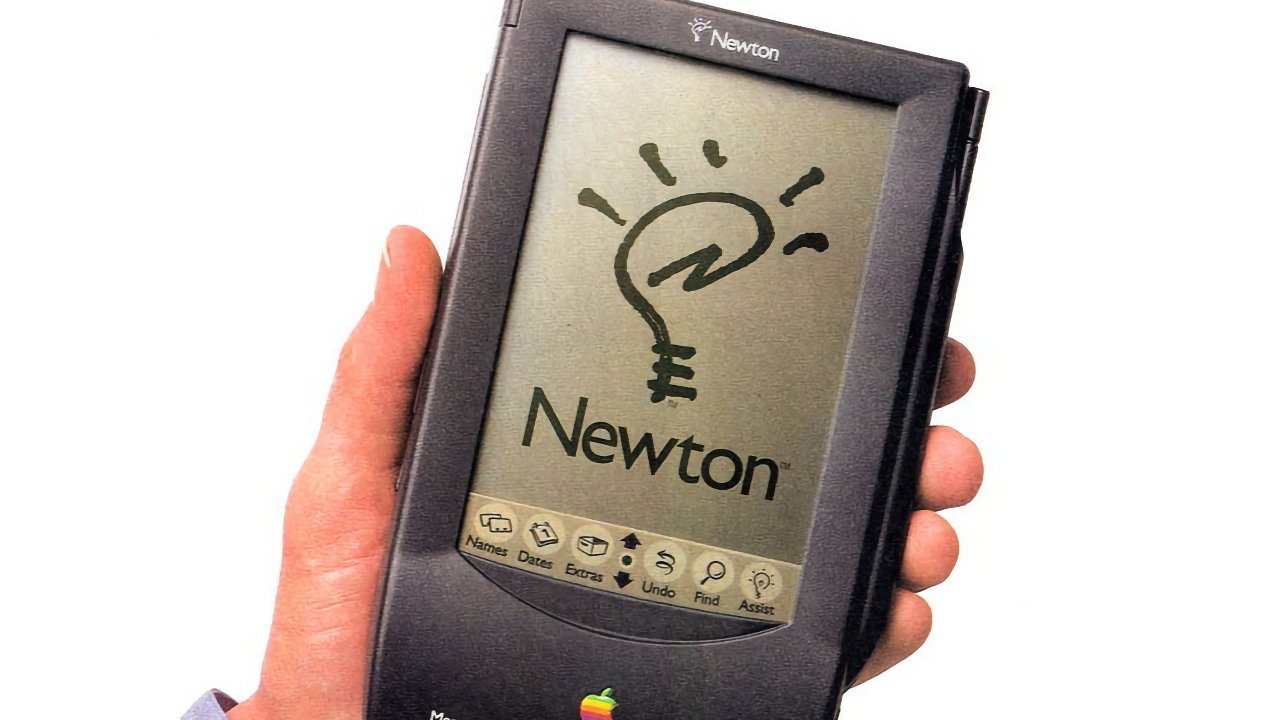
Apple's Newton handheld computer was both the company's biggest failure and its greatest peek into the future. Now, 33 years after launch, AppleInsider reminisces about what Newton was, what it meant, and where it went wrong.
Back in 1993, Apple's press officers did the rounds of every technology magazine there was. When they reached one in London, they had the speech down pat. In particular, they knew how to fend off criticisms by asking questions first.
"What do you think it should have next?" they asked, subtly telling us more versions were coming and buttering up our egos. "Backlighting or color?" Without exception, the ten or so journalists in that office all said "backlighting" in unison.
It wasn't a bad choice. Newton never would get color but it did get backlighting with the MessagePad 130 in 1996.
On reflection, though, the answer to "what does it need next" was a lot more complicated than a simple choice between two features. By the time we were being asked that, the device was already heading to failure because it was competing against everyone's inflated expectations for it. Newton was announced so far ahead of being shipped and it was hyped so much that by the time it came, it was inevitably a disappointment.
That long delay also meant that competitors could at least start making rivals. Yet really the biggest rival to Newton had begun before the announcement. It's just that it had been begun by Apple. At exactly the same time Apple was making Newton, its spin-off company General Magic was attempting to make a similar device.
It's rare for a company to foresee where the future is going but Apple did it in the 1990s — and unfortunately did it twice at the same time. These were two separate Apple-backed devices that eerily predicted the world we live in today. And they both failed.
To understand where Newton went wrong, you need to see what it was trying to achieve before all of the hype and you need to go back further to the mid-1980s.
In 1985, Jean-Louis Gasse wrote that "in five years or less, computers will probably be capable of recognizing handwriting."
Today, Gassee is a businessman turned writer who was long best known for his witty "Monday Note" blog but in 1985 he was Apple's senior vice president of research and development.
In his 2023 biography, "Grateful Geek," Gassee says it was when disaffected Apple engineer Steve Sakoman wanted to quit in 1987, that Newton began. Sakoman wanted to escape Apple's politics, return to product creation, and work on his idea for a device with handwriting recognition.
"I should have given him a pep talk and pointed out that Apple was in great shape with many interesting projects ahead," wrote Gassee. "Without thinking, I asked if he needed a CEO."
They compromised. Sakoman agreed to stay with Apple and make this device only if his work would be kept free of interference.
Gassee set him up in a building on Bubb Road, about ten minutes away from 1 Infinite Loop, and did not report to the Board what he was doing.
Apple's relevant buildings in Cupertino, California. Via Apple Maps. In red left to right: Bubb Road, 1 Infinite Loop and today's Apple Park.
Sakoman wasn't working alone, though. By this point he'd persuaded Steve Capps, co-writer of the Mac's Finder, to return to Apple specifically for this project. What they and their team were doing was specifically to look at making a pen-based mobile computing device. By late 1987 Sakoman had named it Newton, after the original complex pen-and-ink Apple logo.
Also by this point, their plans or at least hopes were well developed. Newton was to be a handheld computer and communicator that sold for $2,495. That's what the original Mac cost so it didn't seem unreasonable. In today's money, though, it's around $7,400, which does.
That price today would buy you two of the base Apple Vision Pro, even after Apple's June 2026 price rises. Or it would have done, but the planned Newton didn't stay that price for very long.
It didn't stay handheld, either: by 1989 Newton was instead on its way to being a tablet measuring 8.5 by 11 inches, codenamed Figaro, and probably due to cost between $6,000 and $8,000. In 2025, that's $16,200 to $21,600 — or nearly six of the Apple Vision Pro.
It's not clear how long Gassee really did keep this project secret from the rest of Apple, but by 1990, the company's Board definitely knew about it. By then, though, there didn't seem such a need to keep it secret in order to prevent any interference.
That's because Newton's big supporter Gassee had first taken over worldwide product marketing and shortly after was also named President of Apple Products.
However, early in that same year, Gassee disagreed with CEO John Sculley who wanted to licence the Mac operating system to other computer manufacturers.
Bill Atkinson (right, with Steve Jobs) was crucial to the creation of the Newton MessagePad — Image credit: Apple
Their difference of opinion and Sculley's position meant that Gassee had a powerful title, but he was sidelined. It was a clear and significant enough change in Gassee's position that he quickly announced that he would resign.
It was all just more internal Apple politics and this time, specifically because of how Gassee was being treated, Sakoman finally did quit Apple on on March 2, 1990.
That could've been the end of Newton except for Bill Atkinson. This is the man who was principally responsible for the Apple Lisa's graphical interface which then became the Mac's.
Atkinson invited Steve Capps plus Apple legends Andy Hertzfeld, Susan Kare, and Marc Porat to his home for a meeting on March 11, 1990. It was to discuss a way of keeping Newton going and, significantly, he also invited John Sculley.
Despite implying in his book that he championed the idea of a Knowledge Navigator, he didn't understand the Newton when it was pitched to him.