
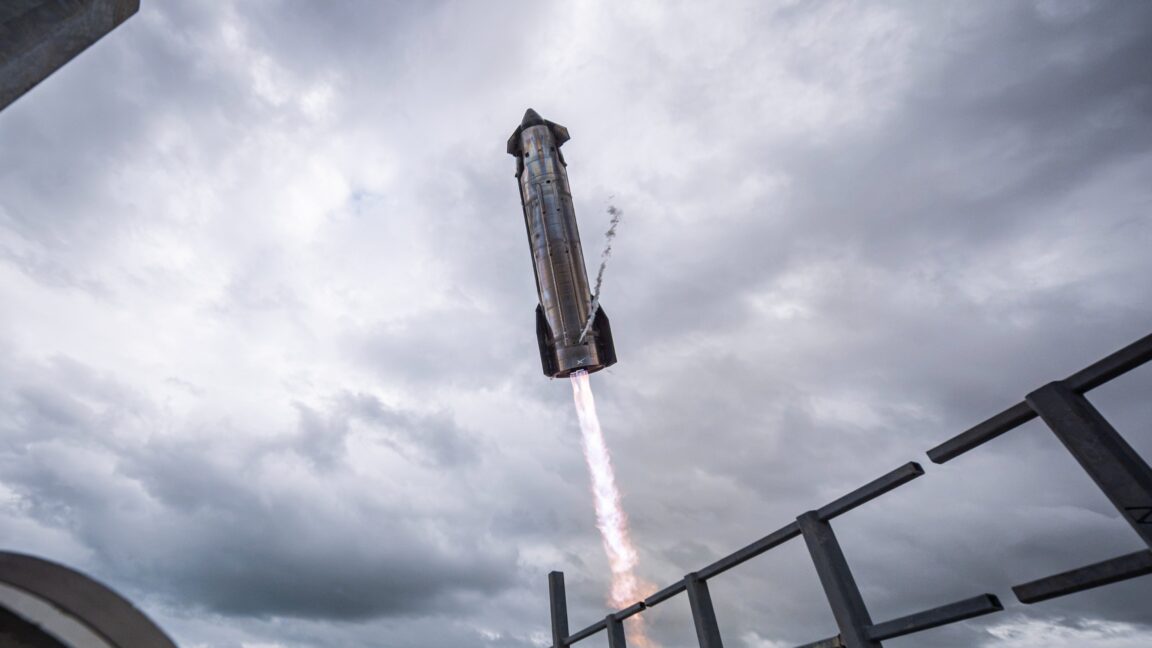
SpaceX’s successful recovery of its Starship rocket last weekend cleared a major hurdle on NASA’s path to the Moon, opening up possibilities for higher launch rates and an all-important, long-delayed orbital refueling demo next year.
For SpaceX’s purposes, Saturday’s mid-air rocket catch will help engineers learn how to rapidly reuse Starships. That should expedite SpaceX’s deployment of its newest generation of Starlink Internet satellites. NASA, meanwhile, believes a higher launch cadence will lead to faster learning as SpaceX develops a deep space version of Starship to ferry astronaut crews to the surface of the Moon.
Early next year, SpaceX plans to bring online a second Starship launch site at Kennedy Space Center, Florida. A second Starship factory is also under construction at Kennedy, joining SpaceX’s existing SpaceX production line at Starbase, Texas. With two launch sites, SpaceX will have the pieces in place to take the next leap with Starship.
The Starship refueling demonstration has slipped two years since late 2024, effectively a day-for-day delay as SpaceX ironed out technical problems with the vehicle. SpaceX may have turned a corner with Saturday’s first-ever catch of Starship at the launch tower.
Other Starship lander tests are coming next year. The first will be NASA’s Artemis III mission, followed by an uncrewed Starship landing demonstration on the Moon. The former requires no orbital refueling, and the latter will need heaps of it.
Ars recently spoke with Steve Creech, the program manager for NASA’s Human Landing System. In this role, Creech oversees NASA’s contracts with SpaceX and Blue Origin to develop crew-rated lunar landers for Artemis.
For Artemis III, NASA will launch a four-person crew to low-Earth orbit on a Space Launch System rocket and an Orion spacecraft. Orion will first dock with Blue Origin’s Blue Moon lander for two days of tests, following its launch on a New Glenn rocket. The astronauts will open hatches and enter Blue Moon’s pressurized crew cabin to test the vehicle’s environmental control and life support systems.
Then, the astronauts will return to Orion and undock from Blue Moon to set up for a rendezvous and docking with SpaceX’s Starship in a slightly lower orbit, keeping it below most of SpaceX’s Starlink constellation. Orion will stay attached to Starship for just two hours, and the astronauts won’t enter the SpaceX vehicle.
NASA changed the plan for the Artemis III mission earlier this year, rerouting the flight plan from a lunar mission to a low-Earth orbit mission. This means the Artemis program’s first crewed lunar landing will be on Artemis IV, targeted to launch before the end of 2028.
So, why is Artemis III seemingly testing so much more with Blue Origin than with Starship? Creech told Ars that a big reason is to maintain SpaceX’s focus on orbital refueling. Blue Origin no longer requires in-space refueling for Artemis landing missions. Also, SpaceX has extensive experience with life support systems with its Dragon crewed spacecraft. Blue Origin has comparatively little.
“The bigger challenges for [SpaceX] were the prop transfer and getting to the uncrewed landing demo,” Creech said. “The thing that we’re going to learn more with Starship is, when we dock with Orion, they will have control of the attitude, control of the stack. That integrated stack control will be on the Starship side. So, with that huge of a vehicle, I think we’re going to learn more on that.
“With Blue, we’re going to have Orion control the stack for this mission,” Creech said. “When we get to a later mission, the Blue lander with fully loaded prop will have to control the stack. But with Blue, trying to mitigate risk, we’re going to have Orion do that.”
Artemis III will be Blue Origin’s first time flying a crew cabin for orbital spaceflight. Blue Origin has experience with suborbital space tourism, but those flights were brief and didn’t require the level of advanced life support necessary for longer durations. Blue Origin and NASA will emphasize those test objectives on Artemis III.
“I think SpaceX’s part was really, we need to focus on the docking,” Creech said. “If we added a crew cabin, that would slow us down on the other things and not add to what we’re already doing.”
The Starship on Artemis III will have a full complement of Raptor engines and a docking port on its nose. Blue Moon will not have any main engines when it links up with Orion on Artemis III, only a set of smaller thrusters for pointing control and minor maneuvers.
“With Blue, you don’t have a BE-7 engine, you don’t have the cryo tanks,” Creech said. “They’re representing the mass of the lander when it comes back from the surface because we think that’s the most critical case. But it does have the crew cabin.”
While there’s no Starship life support demonstration on Artemis III, NASA added a new milestone to SpaceX’s Moon lander contract to test parts of its crew cabin on the ground. The additional testing involves construction of a prototype crew compartment, called Cabin One, at SpaceX’s test site at Starbase, Texas.
NASA levied new test requirements on Blue Origin, too. The company plans to launch its first Blue Moon test mission early next year after a monthslong delay caused by a rocket explosion on Blue Origin’s launch pad in May. This version of Blue Moon, known as Mark 1, has a single hydrogen-fueled BE-7 main engine. Future human-rated landers from Blue Origin will have three.
“One of the things we added into the program in the last year is, we really felt like we needed a test of the three-engine configuration,” Creech said. The hotfire test of the three-engine Blue Moon propulsion unit will occur inside a vacuum chamber at NASA’s In-Space Propulsion Facility in Ohio.
This year’s Artemis shakeup did more than change the flight plan for Artemis III. Engineers also altered the architecture for subsequent lunar landing missions. The updated plans will make life easier for teams working on Starship and Blue Moon. That’s not necessarily the case for Orion.
“Our previous architecture for both these landers required a 90-day loiter in lunar orbit for Orion to arrive,” Creech said. “That was something that, for both of these landers, drove a lot of complexity, and a lot of it made the lander job really hard.”
The new concept of operations removes some of that complexity, according to NASA.
“One of the things we changed was that 90-day loiter,” Creech said. “SpaceX, they solved it by saying let’s do an Earth orbit rendezvous with Orion, and take Orion to the Moon. For both Blue Origin and SpaceX, we have updated their requirements to a four-day surface day initially. Before, our initial missions were six-and-a-half days.”
The six-and-a-half-day surface stay was baked into the Artemis architecture because the Orion spacecraft was originally planned to settle into a long, looping path around the Moon, called a near-rectilinear halo orbit. This orbit was predicated by the expected location of NASA’s now-canceled Gateway lunar space station. That, in turn, was driven by Orion’s inability to reach an orbit closer to the Moon.
Now, instead of rendezvousing with Starship near the Moon on landing missions, Orion will link up with Starship in high-Earth orbit. From there, Starship will propel it toward the Moon.
What’s still unclear, however, is whether SpaceX will have to refuel Starship at an altitude above low-Earth orbit. A graphic presented by Jeremy Parsons, NASA’s Artemis program manager, last month illustrated this possibility with a “final tanking orbit” before Starship docks with Orion in high-Earth orbit.
“We’re still working that out,” Creech said. “We’re making progress, but where we actually rendezvous with Orion is still in trade, so that’s why you saw a little bit of fuzziness there.”
For missions using Blue Moon, the lander will connect with Orion in orbit around the Moon. Blue Origin’s updated plans do away with the requirement for in-space refueling but will still require four launches of the company’s New Glenn rocket, one for the Blue Moon lander itself and three with transfer stages to boost it out of Earth orbit to the Moon.