
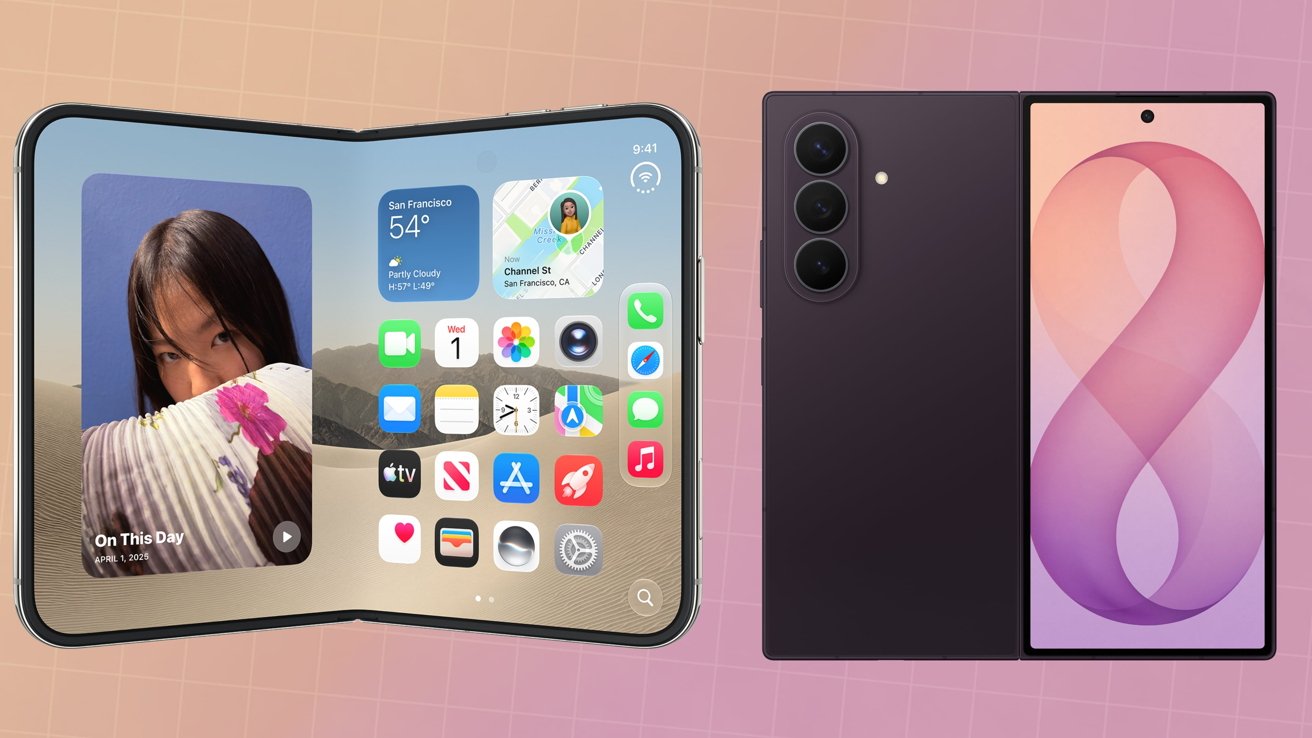
Apple has finally entered the foldable market with the iPhone Duo, its first folding iPhone. Here's how it compares against Samsung's latest foldable, the Galaxy Z Fold8 Ultra.
After more than a decade of rumors, Apple's first foldable arrived at its fall event as the iPhone Duo. A hyper-premium smartphone that has dual displays and folds in half.
It lands in a market Samsung has led for years, thanks to its Z Fold line.
The Galaxy Z Fold8 Ultra is Samsung's most advanced book-style foldable, which it launched in July 2026. It sets the benchmark that Apple's debut foldable has to meet.
This is how the iPhone Duo compares against the Galaxy Z Fold8 Ultra, with the specifications side by side.
From the outset, the two foldables are constructed in the same broad manner. Both are book-style foldables, opening to reveal a tablet-sized inner screen.
To save users from having to open the devices every time they want to use it, there's a smaller secondary screen on the outside. This gives users the best of both smartphone and tablet worlds.
In terms of size, the iPhone Duo is a little shorter but wider overall, at 6.48 by 4.64 inches when unfolded, and 3.31 by 4.64 when folded up. The Fold8 Ultra is taller at 6.24 inches, but the width varies between 5.64 inches when opened to 2.87 inches when folded.
iPhone Duo vs Samsung Galaxy Z Fold8 Ultra: iPhone Duo colors
There's also a difference in thickness, too, with Samsung's device managing to be 8.9mm thick when folded, or 4.1mm when laid flat. The iPhone Duo is thicker at 11.3mm when folded up, and 5.2mm when open.
When it comes to weight, Samsung takes the lead here, at 7.58 ounces to the iPhone's 8.96 ounces.
Just on these specs, the iPhone seems to be the chunkier device, with the weight not helping that comparison at all.
A clue at the weight disparity may be in the choice of materials each company used, beyond physical size.
Apple uses a lot of grade 5 titanium in its construction, which makes sense for a thin device that needs to be as strong as possible.
iPhone Duo vs Samsung Galaxy Z Fold8 Ultra: Samsung's smartphone from the rear.
Samsung, however, went for a mixed-metals approach. It uses a "Flex Titanium" technology with the display to strengthen it, while the outer frame and chassis is made from aluminum.
Continuing the external tour, both have side buttons, which are also used to unlock the devices. Samsung has fingerprint and face recognition, while the iPhone Duo integrates Touch ID into the side button.
Each also has a sizable camera bump on one side, with Apple going for two cameras while Samsung opts for three.
In both cases, there's a robust hinge on one side, while magnets help keep the internal screens protected by holding the smartphones shut.
The displays are the heart of any foldable, and here the two take slightly different approaches.
The Galaxy Z Fold8 Ultra has an 8.0-inch main display at 2,504 by 2,256, with a 422 pixels-per-inch density. Its 6.5-inch cover screen runs at 1,080 by 2,520, and both panels use a 1 to 120Hz adaptive refresh rate.
The iPhone Duo has a 7.6-inch inner Super Retina XDR display, which Apple says is 50 percent larger than the iPhone 18 Pro Max screen. Its 5.4-inch outer display delivers 90 percent of the screen area of the iPhone 18 Pro.
Both iPhone Duo displays share a fairly similar aspect ratio, so content scales proportionally between them. Each panel also has ProMotion, an always-on mode, and 3,000 nits of peak outdoor brightness.
Samsung's screens do not have the same aspect ratio. The external display is 10:16 versus 4:3 for the internal one.
iPhone Duo vs Samsung Galaxy Z Fold8 Ultra: The iPhone Duot's internal display.
There is a notable difference in the outer screen. The Galaxy Z Fold8 Ultra's 6.5-inch cover screen is larger, while the iPhone Duo's 5.4-inch outer screen is smaller.
When it comes to the inner display, both companies have worked to make sure there's as little crease visibility as possible. Over time, and with repeated openings, the center fold line will eventually crease, with the construction of the display and its support determining when that will happen.
Samsung uses Flex Titanium, which combines a titanium plate and titanium alloy film as a backing for the display. On top of that is the OLED panel, a thin layer of glass, and a protective layer.