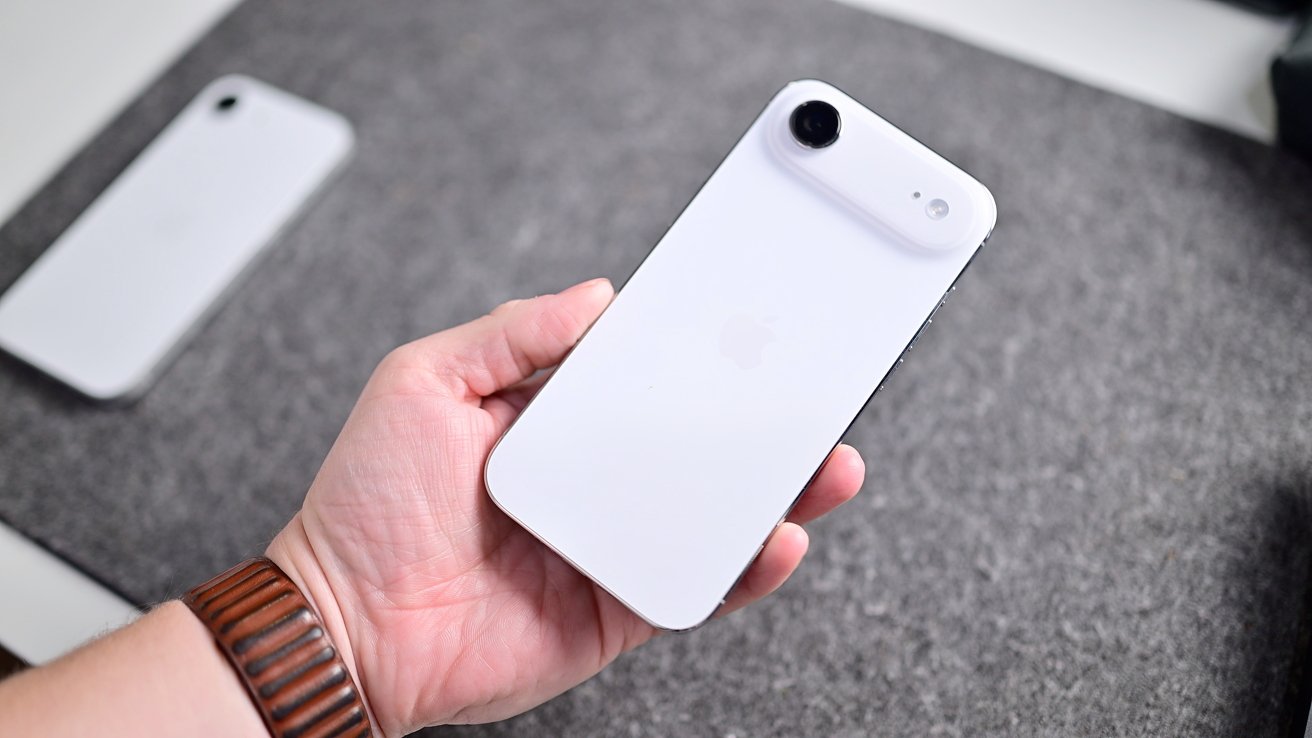
A year ago, people were hand-wringing over the iPhone Air's failings, but 12 months later, it's clear its detractors dropped the ball on an iconic iPhone.
The word "iconic" is thrown around all too easily these days. But it's still one that fits the iPhone Air.
In a sea of all-too-familiar iPhones, the Air easily stands out from the crowd. It's every bit as distinctive as the iPhone 4 or iPhone 6, devices that ushered in new design languages for Apple.
It's also a damned good iPhone, regardless of what you might have heard or read in September 2025. I've carried an iPhone Air for the last year, and if September 2026 brought an iPhone Air 2, I'd jump on it.
But that's not to be, and it'll soon be time to move on. I'll miss this iPhone Air, and it isn't very often I say that about a smartphone.
The iPhone Air naysayers will claim I'm lying. That "Big Apple" got to me. That I'm being paid to say it.
But in reality, all I did was use it. And if more people actually had, I think they'd have fallen for the iPhone Air every bit as much as I did.
To focus on its flaws is to miss what makes it such a wonderful iPhone to use.
Normally, the design and size portion of an iPhone review is pretty standard fare. They're all much the same, give or take a fraction of an inch here and a sliver of an ounce there. But the iPhone Air does things differently.
iPhone Air one-year review: iPhone Air is the coolest iPhone in years
At 6.15 inches tall and 2.94 inches wide, it sits firmly between the iPhone 17 Pro and iPhone 17 Pro Max in terms of dimensions. But things get more interesting when we look at thickness.
The iPhone Air comes in at 0.22 inches thick, compared to the iPhone 17 Pro and Pro Max's 0.34 inches. The difference is even more stark in the hand.
The theme continues when the scales come out. The iPhone 17 Pro sits at 7.20 ounces, and the iPhone 17 Pro Max measures 8.15 ounces. The iPhone Air weighs just 5.82 ounces. Again, you really need to hold this thing to understand what those figures are trying to convey. The iPhone Air is worthy of its name.
Whereas Apple's Pro models are made from aluminum, Apple went a different route with the Air. Titanium is the order of the day here, with four colors on offer: Space Black, Cloud White (the one I've been using,) Light Gold, and Sky Blue.
In reality, there's a black one and three shades of white. Still, I prefer the pure, driven snow-like Cloud White to the other two.
Up front, there's another key spec where the iPhone Air sits between Pro and Pro Max. Its 6.5-inch Super Retina XDR display is larger than the iPhone 17 Pro's 6.3-inch display and smaller than the iPhone 17 Pro Max's 6.9-inch offering.
I came to the iPhone Air as a fan of the Pro Max models. I liked the bigger displays, but I'll admit, the iPhone Air doesn't feel cramped. I'm not sure I'd want to go back to anything smaller still, though.
The iPhone Air maintains all of the features we've come to expect from Apple's top-of-the-line models. Face ID, an always-on display with an adaptive 120Hz refresh rate, HDR and True Tone, they're all present and correct. It even boasts the same 3,000-nit peak brightness when needed, too.
It goes without saying that the display is a stunner. All iPhone displays are, at this point. But its OLED panels just keep on finding new ways to look even better. The Air is no exception.
Other notable design features include the presence of the Action Button and Camera Control. I almost never use either, and I suspect I'm far from alone in that regard.
One design oddity that does bear calling out is the speaker situation. That is, there's no speaker at the bottom of the iPhone Air. In turn, that means there's no stereo output, which is a shame. But as I said in my three-month review, that's what AirPods are for.
One of the main knocks that people have against the iPhone Air is its single rear camera. There's no triple-camera array here.
iPhone Air one-year review: The Camera Control is on the lower-right edge
Instead, you have one 48-megapixel Fusion camera with a digital zoom of up to 10x. It supports Deep Fusion, Smart HDR 5, Night mode, and all the other features Apple's iPhone cameras can muster. It's just that there's only one of them.
The lack of a telephoto or ultrawide camera has put a lot of people off the iPhone Air over the last year, and I get it. I was worried about losing two cameras from my iPhone 15 Pro Max.
I took an iPhone Air on vacation shortly after its release to see how well that single camera would hold up. As it turns out, I didn't use the telephoto or ultrawide anywhere near as often as I thought I did. That's still the case all these months later.
Ultimately, I've found the iPhone Air's camera to be excellent, whether taking high-resolution photos or 4K, 60fps videos. I'd be lying if I said there hadn't been an occasion or two where one of the other cameras would have been handy. But it was so rare that I was never tempted to ditch the Air for something more camera-laden.
Apple's Camera Control is a touch-sensitive button that can launch and then fire the camera. You can also use it to adjust camera settings inside the Camera app, too.