
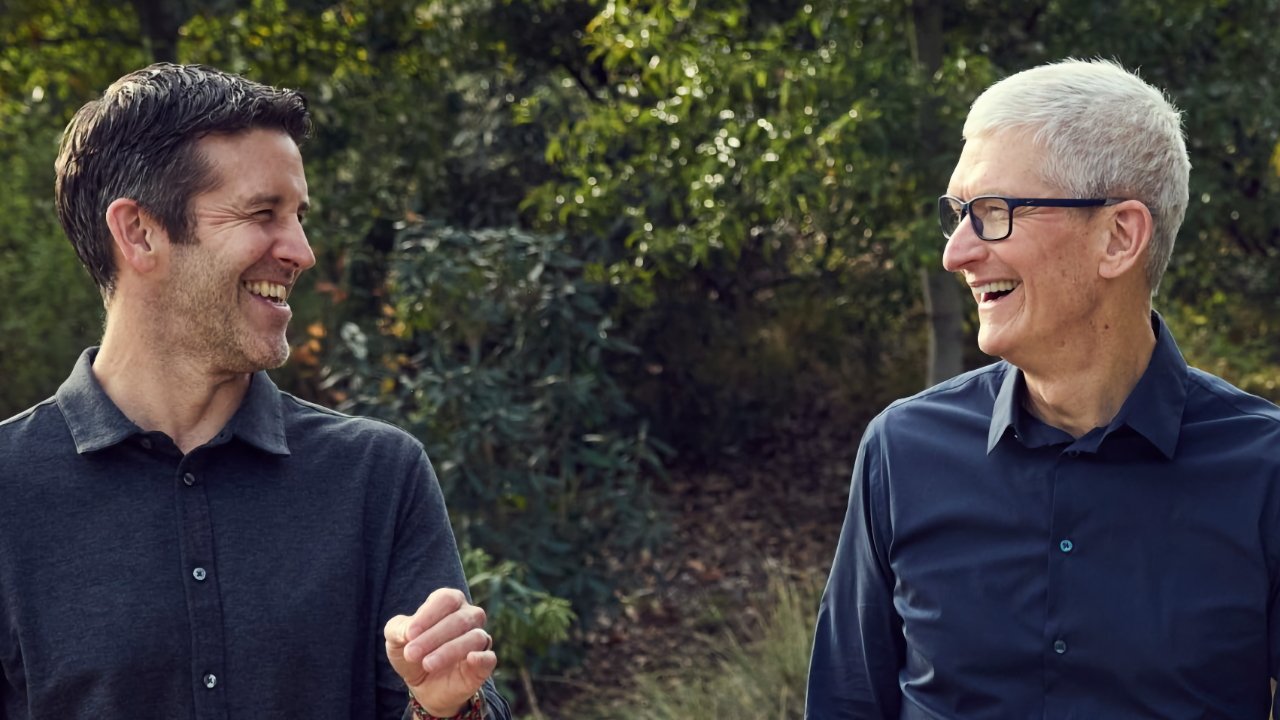
While Tim Cook's legacy and John Ternus's effectiveness will be studied for years, right now Apple is making a change of CEO seem effortless. But never doubt that this will be a sea change for the company, eventually.
No question, John Ternus really became Apple's CEO long before his official start date of September 1, 2026. It's not as if Tim Cook went on gardening leave but this is not a job with a simple cutoff date.
Instead, it's parallel running for a time, then it mixes from all Tim Cook to all John Ternus over at least many months. There is no possibility, for instance, that it was Tim Cook's decision to lay off Apple Vision Pro staff.
Even if Cook had soured on the whole spatial computing lark, you do not make major decisions on the eve of handing over to a new CEO. But if you are that incoming CEO, you can make some changes before the contract dries because you know what you want to get started on.
Normally when you think of Apple's transitions, you actually don't think about them. Motorola 68000 to PowerPC, PowerPC to Intel, Intel to Apple Silicon, it was all done so incredibly smoothly that each one seemed unremarkable and easy.
None of them were that at all, as they went to the heart of all of Apple's devices and they were exceptionally difficult transitions. Microsoft hasn't managed it once, despite trying, and Apple keeps on doing it.
The move from Cook to Ternus is potentially as big a transition. Certainly the one from Steve Jobs to Tim Cook was, although that is a transition that Apple arguably fumbled.
The transition from Steve Jobs (right) to Tim Cook was not done as well as the latest handover of CEOs – image credit: Apple
Compared to this latest handover, Apple didn't seem to be ready. Shareholders asked where the succession plan was and customers saw Steve Jobs looking ill.
Apple of course had a succession plan but that only became known when Jobs resigned and Cook was appointed at his recommendation. But then the comparisons between the two men never really stopped, and they were never once in Cook's favor.
Even by 2019 when Cook had been CEO for eight years, suddenly it was revealed that Jobs had admitted to concerns about him. Jobs had said that Cook just wasn't a "product person."
Compare that to this new handover and also to the styles of Jobs and Cook. There is absolutely no chance whatsoever that Tim Cook will criticize John Ternus because Cook always focus at what will look good and bad for Apple overall.
Although compare the difference between how Jobs and Cook approached retirement. Jobs left because of ill health where Cook is just stepping down, but neither of them were upfront about the change.
Jobs may have not admitted to retirement plans because he didn't want to go. Then Cook wouldn't admit it early because a change of CEO has a big impact on a firm's stock market price, and Cook knows about timing and about managing expectations.
Tim Cook did always look as if he really enjoyed his job – image credit: Apple.
Even so, Cook made an unnecessarily odd statement about retirement near the end. For some reason he chose to deny having ever said anything about leaving, when it's a matter of record that he did.
The announcement that Tim Cook was to become CEO was overshadowed by how the announcement was really that Steve Jobs was leaving. It was one of those surprises that you somehow expected, but it was still a jolt.
Whereas it is true that the particular day that the news broke that John Ternus was to take over, that was a surprise, but not in the same way. This one was a surprise only because of the timing, and only because no one predicted the day it would happen to be announced.
What wasn't remotely a surprise to anyone was who Cook's successor was to be. There had been plenty of speculation that included just about all of the Apple senior staff, although not head of personnel Deirdre O'Brien. Including Ternus, Apple has had eight CEOs and none were women.
There was also speculation over the odd rogue outsider, such as "father of the iPod," Tony Fadell. But surely nobody lost a bet because it was Ternus who got the job.
Background L-R: Craig Federighi, Greg Joswiak, John Ternus. Foreground: Tim Cook. Some of the many names who various people predicted would replace Cook. Images credit: Apple.
That was not an accident. Whatever process Apple went through internally, externally it has always had its ways of letting things be known. It does this all the time with products, helping the word get out when something is about to be launched, or whether it won't be.
There's little doubt, for instance, that the iPhone Ultra will finally be launched because if it were delayed, Apple would have made sure that the news got out somehow. Apple is very good at controlling the story it wants to be told.
Also before Ternus was announced, there was a lot of press coverage about how Apple could survive the loss of Tim Cook. That was despite so much press coverage having previously said Apple couldn't survive the loss of Steve Jobs, but then business analysis has always been subject to a bit of clickbait.
When Ternus was announced, there were no proclamations of disaster, no commentary that Apple is doomed. There were proclamations by people who said they knew precisely how Ternus was going to revolutionize Apple, and other people who know for certain that he won't rock the boat.
Ternus knows best what he will do and Cook knows second best, but actually not even they can really be sure. No job is quite how you expect until you get it.
No plan survives contact with the enemy, or the customers, or the shareholders, or more recently also politicians. Apple's CEO position is now part technology leader, part politician, part logistics expertise, and more.
Whatever Ternus pitched in his interview, he will be trying to implement it all in a world that cannot be under his control. Cook couldn't have predicted COVID, Cook couldn't have imagined Trump, and Ternus cannot know how the global chip shortage will pan out.