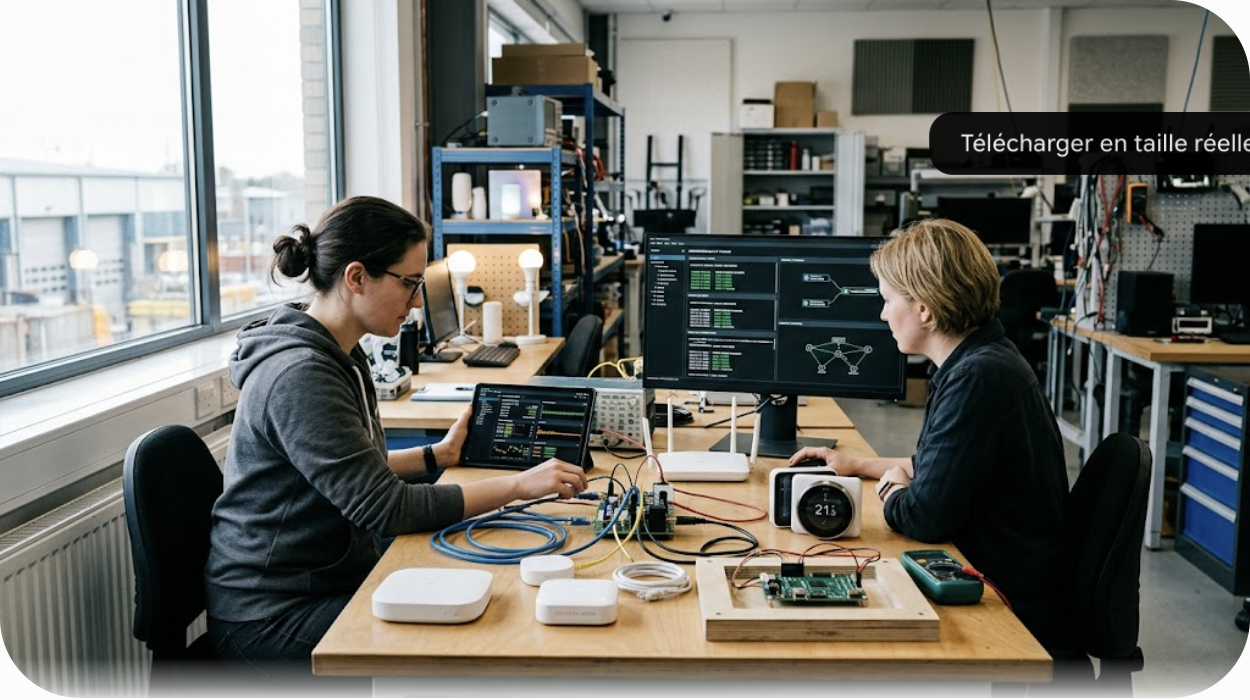
The modern smart home relies on a delicate balance of diverse wireless protocols, distinct hardware manufacturers, and continuous data exchanges. When a consumer purchases a smart bulb, a wireless sensor, or a secure gateway, the expectation remains straightforward: the device should join the local network seamlessly and communicate reliably with existing infrastructure. Yet, achieving this baseline of reliability demands rigorous preparation before any product reaches retail shelves. Behind every certified connected ecosystem lies a dedicated physical environment designed to challenge, stress, and validate how different technologies interact.
For developers, product designers, and procurement teams navigating the Connectivity Standards Alliance ecosystem, the Interoperability Testing Facility serves as a critical milestone. Rather than leaving multi-vendor compatibility to chance, this specialized laboratory setup provides the controlled conditions necessary to verify that firmware, software stacks, and hardware designs align with global connectivity standards. Understanding the tangible impact of these testing facilities reveals why certain products integrate effortlessly while others introduce friction into everyday domestic automation.
Deconstructing the Hardware Impact: Physical Realities and RF Environments
Hardware manufacturers face immense pressure to miniaturize components while improving energy efficiency and wireless range. However, physical constraints often lead to unexpected radio frequency interference, antenna placement challenges, and power regulation anomalies. A smart lock featuring a compact chassis might struggle to maintain a stable mesh connection if internal components degrade signal propagation.
Testing facilities address these physical hurdles by subjecting devices to precise RF environments. Engineers evaluate how well a microcontroller handles physical obstructions, distance attenuation, and electromagnetic noise generated by neighboring domestic appliances.
Antenna performance validation: Assessing radiation patterns to ensure consistent signal reach. Power consumption profiling: Measuring battery drain under active data transmission and idle mesh states. * Thermal and structural stress: Verifying that housing materials do not interfere with wireless propagation.
By identifying these physical limitations in a controlled setting, hardware teams refine their circuitry and casing designs before committing to mass production. This proactive scrutiny prevents hardware recalls and ensures that end users do not experience sudden dropouts due to poor physical integration.
Protocol Harmonization: Bridging Divergent Communication Standards
A connected home rarely runs on a single communication language. Bluetooth Low Energy, Zigbee, Thread, and Wi-Fi frequently coexist within the same walls, creating a complex web of overlapping frequencies and packet structures. When devices attempt to translate commands across these boundaries via border routers or multi-protocol hubs, translation errors can introduce frustrating latency or complete command failure.
Interoperability labs focus intensely on protocol harmonization. Testing procedures analyze how devices handle packet loss, retransmission requests, and network congestion. If a smart thermostat sends a status update precisely as a security camera initiates a high-bandwidth data stream, the network stack must prioritize and route traffic efficiently.
Packet inspection: Monitoring payload integrity across different protocol layers. Mesh topology resilience: Simulating node dropouts to test self-healing routing algorithms. * Command latency benchmarking: Measuring the exact time elapsed from user input to physical actuation.
Through these rigorous checks, software architects discover edge cases where protocol stacks misinterpret state changes. Resolving these bottlenecks ensures that multi-brand deployments maintain stable communication channels without requiring constant re-pairing or manual intervention.
Data Consistency: Ensuring Unified Semantic Understanding
Hardware connectivity and protocol stability are foundational, but true interoperability requires a shared vocabulary. Two devices can successfully exchange data packets while completely failing to understand the semantic meaning of those payloads. For instance, if an automation platform interprets a dimming command as an on/off toggle, the underlying data schema is misaligned.
Standardized data models dictate how attributes like temperature, luminosity, lock status, and energy consumption are formatted and transmitted. Testing environments verify that devices report their capabilities accurately and respond to generic commands using universally accepted data structures.
Data type verification: Ensuring numeric values, strings, and boolean states conform to standard definitions. Attribute reporting frequency: Testing whether sensors flood the network with redundant updates or drop critical state changes. * State synchronization: Confirming that mobile applications and physical controllers display identical, real-time status data.
When data consistency is strictly validated, users avoid the frustration of mismatched interfaces. A command issued from a wall-mounted panel reflects instantly on a smartphone app because the underlying data payload adheres to a strict, predictable schema.
Procurement and Purchasing Strategies: Mitigating Supply Chain Risk
For IT executives, facility managers, and smart home integrators, purchasing decisions carry long-term financial and operational consequences. Selecting unverified hardware can lead to high support ticket volumes, expensive firmware maintenance, and premature hardware obsolescence. Incorporating formal certification benchmarks into procurement criteria fundamentally shifts risk management.
Smart procurement teams rely on the rigorous evaluation standards maintained at facilities like the Interop Lab to filter out substandard components. Requiring proof of thorough interoperability testing ensures that bulk purchases will integrate smoothly with existing enterprise management systems or consumer-grade automation hubs.
Vendor accountability: Requiring documented compliance with recognized connectivity standards. Lifecycle longevity: Choosing hardware built to receive secure over-the-air updates without breaking local network integration. * Reduced integration overhead: Minimizing custom development hours spent writing bespoke drivers for non-standard devices.
By anchoring purchasing policies to verifiable laboratory testing, organizations protect their investments and guarantee a predictable deployment timeline.
Everyday Usability: Translating Laboratory Rigor into Seamless Domestic Experiences
Ultimately, the complex engineering and stringent testing protocols executed in specialized facilities culminate in a single objective: an invisible, friction-free user experience. Consumers rarely think about packet collision, data schemas, or RF attenuation when they ask a voice assistant to dim the living room lights or check a security feed. They expect an immediate, reliable response.
When products undergo comprehensive multi-vendor compatibility evaluations, the resulting ecosystem operates cohesively. Users can mix and match lighting, climate control, and security components from competing manufacturers without building custom automation scripts or troubleshooting connection drops.
Simplified onboarding: Out-of-the-box pairing processes that complete in seconds. Reliable automation routines: Triggers that execute consistently across different brand ecosystems. * Reduced troubleshooting: Fewer instances of unresponsive hardware or lost network credentials.
The invisible scaffolding of standardized testing transforms the smart home from a fragile collection of competing gadgets into a dependable, unified living environment. As connected technologies continue to expand into new domains of personal technology and smart architecture, this rigorous foundation remains essential for sustainable growth.
#smarthome #iot #connectivity #technology #automation