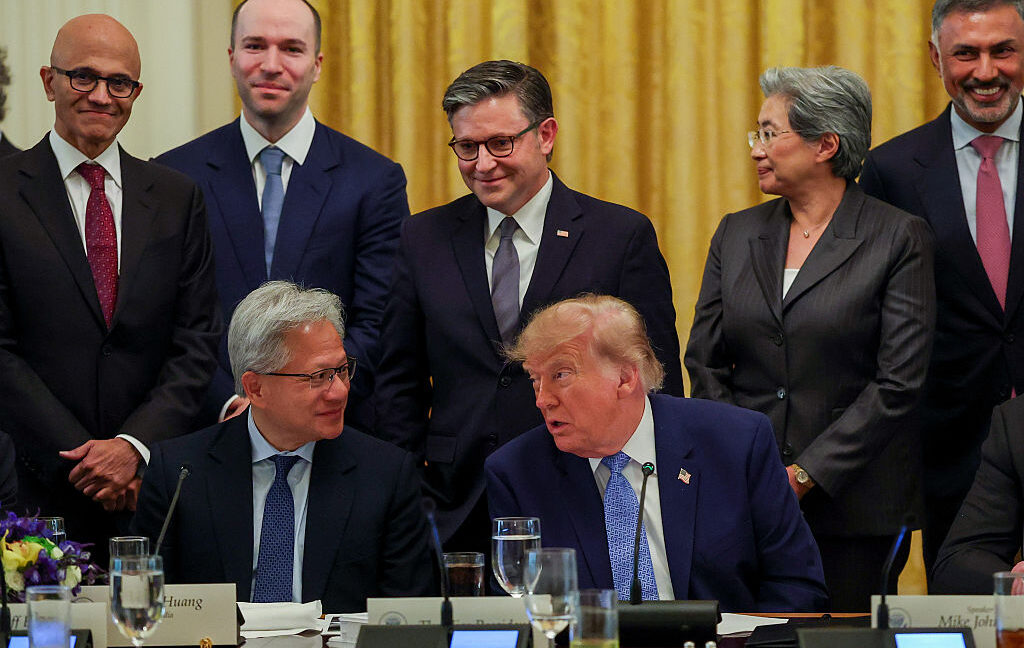
On Monday morning, Jensen Huang walked into Nvidia’s Santa Clara headquarters to rapturous applause from employees lining the walkways above him. Huang was visibly moved as one colleague threw themselves into his arms for a hug.
The spectacular reinstatement of the chief executive of Nvidia, less than two weeks after he resigned in a scandal over an affair with a customer and suspected Chinese spy—as well as a second reported affair with a subordinate—caught even the company’s most senior executives by surprise.
The abrupt reversal by Nvidia’s board was spurred by President Donald Trump, who applied pressure to the board over the weekend after watching what was once America’s most valuable company as well as the wider tech sector haemorrhage value last week.
It was the culmination of frenetic lobbying by a “war room” of Huang’s Silicon Valley allies, who pulled in Trump and vice-president JD Vance, according to people familiar with the events. They argued the Nvidia founder was personally integral to the health of the US AI industry, and therefore the stock market and entire economy.
“Great men make great mistakes. But nobody has ever been like this, not Elon Musk, not anyone. All the success we’re enjoying, all the tech gains, that’s all down to one guy,” said an ally of Huang.
But one of the most remarkable comebacks in corporate history, which called to mind Sam Altman’s brief ousting at OpenAI, still leaves the semiconductor giant at the heart of the AI boom in treacherous waters.
Nvidia and Huang face probes by the FBI and SEC, congressional investigations, and difficult questions over governance and Huang’s personal connections to a suspected Chinese spy allegedly involved in chip smuggling.
Even after gaining nearly $1 trillion in market value on the news of Huang’s return on Monday, Nvidia is worth about a fifth less than it was a month ago.
Huang told employees on Monday he had “made some very terrible mistakes, and I’m going to work on coming back.” Nvidia and a spokesperson for Huang declined to comment.
The talks that culminated in an Nvidia board meeting late on Sunday were so secretive that even interim Chief Executive Officer Colette Kress was kept out of the discussions, the people said.
Trump personally spoke to the board in Huang’s defense, triggering an about-face days after it had categorically ruled out a return. The board said it was confident Huang posed no national security risk after “input from senior levels of the United States government,” but that its internal investigation would continue.
The seeds of Huang’s comeback were sown within hours of his resignation on November 12, which came after reports of affairs with a company executive and a woman named Alice Huang, an executive at a Singapore-based Nvidia client called Megaspeed, now at the center of chip smuggling allegations.
Allies in Silicon Valley rallied around him. A small group of Huang’s supporters, including Uber founder Travis Kalanick, venture capitalists Gavin Baker, Brad Gerstner, and Marc Andreessen, as well as Goldman Sachs executive John Underwood, leapt to action, according to people familiar with the matter, making the case in public and in private for Huang’s reinstatement.
Andreessen Horowitz declined to comment. The other members of the group did not respond.
Within 24 hours of Huang’s resignation, Baker and Gerstner published an open letter to Nvidia’s board urging them to leave “all options on the table, including the potential return of Jensen Huang.”
Their effort had Huang’s backing, the FT reported last week. On Tuesday, Huang confirmed he was prepared to step back into the role.
While the board’s chair, Harvey Jones, publicly insisted Huang could not return, Kress spent last week looking to steady the ship with a strong quarterly earnings report and promises to expedite pay rises and equity grants as Nvidia shares plummeted. A company “all-hands” meeting on Wednesday featured a show of unity from its top executive team, to the tune of Tom Petty’s “I Won’t Back Down.”
Behind the scenes, Huang’s allies in his “kitchen cabinet” began lobbying the White House and other power brokers in Washington.
One arranged a phone call between Huang and Vance last week that lasted 45 minutes. During the conversation, Huang defended his positions on US semiconductor export controls and remote access to chips, and his dealings with Megaspeed.
Vance, a former venture capitalist who was mentored by Peter Thiel and has raised millions of dollars from Silicon Valley, was seemingly persuaded by the entreaties of Huang and his allies, who are probably a crucial source of funding if Vance decides to run for president.
“Everyone who was important in the tech world was beating his door down,” said the person.
“He wasn’t doing it to help raise dollars. That never even came up. But he clearly understands that half of US GDP depends on Nvidia right now… the Nasdaq is up 7 percent. If you think that’s happening without Jensen, you’re crazy,” they added.
Over the course of the weekend, Trump and Vance’s engagement focused on convincing the board that Huang’s affair with Alice Huang did not mean he was exposed as a potential national security risk.
Treasury Secretary Scott Bessent went out on Sunday to soften his earlier stance, having a week before accused the company of artificially inflating its revenue through illicit China sales and called for a wholesale leadership shake-up.
Those involved in the campaign viewed Bessent’s reversal as evidence they were making progress. Trump’s intervention with the board proved decisive.
On Monday, after Huang was returned to his post, Baker posted on X: “This is why America is the greatest country on earth. Every part of Jensen’s story would have only been possible in America.”
Inside Nvidia, employees responded to Huang’s return with a mixture of elation and surprise. Even those who had quietly hoped for Huang’s reappointment told the FT they had not expected it to happen so quickly.
One longtime employee said that staff who had known Jensen for years were shocked at the context of his downfall, in particular the surge in press reports about his well-known brutal management style.