It's awkward to pick up an iMac, and it's worse when you are transporting millions of them, so Apple has been researching how to give it a handle, or make a flat-pack version.
It's not as if it's a giant market, but there are people who need to travel with their iMac and for them, existing firms will sell enormous and well-padded cases. Apple also needs to transport iMacs, though, and preferably to sell them without complex packaging.
Now in a newly-granted patent called just "Low profile computer support," Apple proposes multiple ways of making it easier to move iMacs.
"Today's desktop computers are made smaller, thinner, and lighter than ever before," says the patent. "Over time, this has produced sleeker and thinner devices with large displays, but the pursuit of thinness, coupled with large displays, has led to products that can be overly difficult to move and inefficient to package and transport."
There are already existing stands, of course, but the patent's six credited inventors are not impressed.
"Additionally, stands and supports for the computing devices often inefficiently take up weight and space as compared to the highly optimized remainder of the computing device with which they are used," says the filing.
Consequently, Apple proposes ways of addressing all of this, and part of its patent centers on using a dock. The idea here is that at present stands are solely used to support displays and computers, they're just blocks of metal.
Whereas Apple argues that instead a stand could become a dock, "by integrating additional features… such as device chargers, cord or cable management features, or computer components."
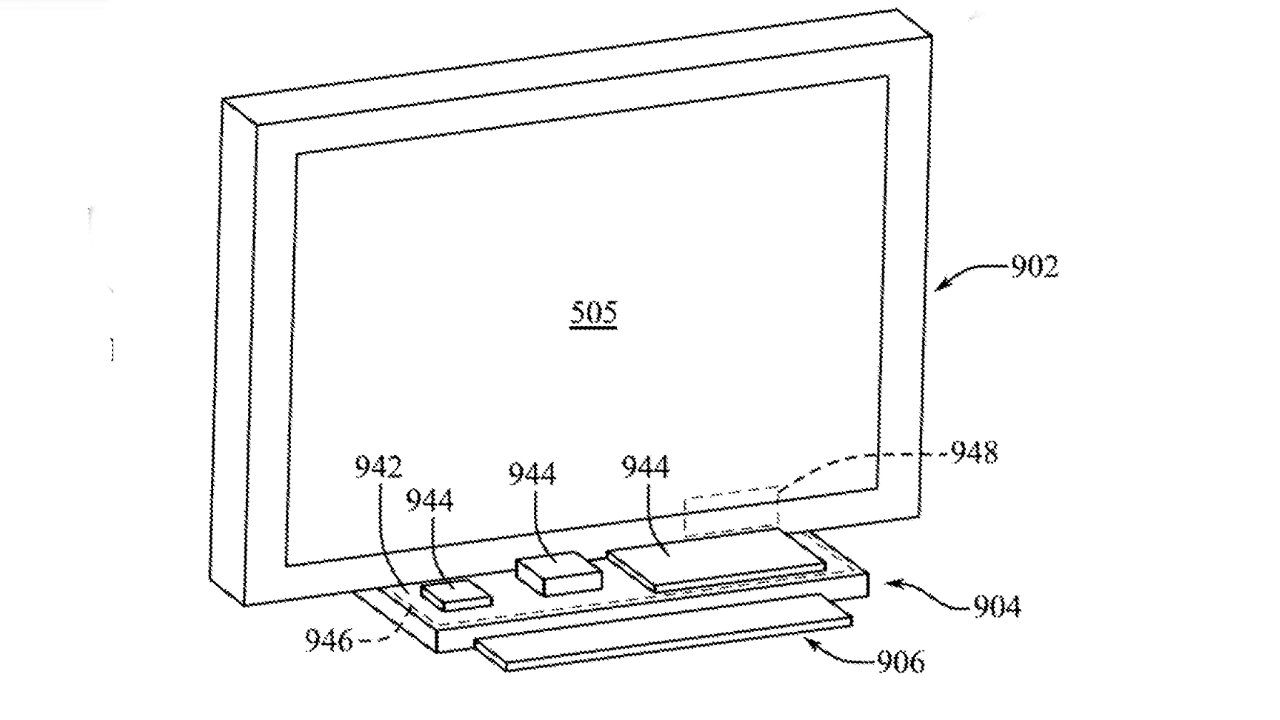
Apple even suggests that making such a stand could let it separate components, so that the dock was effectively the whole computer, and the display was solely a screen. They could be connected to each other through a system like the Smart Connectors on an iPad.
"Accordingly, the computing device and dock device can have a cleaner and simpler appearance," says Apple, "and their connection is not susceptible to cable bending failures or other issues related to cable connections."
Plus with just a slim electrical connection to join them together, the dock and computer could "have equal thicknesses (or the dock can be thinner than the computing device)."
Detail from the patent showing a dock at the rear, with a form of Smart Connector labelled 522, and the iMac-style display flat in front of it – image credit: Apple
So Apple is really saying that when such a computer and dock are separated, they could basically be flat-packed.
But it is also saying that such a dock could be designed so that as well as supporting the display and containing the computer, it could do a little more. Apple's drawings show a shelf-like section of this dock where it proposes multiple devices could be placed for wireless charging.
Beyond this idea, though, the patent also goes the opposite way and proposes having no more functionality in the stand than at present. But it suggests making that stand be a collapsible one.
In this idea, the stand collapses into the computer when desired. It could even be designed so that the stand provides "a carrying handle or grip that improves the portability."
An alternative design that would see the iMac's stand recessed up into the body of the computer, and creating a handhold at the top – image credit: Apple
While Apple is careful to never say the word "iMac," and so limit the scope of the patent, all of its drawings appear to of this model. So instead of where the leg of the stand connects to the back of the iMac, picture it recessing into the computer and leaving a handhold.
This would involve adding articulated hinges to a stand, and the patent goes into detail over their positioning and arrangement.
That's probably the difference that made this a design that could be patented. Because aside from recessing in to the body, or using a cylindrical hinge, the idea is much the same as can already be found on TV sets,
An existing two-part TV stand that resembles part of what Apple is proposing
In this image, the TV stand is in two parts that are screwed together. Other models have a flat segment that slots into a recess in the set.
Nonetheless, Apple has been granted a patent and its inventors include the prolific Paul X Wang. His previous work includes patents regarding splitting a MacBook Pro into separate modular components.