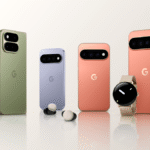
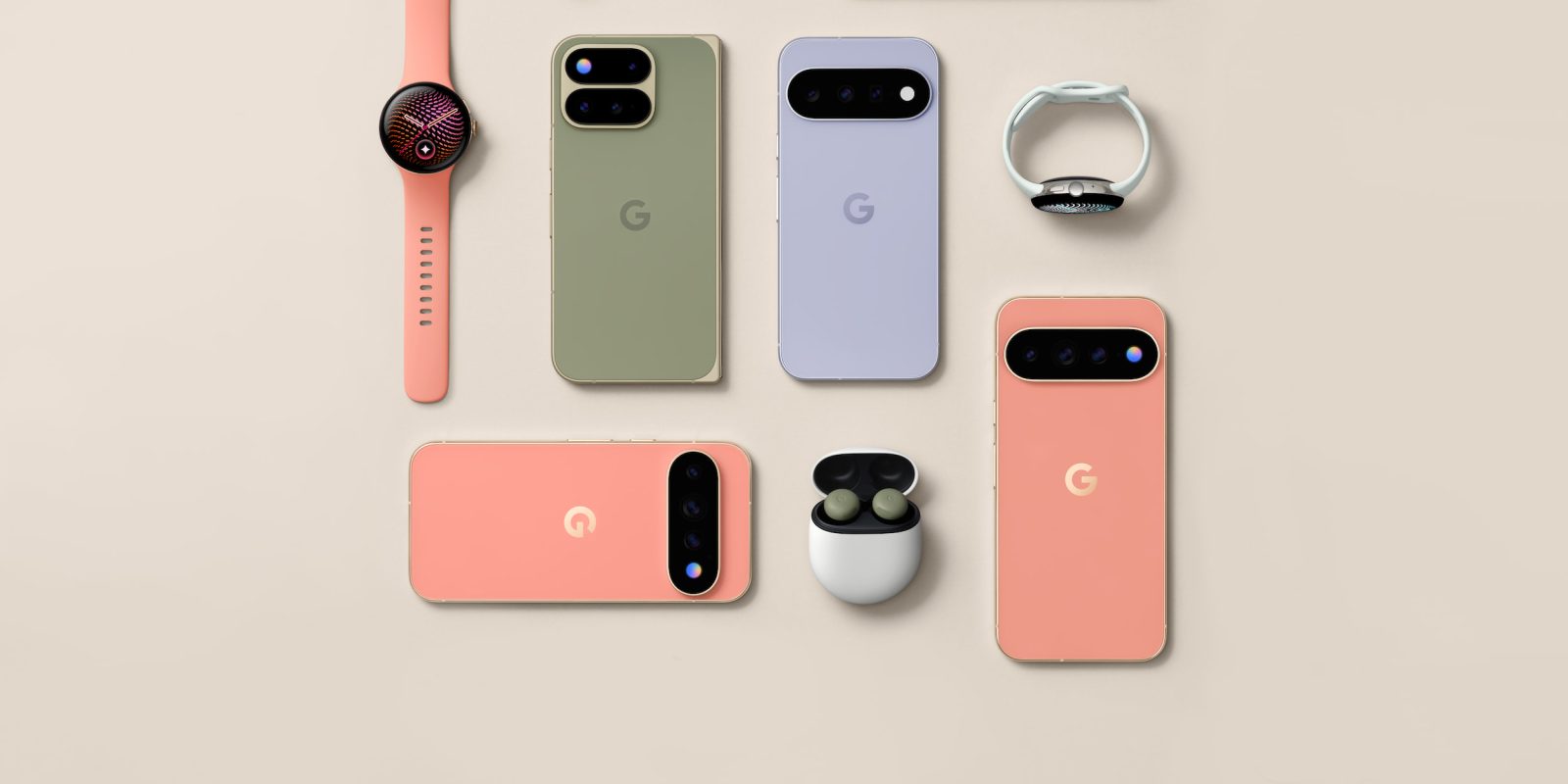
While the actual Made by Google 2026 event isn’t happening for another eight hours, Google has fully detailed the Pixel 11, Pixel Watch 5, and Pixel Tag.
Here’s a summary of everything announced at Made by Google 2026. Each section has a link to our full hands-on with the new hardware and software features, with more posts coming over the coming hours.
The Pixel 11 features an all-glass Camera Bar that is 40% thinner than last generation and protrudes noticeably less. Google advertises how the plateau “practically” disappears when you use an official case.
There’s a larger 48MP wide sensor that offers 56% more light sensitivity and slightly wider FOV. Tensor G6 unlocks 30x SuperRes Zoom with the 5x telephoto.
The chip is paired with 12 GB of RAM and 256 GB of storage, which is the new baseline. This year’s base phone supports 25W Qi2.2 wireless charging (up from 15W) that is up to 25% faster, but the quoted 30+ hours of battery life is unchanged.
The Pixel 11 is available in Frost, Obsidian, Hibiscus, and Pistachio from $899.
Hands-on | Pre-order: Google Store — Amazon — Best Buy
The edge-to-edge Camera Bar on the Pro series houses what Google calls “HiLight.” Replacing the temperature sensor after three generations is a ring of ambient LEDs built around the flash. It’s meant to help you stay connected when the Pixel 11 Pro is face down. For example, it provides visual feedback that Gemini heard you with different patterns for listening, thinking, and responding, just like the Google Home Speaker. You can also have custom colors pulse when favorite contacts call (Phone by Google and WhatsApp), with future updates adding more capabilities like message notifications. You enable HiLight and set one of five colors from a person’s Google Contacts page.
The Pixel 11 Pro and 11 Pro XL introduce a new 50MP wide sensor and 48MP telephoto with a larger image sensor and 30% more light sensitivity. This allows Portrait Mode at 5x, and 120x Pro Zoom thanks to Tensor G6 and Google’s latest imaging models. The chip and redesigned software also make possible Instant Night Sight that is up to 4.5x faster.
The Super Actua display gets a bump to 3,600 nits of peak brightness, and is 2x more scratch-resistant thanks to a new coating.
Tensor G6 is paired with 12 GB of RAM on the 256 GB model. In acknowledgment of the 4 GB reduction, Google credits software and silicon optimization for faster and smoother performance than last year’s Pro devices. That said, you can upgrade to 16 GB by getting the 512 GB or 1 TB models.
On the 11 Pro XL, Faster wired charging provides up to 75% in about 30 minutes, while wireless charging is 29% faster with 25W Qi2.2.
The phones are offered in Canyon, Fog, Olive and an all-matte Obsidian for the first time, with Google drawing inspiration from the natural world. The 6.3-inch Pixel 11 Pro starts at $1,099, while the 6.8-inch Pixel 11 Pro XL is available from $1,299. On Pro phones, Google now only offers six months of AI Pro access.
The Pixel 11 Pro Fold is nearly 10% lighter (258 vs. 239 g) and 0.7 millimeters thinner than last year’s model. This foldable is 3x more durable thanks to a new glass fiber composite back cover in matte that is “nearly impossible to crack.” A new hinge design protects the inner display from accidental drops.
The outer 6.5-inch display is now Super Actua (20% brighter) and protected by a glass ceramic cover. The inner Super Actua Flex display (now 3,600 nits) features thinner bezels and thicker ultra-thin glass with dual layers of anti-impact film for improved crease performance.
A new 48MP wide camera sensor improves light sensitivity by 56%, while the telephoto camera supports 30x Super Zoom. You’ll also find HiLight on the Pixel 11 Pro Fold.
The Tensor G6 is paired with 16 GB of RAM and 256 GB of storage. The battery has shrunk from 5,015 to 4,750 mAh, but remains rated at 24+ hours of usage with 25W Qi2.2 wireless charging.
The Pixel 11 Pro Fold sees a $100 price increase to $1,899 but does offer 16 GB of RAM with 256 GB of storage.
Hands-on | Pre-order: Google Store — Amazon — Best Buy
The new Gemini Nano 4 model benefits from a TPU with 50% more compute and 2x memory bandwidth. This translates to on-device AI tasks being up to 3.5 times faster, while using up to 3.5 times less energy.
Meanwhile, the CPU delivers 15% faster app loading and 25% faster web browsing.
An upgraded ISP (Image Signal Processor) unlocks camera features like expanded zoom ranges and low-light improvements. A new custom accelerator is designed to capture and render portrait video for 4K Bokeh video.
There’s a new Titan M3 security chip that will help protect against future quantum computing threats.
While the Camera app mostly looks the same, Google has made a number of changes to accommodate the new features. For example, Quick access controls expand beyond white balance, exposure, and shadows with new sliders for Looks, Focus, Shutter Speed, and ISO. The new interface lets you choose what apps on the left and right edge of the viewfinder after a tap.
Magic Capture is a bit like Google Clips in that you just start a session and Google will pick the best HDR+ photos and videos. Accessed from a new tab next to the camera and video modes, it analyzes around 500 frames to find the right shot, with optional cropping, straightening, Unblur, and other light edits. The aim is to let you just point and stay in the moment.
Camera Looks lets you set a default aesthetic at the time of capture. Google made adjustments to its camera pipeline like “merging fewer frames than usual for a minimally processed feel” and “rewriting color lookup tables at the sensor level to emulate classic film chemistry.” The Pixel 11 offers these alternate HDR options:
Then there are Stylistic Looks like Digi, Black Tie, Minimal, Editorial, Classic, and Velvet, with users able to make further edits.
On-device video processing benefits from refined sharpening, noise, and detail, while Pro Stable Video on the Pixel 11 Pro activates in shaky, bright lit scenes. A new Creator Suite adds a number of tools to the Camera app: