Posted by Rob Orgiu, Developer Relations Engineer, Adaptive Apps, Android


Adaptive app development is fundamental on Android, but making sure everything looks good and every feature works the way it should require multiple tests on multiple devices. Or does it?
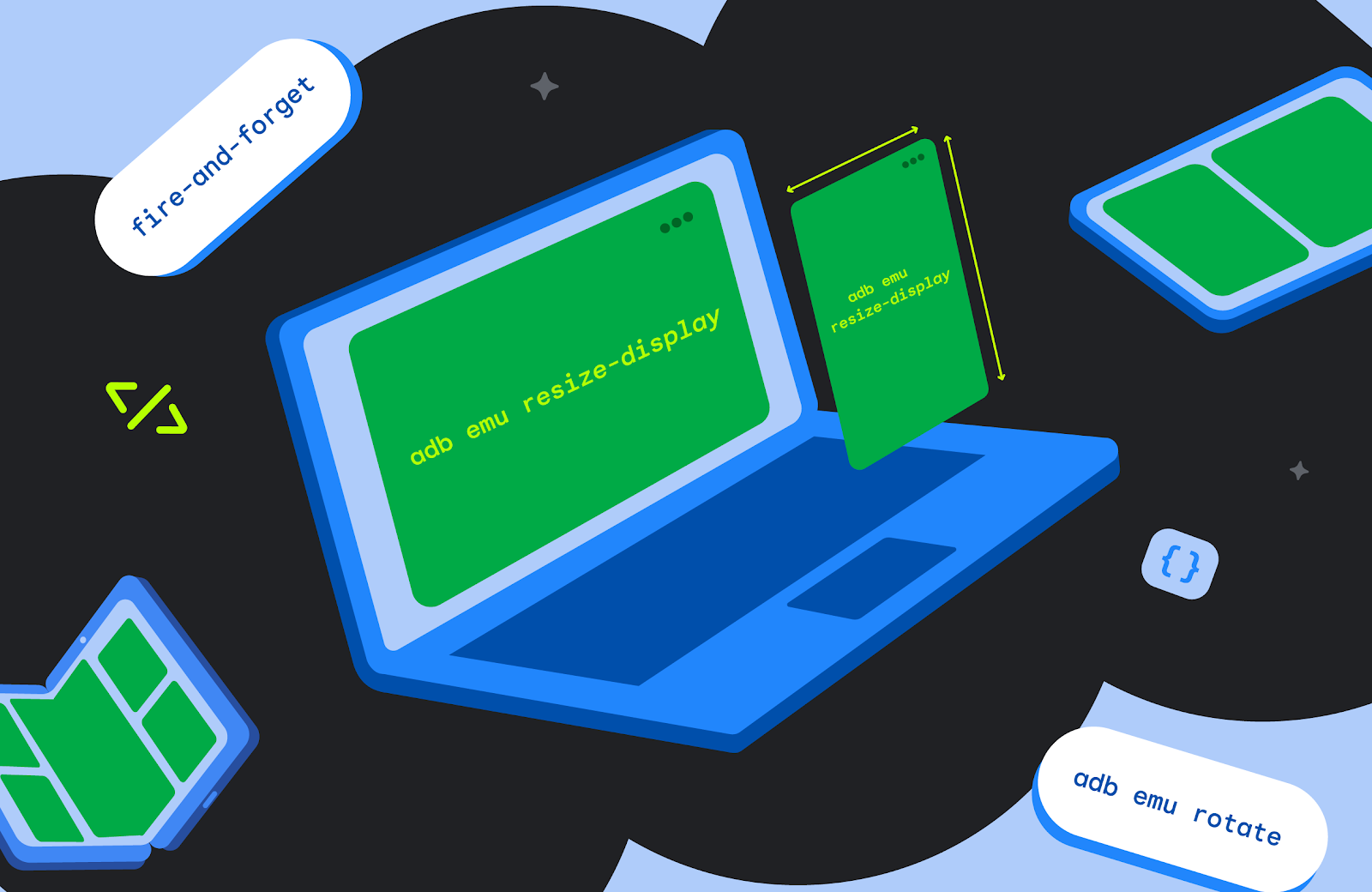
Well, yes… and no! While Android Studio is bundled with the Resizable Emulator to let you test layouts manually, there’s a faster, more streamlined way to control form factors directly from your terminal. By leveraging fire-and-forget console commands using the adb emu shortcut, you can execute commands that immediately return control to your invoking shell.
If you have multiple emulators running at the same time, you can target a specific virtual device by passing in the shortcut’s serial:
adb -s <serial> emu <command> <parameter>First things first: Fold and unfold
To test foldable-specific user journeys and layout configurations, you can fold and unfold your emulated device programmatically.
adb emu foldIf your foldable emulator is unfolded, you can fold it to display its smaller screen configuration, powering on the (virtual) external display. To unfold the emulator and power on the internal display, simply run:
adb emu unfoldNow, you can instantly verify that your app preserves its state and that layouts appear exactly as they should on different display sizes.
Rotation, rotation, rotation
Correctly handling orientation changes is a cornerstone of adaptive app development. You can trigger device rotations programmatically to test how well your app handles configuration changes, including state restoration. The following command rotates the device 90° clockwise:
adb emu rotateSimulating postures using sensors
What about placing the emulator into a specific physical posture, like tabletop mode? The easiest approach is querying for the number of available positions with .
First, list all available sensors and their current status:
adb emu postureThis returns a list of positions similar to the following:
Usage: "posture <posture_id>" 1: closed 2: half-opened 3: opened …You can then invoke the tabletop posture by using the half-opened ID:
adb emu posture 2Note: Not all postures are supported by every virtual device. Standard AVD templates like the Pixel Fold or the Resizable AVD only support postures 1 , 2 , and 3 . Attempting to set 4 or 5 on these templates will return a KO: Failed to set posture error.
What about the resizable emulator?
The resizable emulator has the super power to change its size with ease. With the adb emu command, you can move it freely with one command. Before you can do any changes, querying for the available resize presets requires only one call:
adb emu resize-displayThis will return the list of available presents:
KO usage: "resize-display <index>" 0: phone 1: unfolded 2: tabletNow, invoking the resize-display parameter with the wanted ID will resize the emulator to the wanted size:
adb emu resize-display 1Streamline your testing today
And that’s it! By integrating fire-and-forget commands into your command-line workflow, you save a lot of time and resources compared to running multiple emulators simultaneously.
Now is the time to start experimenting. If you haven’t used these console shortcuts before, open up your terminal, fire up your emulator, head over to the documentation, and get started today!