
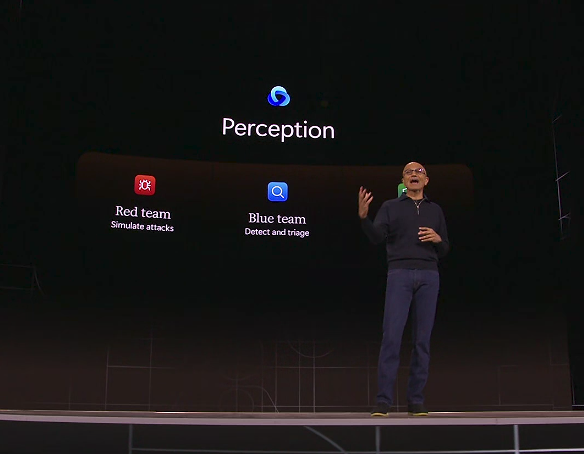
Opening the keynote at its Ignite event, Microsoft CEO Satya Nadella outlined the company’s vision for its new “frontier ecosystem,” announcing Tuesday the general availability of Word, Excel, and PowerPoint inside Copilot, which he described as “the new OS for work.”
The announcement is a striking inversion of how we’ve traditionally used software. Rather than an app like Word being the attraction and Clippy the assistant to help you use it, Microsoft envisions the new Copilot integrations will see agents driving things, with the software packages riding shotgun. Applications will become plugin components of the agent’s work, backed by an organizational knowledge layer that draws context from emails, meetings, calendars, chats, and files. Users will now be able to create documents, spreadsheets, and presentations directly in Copilot, with the resulting files remaining editable in their respective Office applications.
The rollout marks a major step toward the Copilot redesign the company first announced in September. Parts of that vision are now becoming “generally available,” as Nadella puts it, with autonomous agents and new governance tools arriving alongside them.
Copilot Autopilot (not to be confused with Windows Autopilot) is a “persistent, proactive agent for personal productivity” according to Microsoft. In a nutshell, Autopilot is a cloud-based autonomous AI agent that users can delegate responsibilities to, not just single tasks. Autopilot can be authorized to work across services like email and calendars and complete tasks assigned to it as part of its role. Autopilot will use usage-based billing via Copilot Credits, but final pricing has not been announced ahead of general availability.
Also announced as generally available at the keynote speech was Microsoft IQ, an intelligence platform that houses Work IQ, a context layer that helps agents understand a company’s communications, relationships, and ongoing work. Nadella described Work IQ as perhaps a company’s most valuable database: “It has a deep understanding of the people, their relationships to other people, your emails, your meetings, chats, projects that make up all the fabric of work.” Whether companies want autonomous agents to have access to internal documents and messaging data will have to be determined by their own internal IT review.
Copilot Workspaces is a collaborative environment currently available through Microsoft’s Frontier early-access program, but coming soon will be the ability to bring personal Autopilot agents into Workspaces. Early in the keynote address, Nadella said that “Until now, AI interactions have mostly been single-player. Workspaces makes it a truly multiplayer experience, where people and agents drive towards a common goal, with shared context.”
Trust, the third pillar of Microsoft’s new frontier ecosystem, was something that Nadella continued returning to during his presentation, and not in a way that some might expect. “We find ourselves in a place where alignment is elusive. Mechanistic understanding of these models is elusive. The question is: How can you even trust all this powerful technology? The reality is, by definition, you can’t,” he said.
In a departure from the norms of “AI is magic” corporate hype sentiment, Nadella conceded that the internal workings of AI thought processes remain difficult to understand, and models cannot be trusted to govern themselves, regardless of whether their answers are accurate. Nadella described the solution as “an architectural imperative to separate the supply of intelligence” from the authority granted to it. Microsoft says each Autopilot agent will have a unique ID, and administrators can restrict permissions or block it entirely. All agent activities are logged for human review, and Autopilot can ask for human approval before engaging in certain actions.
The promised agent controls and admission that AI systems can’t always be trusted are meaningful, but Microsoft is asking businesses and users to place their trust in the company’s own safeguards instead, though the effectiveness of those safeguards against mistakes, rogue actions, or data exposure will still have to be demonstrated. In Microsoft’s view, the solution to untrustworthy intelligence is not to make AI agents trustworthy, but to control what they’re permitted to do. Businesses will have to decide how much autonomy they delegate to agents.
Along with the guardrails, Microsoft announced what it calls the “AI Transparency Initiative.” The effort has partnered with 40-plus major companies, including Adobe and Mastercard, to develop open, industrywide standards for AI governance and security. Nadella described the initiative as a way for industry to “help establish an open standard that makes AI safer, more transparent, and more accessible.”
Along with the other announced additions, Microsoft also announced expanding capabilities for Agent 365, its existing control plane for managing AI agents across enterprise environments. The new agent sheriff extends existing identity, security, and management systems to AI agents. Microsoft describes the objective as providing “observability at every layer of the stack.” Agent 365 offers governance controls over agent behavior in what Microsoft says is “autonomous in execution, but bounded and supervised.”
Along with Agent 365 comes Agent 365 Business Analytics: “You can simply think of this as an ERP system of AI usage. You can see exactly what’s driving the spend and connect the spend to the outcomes that drive business value,” said Nadella. Customers will be able to see real-world costs associated with AI token-spend, and compare those metrics to the value of work performed. Microsoft acknowledged that the estimations of assisted work hours are determined by a model, and not a direct measurement of time that may have been saved. This is a telling concession for Microsoft to make as businesses evaluate whether there will be an ROI on AI implementations, but according to Judson Althoff, CEO of Microsoft Commercial Business, “anything you can do with Claude or ChatGPT, you can do better with Copilot, for less.”
Nadella offered only a brief acknowledgment of last week’s outage that disrupted access to services like Exchange Online and Teams for users across the globe. “Last week was a reminder of how critical digital infrastructure is as the dial tone for the world,” he said. “We know the trust you place in our services and take that responsibility extremely seriously, and in that context I know we have work to do.”
That statement was all the time the elephant in the room was given, but Microsoft did seem to acknowledge the public’s growing concern over data center projects by highlighting the previously discussed “community-first AI infrastructure plan.” Not a surprise in a presentation that asks organizations to extend more autonomy to software agents, at a time when Microsoft’s existing infrastructure is under increased scrutiny.