Apple has significantly increased how much it pays you to trade in most devices, but you should compare carrier offerings, other trade-in vendors, and private sale values to get the most for your hardware.
There's no question but that Apple is looking down the barrel of weaker than usual sales for the forthcoming iPhone 18 Pro. No matter how good that smartphone is, it comes at a time when the global chip shortage has forced prices up.
Apple's plans to beat those component cost increases have not gone well, but it is doing better fighting the battle on other fronts. First it launched the leasing program Apple Upgrade so that up-front device costs are lower, and now it's stepped up its trade-in game.
Not everything has seen an increase. Including those unchanged ones, the range of increases is:
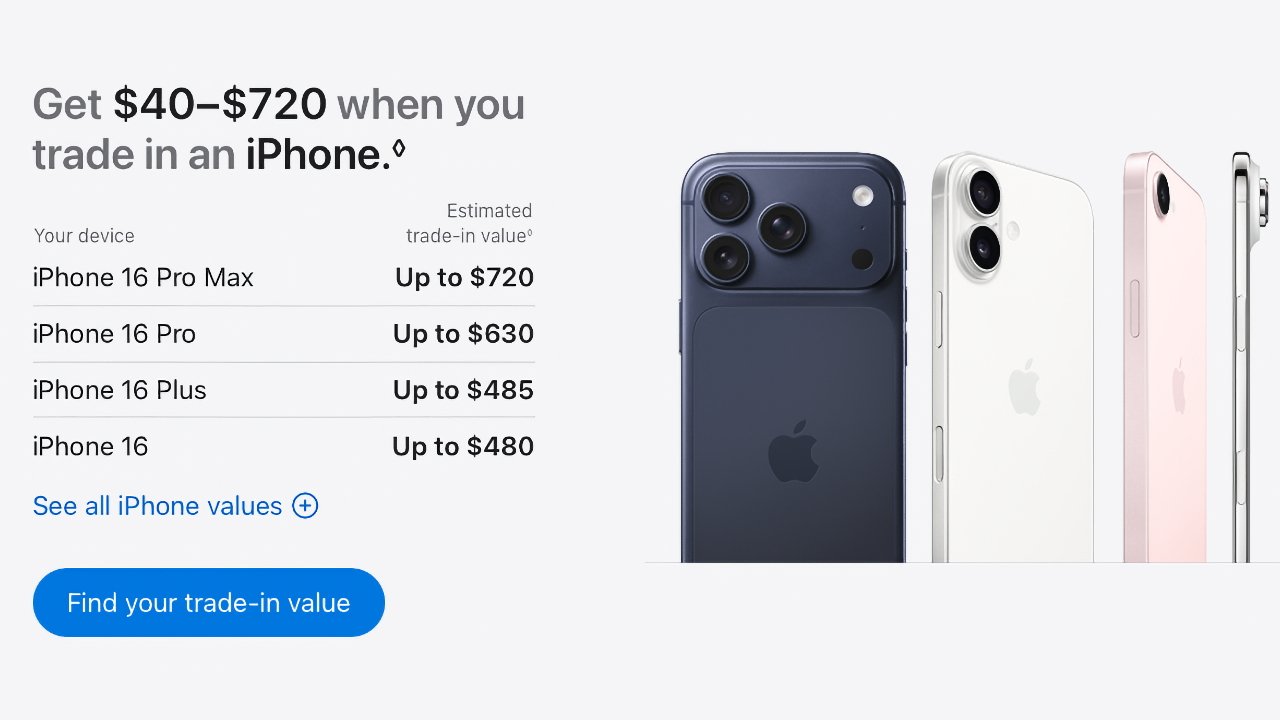
Of the 32 models of iPhone that Apple lists trade-in values for, 5 are unchanged, and 5 are up by $5. The most marked increases are $70 more for the iPhone 16 Pro, and $40 more for the iPhone 15 Pro Max.
With Macs, only the iMac Pro is unchanged and it remains at $315. The most significant increase is $260 for the Mac Studio, which the MacBook Pro is up by $165.
In comparison, all four iPads that Apple lists for trade-in values are up. The base iPad has the lowest value at $260, up from $235, and the iPad mini has the greatest increase, going up $35 to $300.
There is also an increase in the trade-in values of just under half of the nine Apple Watch models Apple lists. Of those, the Apple Watch Series 10 has the greatest increase, going up $15 to $165, while the three models including the Apple Watch Series 9 go up by $5.
Importantly, though, these figures are from Apple's overall guide (and the Wayback Machine's record of how they were before). Apple shows these all as "up to" figures, and the real sum depends on the configuration of the device, plus its age and condition.
You will only get an estimate of the real trade-in value after you have gone through the online process. The actual final value will only be confirmed after you've sent the device in and it's examined.
Unsurprisingly, Apple's final price for your trade-in may of course well be lower than its published "up to" prices. But curiously, AppleInsider staffers have just occasionally found that they were offered more.
Left: Apple's latest trade-in values list, which says it will pay up to $1,305 for any Mac Studio. Right, and taken at the same time, Apple offers us considerably more for our Mac Studio.
For example, the new trade-in prices list a maximum value of $1,305 for a Mac Studio. But in researching how the process works, we were offered $1,660 instead.
It's tempting to be offered $1,660, except you're not being offered it in cash. That or whatever value you are quoted is what you can get off an Apple purchase that you make at the same time.
Whereas if you go via a buyback scheme from another vendor, you can get cash. And you will invariably get more, which you can then choose to put toward the cost of a new device, or not.
If you want to get cash for your used device, what you can earn is typically higher selling through a platform like eBay.com.
Buyback service providers like BackMarket and Gazelle also accept a variety of Apple devices.
At press time, BackMarket is offering up to $1,111 on iPhones, including the iPhone 17 Pro Max, whereas Apple caps its offers on the iPhone 16 Pro Max.
BackMarket's Mac trade-in prices encompass models up to the M4 Max line, with values up to $3,341. This is far more than Apple's trade-in cap at $855.
You can also secure a higher trade-in price for your used iPad, with values topping out at $805 at BackMarket depending on condition, whereas Apple's max trade-in value is $720.