
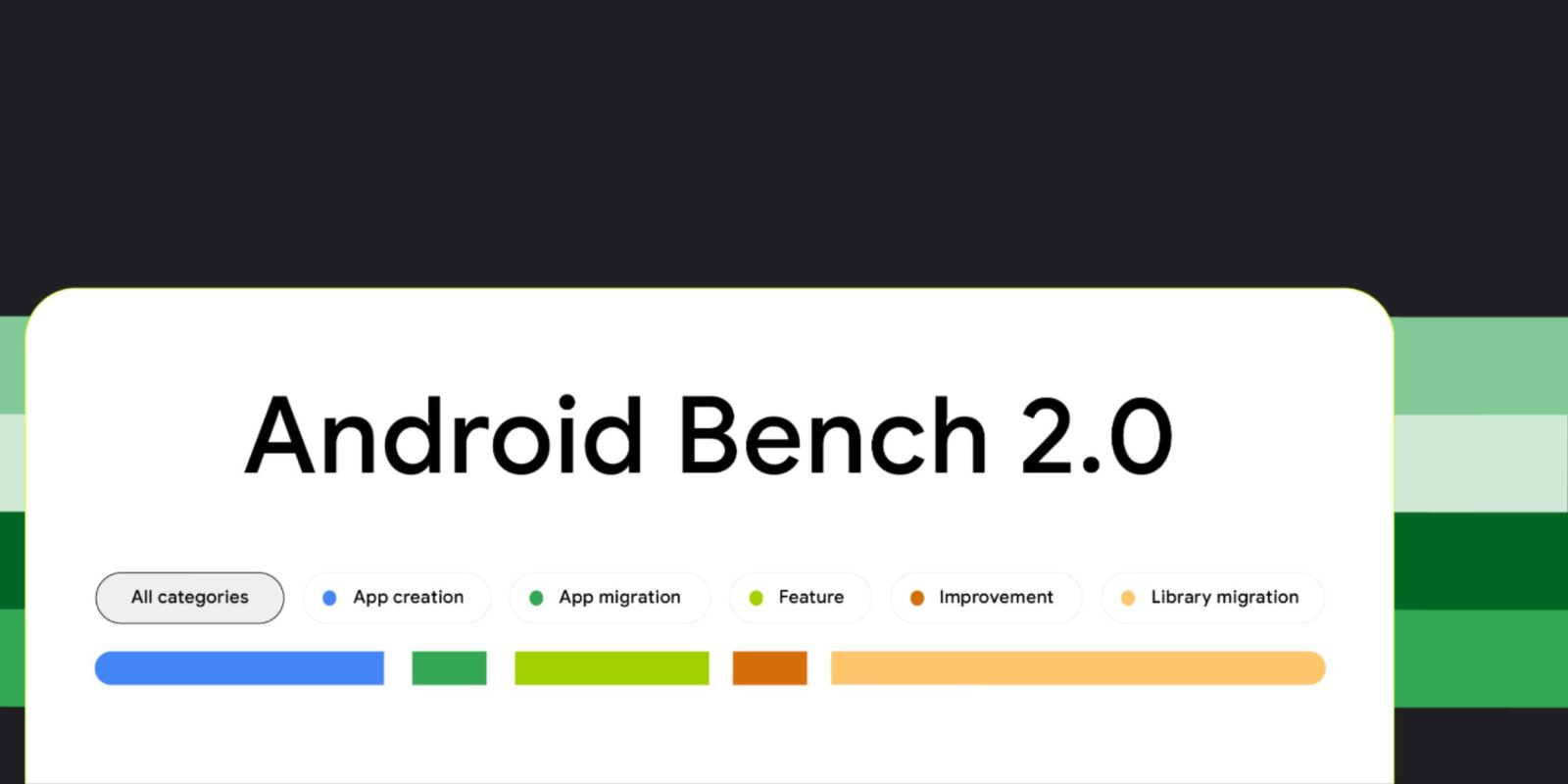
Google’s development of Android Bench continues today with a version 2.0 that reflects how AI can handle more complex development tasks.
The first version “focused on incremental changes to existing repositories,” like bug fixes or smaller feature requests. Android Bench 2.0 targets “tasks of great complexity that take an engineer multiple days or even a week to complete,” such as adding new features, building apps from scratch, and converting cross-platform apps to Android.
This new focus required “more nuanced evaluation and scoring” that goes beyond pass or fail grading. Google is moving from binary to continuous scoring:
We calculate this completion rate through a combination of factors like functionality, visual fidelity, and avoiding regressions. We also apply objective scoring penalties for deviations from evaluation instructions or structural constraints.
Google has rated Gemini 3.7/3.8 Flash, OpenAI GPT-6, Anthropic Fable 5.1, Kimi K3, and Qwen 3.8 Max. GPT-6 Astra is at the top of the benchmark with a 28% pass rate (compared to scores in the 90% range with the previous approach).
Google shared insights like how “porting cross-platform apps to Android remains an open challenge—no model hits a 100% pass rate, and frontier models reach at most a 80% completion rate.”
With agent evaluations, Android Bench ran “agents from the corresponding model provider,” like Gemini 3.8 Flash on Google Antigravity and GPT-5.6 Sol with Codex. Google says “harness design positively impacts developer outcomes,” with Android Bench planning to include different model and agent combinations in the future.
FTC: We use income earning auto affiliate links. More.
Check out 9to5Google on YouTube for more news:
Breaking news for Android. Get the latest on app…
Editor-in-chief. Interested in the minutiae of Google and Alphabet. Tips/talk: abner@9to5g.com