
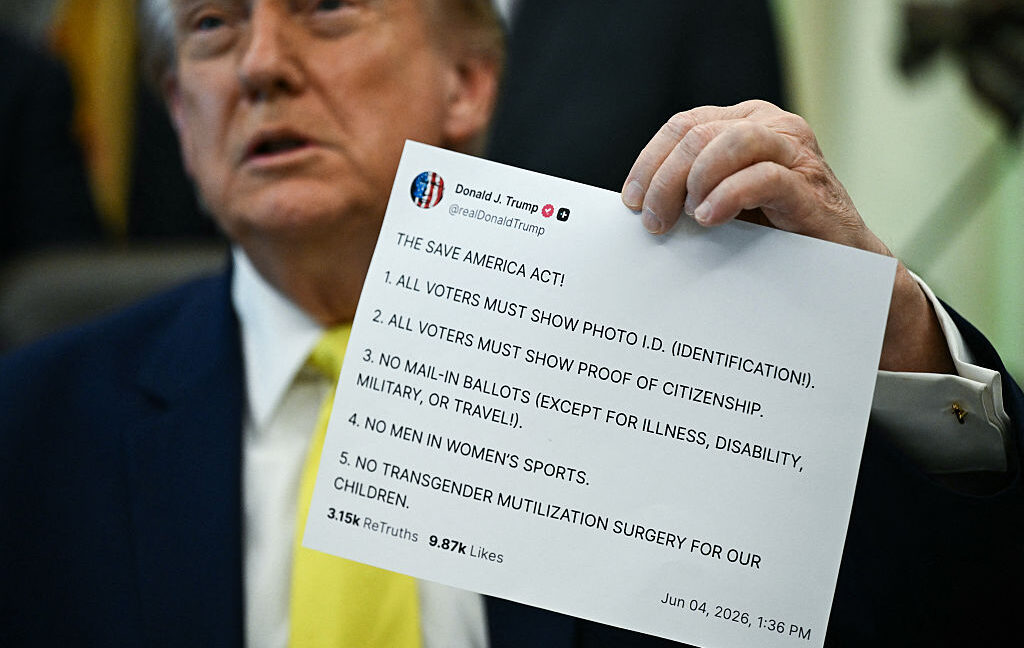
Likely in the next few weeks, a federal judge will decide if Donald Trump can become the first president to personally profit from selling early access to government information in his social media posts.
At a hearing Wednesday, Department of Justice civil attorney Brantley Mayers argued that there was no conflict whatsoever with Trump charging up to $100,000 monthly for instant API access to Truth Social posts that often break news from his administration.
Trump is the largest stakeholder and majority owner of Trump Media & Technology Group, the parent company that owns Truth Social, and the value of the API access comes largely from Trump’s role as president.
News groups suing have argued that Trump’s exorbitant API fees violate the First Amendment and the Presidential Records Act by creating tiers of access to government information in social media posts that Trump doesn’t technically own. Additionally, Trump’s exorbitant API fees undermine the Fifth Amendment. That prohibits the government from “charging unreasonable sums that cannot be justified to offset the cost of the government benefit, and granting preferential access to crucial government information for arbitrary and irrational reasons,” news groups argued.
However, Mayers likened Trump’s Truth Social posts—which have announced military strikes, ceasefires, tariffs, immigration policies, and major changes in his administration—to Franklin D. Roosevelt’s evening radio addresses known as “fireside chats,” Courthouse News reported. His personal feed acts as an unvarnished public service, not a greedy profit grab, the DOJ argued.
It’s clear, though, that Trump could potentially make $1.2 million per subscriber annually by selling government information that is not Trump’s property. Before Mayers could proceed, US District Judge Paul Oetken “cut him off,” Courthouse News reported.
“Well, President Roosevelt didn’t charge money for his fireside chats, did he?” Oetken asked.
Responding, Mayers suggested that although Roosevelt didn’t charge for his broadcasts, there were similar “barriers to entry” keeping every American from tuning in. Just as some news groups today can’t afford to pay $60,000 to $100,000 for Truth’s API, some Americans in the ‘30s and ‘40s couldn’t afford radios, he argued.
Nikhel Sus, chief counsel for a group representing news plaintiffs called the Citizens for Responsibility and Ethics in Washington (CREW), told Ars that the judge was right to push back on the DOJ’s comparison. During the hearing, the judge acknowledged that the Truth API could be discriminatory by creating “two classes of people,” Courthouse News reported. Sue said that he also clearly recognized the “symbiotic relationship” between Trump and Truth Social.
Criticizing the comparison to FDR’s fireside chats, Sus told Ars that the DOJ “can throw out these hypotheticals that have absolutely nothing to do with this situation until the cows come home, but they’re not persuasive.”
At the hearing, Oetken asked “tough questions” of both sides, Sus told Ars. No elected official has ever owned a media company where they can profit off presidential announcements, and the judge took time to remark that “there hasn’t really been anything like this case.”
Talking to Ars, Sus argued that the lack of precedent should trigger alarm bells, not excuse the conduct, as the DOJ has suggested. “Just because no prior president had the gall to try to do something so flagrantly corrupt and illegal doesn’t mean that it is legal,” he said.
Initially, Oetken approached claims that the API scheme violated the First Amendment with skepticism, Courthouse News reported. At one point, he wondered if Trump delaying the general public’s access to information by potentially as little as a fraction of a second would meaningfully harm the free press. Although it’s easy to see how an algorithmic trader would benefit from getting information just a little bit sooner, “It’s a negligible delay to a human being,” Oetken suggested.
But the conflict isn’t only about timing, nonprofit news organizations have argued. TMTG has confirmed that large news groups are already in talks to buy API access because there is immense value in the service that goes beyond getting instant access to Truth Social posts. For example, the API “provides a machine-readable feed and a historic archive of all of President Trump’s Truth Social posts,” Sus told Ars. With that access, even if Trump deletes posts—which he frequently does—any news group can maintain a more reliable log of all posts.
“It is absolutely worth something,” Sus told Ars. “And it’s not just the algorithmic traders. News outlets use APIs too.”
The judge sees the case as complex and did not rule from the bench, instead promising a written ruling on whether to enjoin Trump from selling API access while he’s in office at a later date. Sus told Ars that courts typically treat requests for preliminary injunctions urgently and that he expects a decision in the next few weeks.
Until then, news groups remain optimistic that the court’s ruling will swing their way, Sus said.
“All we’re asking for is that when the president chooses to make government information available to the public, he has to do so on equal terms,” Sus said. “He cannot discriminate based on who’s willing to pay the president’s personal company hundreds of thousands of dollars. That is obscenely corrupt and unconstitutional.”
Defending Trump’s scheme, Mayers asked the judge to look at Trump’s interests as wholly separate from the media group that bears his name. He claimed Trump had nothing to do with the decision to charge for API access to his posts, branding them as a “completely private commercial decision” made exclusively by TMTG.
Nonprofit news groups suing, however, have argued that the expensive API pricing is “corrupt,” ignoring America’s long history of providing equal access to presidential records. On Wednesday, David Schulz, an attorney representing The Intercept, argued that the scheme gives a “direct advantage” to newsrooms that can pay the high price for previously free access.
“Trump Media specifically is courting the largest news organizations in the country to get them to subscribe to Truth API,” Sus told Ars.
If Trump’s gamble pays off and the judge approves the API sales, Sus warned that the press would suffer, as more politicians could follow his lead and access to even more government information would be delayed behind paywalls.
“If the president is allowed to do this, it sets a very dangerous precedent for enabling public officials to profit off of their office and specifically profit off of government information,” Sus told Ars.