
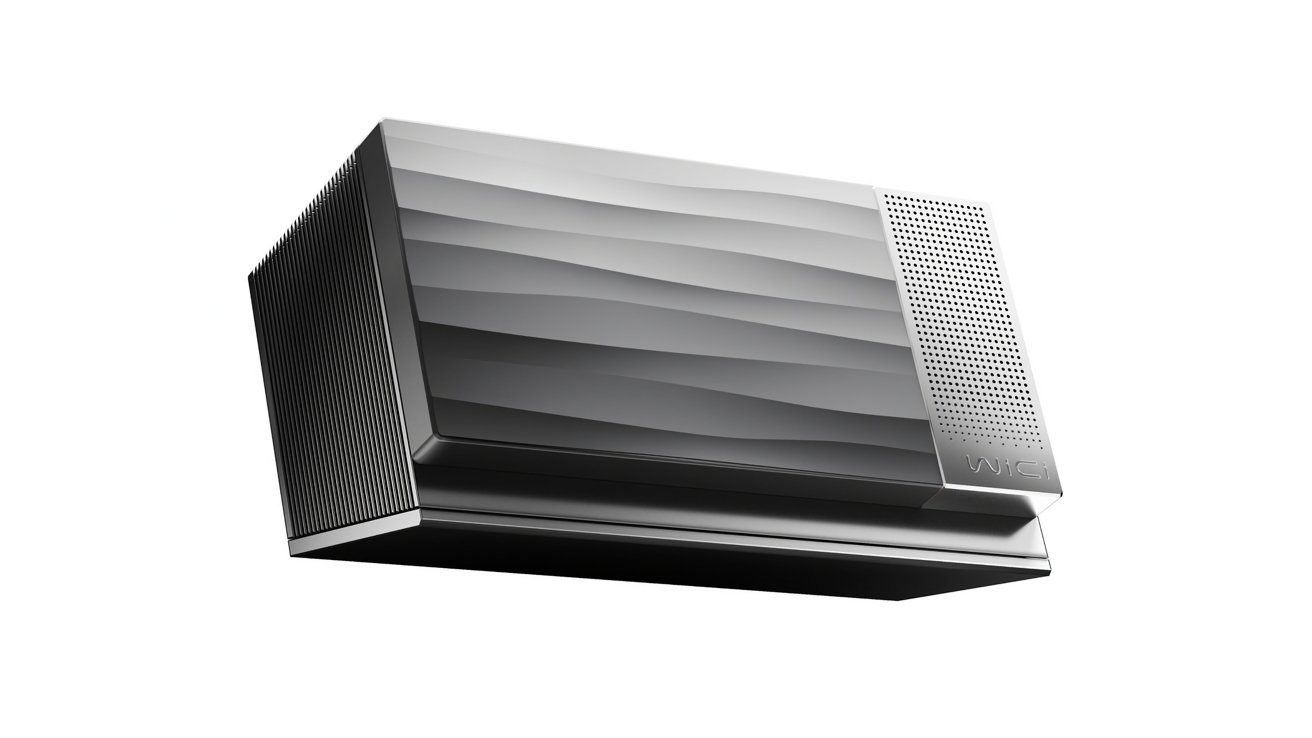
The WiCi One is a wireless GPU that can handle AI tasks and even gaming graphics rendering for your Mac over a network. We have questions.
The graphics processing unit (GPU) is an important part of everyday computing. Doing everything from handling graphics for games to processing AI tasks locally.
For users of small computers incapable of holding a full-size graphics card, such as a thin notebook or a compact computer, an option is an external GPU enclosure.
However, that brings with it a bunch of other issues. No one with a notebook wants to keep their thin and portable device connected to a large box using a Thunderbolt cable all the time.
The WiCi One is trying something different. While it is an external GPU, it's one that is instead designed to work over a wireless network.
The ides is that the WiCi One is a computer on your home network, packing a beefy GPU. A Mac or PC could then access the power of that GPU over the network to handle a variety of tasks.
That can include locally processed AI and models using Ollama, LM Studio, Hugging Face, and PyTorch. The GPU can also be harnessed to handle video rendering in Premiere Pro and CapCut, or 3D rendering for Maya, AutoCAD, or Blender.
There's also the possibility of using it for gameplay, with WiCi claiming it can even drive the graphics in games like Cyberpunk 2077. And the company says this is all done by the unit acting as a local GPU over Wi-Fi.
Inside the WiCi One is one of two configurations, with the base one being an Nvidia RTX 5060 Ti with 16GB of DDR7. That's running alongside an Intel Core 3 100U processor and 1TB of NVMe 4 storage.
The upper-tier model is fitted with a beefier Nvidia RTX 5090 with 32GB of GDDR7 memory, along with an Intel Core Ultra 7 255H processor and 4TB of NVMe 5 storage. While it does have a processor, the WiCi One is designed to act just as a GPU source, not as a server in its own right.
So, in essence, this is a Intel server, with a Nvidia GPU inside.
When it comes to performance, the company claims high performance when it comes to AI work. That includes an AI compute capability of about 420 FP16 TFLOPS for the 5090 edition, and 95 for the 5060 Ti.
An M5 Max Mac Studio is claimed to reach about 70TFLOPS by comparison.
For holding AI models in memory, the WiCi One takes advantage of the NVMe SSD for paging with TurboStream. On the Mac Studio, the comparison is with the memory, between 36GB and 128GB.
The ability hold large models is also another advantage, with the WiCi One capable of holding Kimi K3 with 2.8 trillion parameters. The 36GB memory of the Mac Studio is estimated to hold 70 billion parameters.
This is all packed into a compact chassis that WiFi claims has a quiet thermal design. It's an item that could theoretically sit on a shelf, out of the way, instead of on a desk somewhere.
Networking is handled by a Wi-Fi 7 radio with 4×4 MIMO, 320MHz of bandwidth, and twin antennas to minimize latency. It's described by WiCi as having "Router-grade AirLink Multi-Link transport."
The use of Wi-Fi sounds like a bad idea compared to a connection like Thunderbolt. However, Wi-Fi 7 has a maximum theoretical bandwidth of 48Gbps under optimal conditions, which should be more than enough for an eGPU to function.
And, there hasn't been Thunderbolt eGPU support, much less modern Nvidia drivers, on Apple hardware for years.
Theoretical being the main word there, as real-world connectivity will be much less than that.
The back of the WiCi One, with unmentioned Ethernet – Image Credit: WiCi
WiCi is certainly marketing it as a wireless-forward device, to the point that it doesn't mention any alternative connections on its website. However, press images show there may be an Ethernet connection and either a USB-C or Thunderbolt port on the rear.
All of these claims make the WiCi One an interesting choice for gamers who want to play on a MacBook Pro, but especially for those who are working in the field of AI.
Considering how expensive cloud-based AI services can get for heavy users, a high-end local processing solution is a viable option.
With Apple promoting its Mac Studio as an AI powerhouse, this is precisely the kind of market that the WiCi One is taking on. That goes for the premium pricing too.
The WiCi One starts with a list price of $2,599 for the 5060 Ti model, rising to $9,999 for the 5090 model. Both are being sold with a $600 discount for early buyers, bringing the prices down to $1,999 and $9,399 respectively.
For reference, the M5 Max Mac Studio starts from $2,499, with the M5 Ultra from $5,499.
AppleInsider will be finding out whether it lives up to its wireless claims as part of a review of the WiCi One soon.