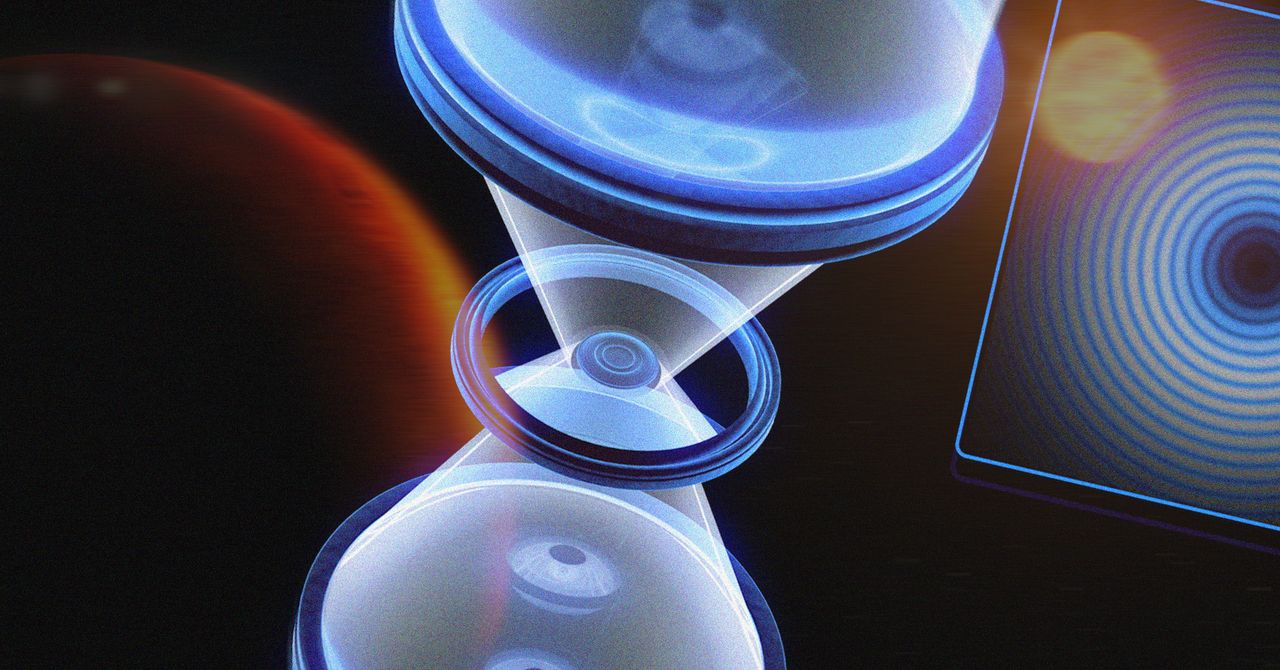
Two mirrors, each small enough to fit in the palm of your hand, are set to change how we understand the cosmos.
The launch window for NASA’s Nancy Grace Roman Space Telescope is about to open. The telescope’s primary instrument is due to inform practically every area of astrophysics, but also tucked inside the telescope is a specialized coronagraph, an experimental apparatus that will attempt to directly capture starlight reflected off a planet’s surface for the first time. It’s an ambitious project that NASA hopes will pave the way for a space telescope that can one day provide a glimpse of an Earthlike planet orbiting a sunlike star.
That’s a feat far beyond the power of current engineering—hence taking the basic technique for a spin on Roman. “We’ll test them in space for the first time, and we’ll understand what work still is left to go,” says Vanessa Bailey, an astrophysicist at NASA’s Jet Propulsion Laboratory and instrument scientist for the coronagraph.
At its core, a coronagraph is just a science-minded sunshade that can block out the light of a bright star and reveal a fainter object otherwise lost in the glare. Such instruments have flown in space before—both the Hubble and James Webb space telescopes carry coronagraphs. But Roman’s is light-years more sophisticated than its predecessors, thanks largely to technology called adaptive optics, which deforms a telescope’s mirror to cancel out these light distortions. It still faces a monumental challenge, though: NASA compares the task of Roman’s coronagraph to photographing a firefly perched next to a floodlight—from across the country.
“Any little bit of starlight that gets in the wrong place could just destroy a whole portion of the image,” says Margaret Turnbull, an exoplanet scientist at the SETI Institute, a nonprofit research organization in California, who leads a Roman coronagraph science team.
The technology is standard on advanced ground-based telescopes, including the Very Large Telescope in Chile and Hawaii’s twin Keck Observatory. Here, adaptive optics monitors interference from the thick, shifting layers of Earth’s atmosphere that muddy starlight, allowing observatories to capture sharper images.
Space telescopes haven’t traditionally needed adaptive optics simply by dint of being beyond the atmosphere’s interference, but they’ve never even tried looking for old, cool planets illuminated solely by reflected starlight.
For Roman, the key to its success is those two palm-sized mirrors, each of which is rigged with approximately 2,300 tiny actuators that expand when a small jolt of electricity is applied, infinitesimally reshaping the mirror to reverse interference. It’s the agency’s first time ever flying active deformable mirrors in space.
But the mirrors can’t do much on their own. The system requires supersensitive detectors to amplify the signal from individual photons—a necessity given how few photons the instrument will catch from any given planet. Then there’s the heart of any coronagraph, the star shades—in Roman’s case, a set of exquisitely detailed masks that Bruce Macintosh, an astronomer who leads the University of California Observatories and a Roman coronagraph science team, calls “beautiful, complicated shapes” unlike anything currently in space. “The Hubble ones are just completely brute force, just literally a little piece of metal that gets in the way of the star,” he says.
During the Roman coronagraph’s operations, engineers will gather scads of test data to evaluate how well it works in space and any problems to address before similar technology flies again. Scientists will test the coronagraph by seeing if it can spot a handful of known exoplanets.
“If we go through the whole thing and we don’t see them, then we know something is wrong with the coronagraph, because those planets are there,” Turnbull says. The instrument will also target a few stars surrounded by clouds of dust or debris, gathering observations that could reveal gaps caused by planets that scientists can’t yet detect and give scientists a whole new perspective on how normal our solar system’s level of clutter is.
Everything about Roman’s coronagraph will inform future telescopes seeking ever-smaller planets, including the Habitable Worlds Observatory that NASA hopes to launch, perhaps in the 2040s, that will need a coronagraph up to 100 times more effective; a coronagraph armed with adaptive optics and nearly as sensitive as Roman’s is also due to fly on the planned Lazuli Space Observatory that ex–Google CEO Eric Schmidt’s research institution announced in January. Although seeing alien worlds is the most tantalizing application, coronagraphs could someday show astronomers binary stars or objects hiding near bright quasars.
Roman is a first, vital step toward this future—and the marvels it may show scientists along the way can support that future too, says Julie McEnery, an astrophysicist at NASA’s Goddard Space Flight Center in Maryland and senior project scientist for Roman.
“Obviously, the best way of demonstrating that something works is to do something interesting scientifically,” she says.