
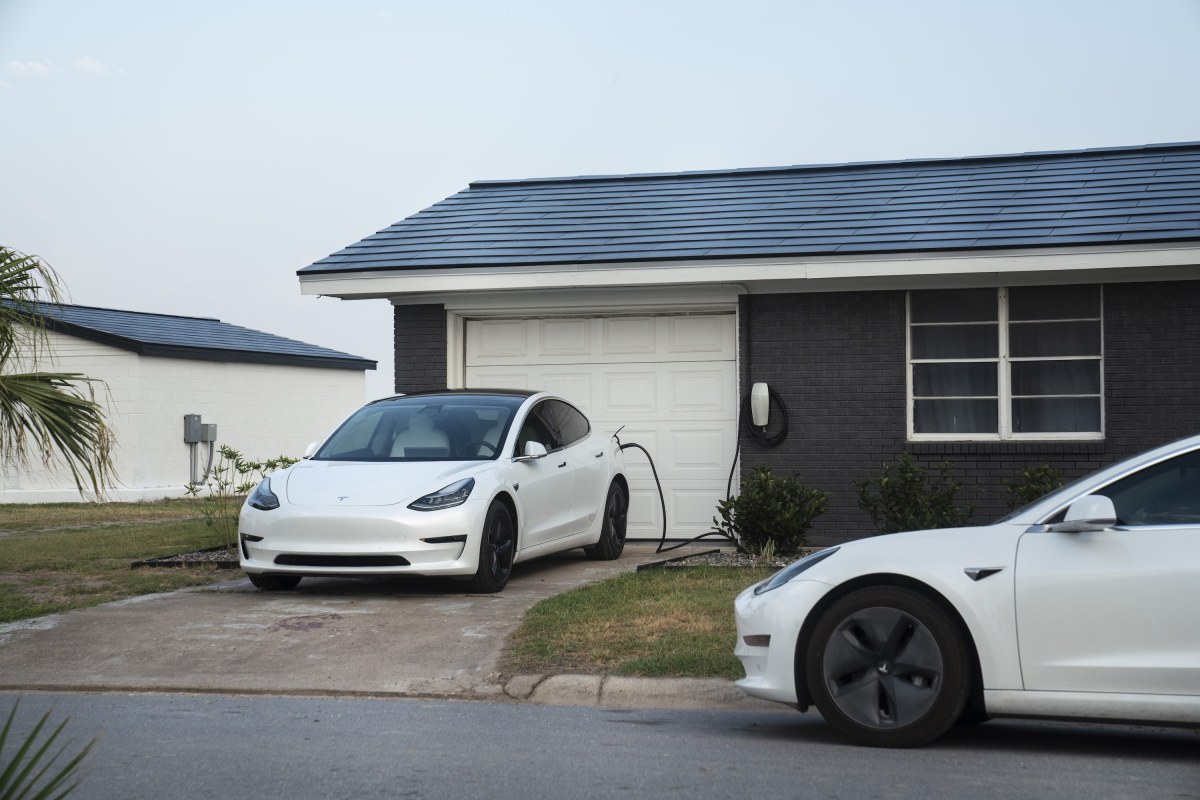
Nearly a decade ago, Tesla introduced its solar roof, which was essentially a mini-power plant that happened to look like high-end shingles, fancy terra-cotta tiles, or refined slate slabs.
Now the solar roof is dead. Tesla has scrubbed public-facing mentions of the product from its website. TechCrunch has confirmed that the solar roof URL now redirects to its generic solar landing page on Tesla’s website, and all of the support pages redirect, too. Electrek was first to report on the product’s disappearance.
But like other Tesla initiatives, the concept might have a life beyond the company. Two solar installers told TechCrunch their company was still offering the solar roof, though one said availability would depend on the timeline of the project. That suggests Tesla is working to offload existing inventory.
Depending on how full that warehouse is, the solar roof might be available for some time. Tesla had lofty goals for the product, aiming for 1,000 installations per week, but after years of refinement and process improvement, the project got to somewhere between 20 and 40 per week as of 2022.
Tesla’s solar roof never had a bright future. From the start, it was positioned as a luxury product, and it only got more expensive over time. In its marketing materials, Tesla compared the solar roof with the cost of solar, plus roof replacement. That positioning made the product seem attractive, especially if you really didn’t like the looks of regular solar panels. But even when you factored in replacement, the product could be eye-wateringly expensive. People reported receiving quotes of $200,000 to install one.
Even as silicon-based technology got cheaper over time, the solar roof proved an aberration. Regular panels dropped in price because the world makes billions of standardized solar cells every year and assembles them into largely standardized panels. The solar roof might have used standard cells, but the tiles were unique to the system. That meant Tesla had to design and buy its own manufacturing equipment, and when sales didn’t materialize as expected, the per-unit cost of that equipment went up.
Physics wasn’t kind to the project, either. Anything that’s under full sun exposure has to deal with heat, and there were reports of the solar roof’s non-solar parts warping and roof underlayment melting. For Tesla, perhaps more troubling were reports of underproduction: The system wasn’t making as much electricity as Tesla said they would.
It’s hard to say what, exactly, resulted in the underproduction, but a likely culprit is heat. Like many electronic devices, solar panels perform better when they’re colder. Voltage tends to decline by about half a percent for every degree Celsius. Regular solar panels cope with this by leaving a gap between the panels and the roof, allowing for some airflow to cool things off. Tesla did the same with the solar roof, but the gap was much smaller, which may have led to high temperatures that robbed the cells of some efficiency.
So now that Tesla is pushing buyers to its traditional solar panels, does this spell the end of integrated solar roofs?
For now, no. Other companies like GAF and Merlin Solar are still angling for a piece of the market. Plus, it’s likely that a number of buyers with specific aesthetic tastes will keep companies interested.
Still, Tesla’s decision could deal a blow to the idea of a solar roof. If one of the world’s most valuable companies can’t make it work, who can? Maybe that’s an indictment of the entire concept. Or maybe it sounds like a challenge to an eager founder willing to prove Elon Musk wrong.
When you purchase through links in our articles, we may earn a small commission. This doesn’t affect our editorial independence.
Tim De Chant is a senior climate reporter at TechCrunch. He has written for a wide range of publications, including Wired magazine, the Chicago Tribune, Ars Technica, The Wire China, and NOVA Next, where he was founding editor.
De Chant is also a lecturer in MIT’s Graduate Program in Science Writing, and he was awarded a Knight Science Journalism Fellowship at MIT in 2018, during which time he studied climate technologies and explored new business models for journalism. He received his PhD in environmental science, policy, and management from the University of California, Berkeley, and his BA degree in environmental studies, English, and biology from St. Olaf College.
You can contact or verify outreach from Tim by emailing tim.dechant@techcrunch.com.
In less than 48 hours, your chance to save up to $300 on your tickets will end!
Home batteries are suddenly cheap and everywhere. Here’s why.
Cursor capitalizes on GitHub frustration, launches rival hosting platform
Etched’s valuation doubles to $21B in a month
AI automation startup Relay shuts down, staff joins Google’s Chrome team
Stripe will reportedly acquire AI gateway startup OpenRouter for $7B+
Anthropic shares more details about how Claude’s new watermarks will work
7 desk gadgets that can make your workday better