
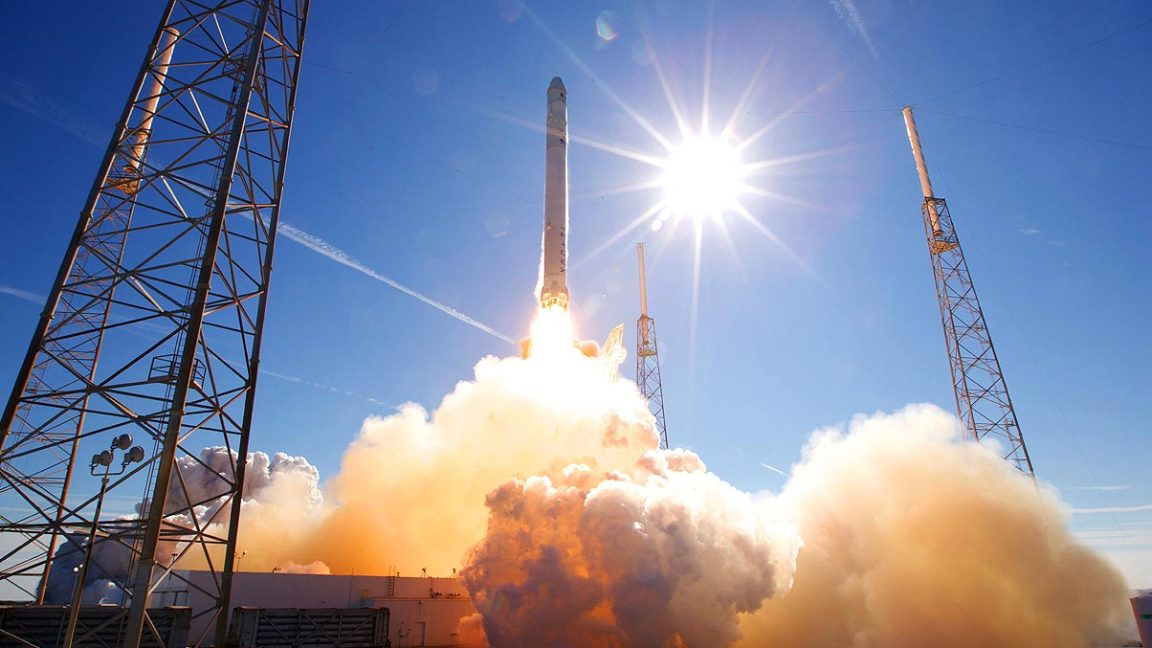
During the last three years, an average of 270 orbital rockets have launched from Earth, a more than three-fold increase from only a decade ago. By every metric available, the launch industry is crushing it: Prices have never been more competitive, launches never more frequent, and access to space never more rapid.
Paradoxically, though, there is a growing crunch in launch availability.
As part of his job as the director of research at Quilty Space, Caleb Henry speaks with satellite operators all the time. And he is hearing a constant and increasingly loud refrain from companies that want to put stuff into space.
“What we have is an industry in panic,” Henry said.
Anecdotes abound. A Canadian satellite company, Telesat, recently received inquiries from other companies asking if they would consider sharing some of the 11 Falcon 9 launches Telesat has booked for its new constellation. (Sorry, no, is the reply). The Amazon LEO constellation has had to throttle back production of satellites because few of the dozens of launches it booked half a decade ago are ready. And during an earnings call last Monday, officials from AST SpaceMobile said launch availability was now the pacing item for deploying its constellation.
With a growing number of constellations big and small, there is a huge and growing demand signal. The Commercial Space Federation predicts demand for thousands of satellite launches annually in less than a decade. Analysys Mason forecasted that more than 37,000 satellites will need to be launched between 2023 and 2033. Henry’s own firm, Quilty Space, has charted a change in the discussion from how many launch companies the US market can support to who can execute the fastest to meet surging satellite needs.
And if things are bad now, there are reasons to believe they may get even worse over the next two to four years.
Myriad factors are driving this crunch, but the principal concern of late has been SpaceX.
The company that is almost exclusively responsible for the dramatic increase in launch availability in the 2020s has signaled that it intends to wind down Falcon 9 operations as quickly as possible in favor of the larger Starship rocket. Some might see that as a good thing due to Starship’s enormous payload capacity. But there are growing concerns that SpaceX will largely focus on its own payloads—Starlink v3 satellites and orbital data centers—because of their potential to drive far greater profits. The Starship rocket’s PEZ satellite dispenser, optimized for Starlink, is an indication of the company’s priorities.
In financial documents, it’s clear that SpaceX views commercial launch as a rounding error compared to revenues from its own satellites in space. A majority of the company’s revenue ($4.3 billion out of $7.8 billion) during the second quarter of 2026 came from Starlink, whereas less than 12 percent was due to space services, of which commercial launch is but a fraction. This disparity is only likely to widen.
SpaceX has already moved beyond “peak” Falcon 9 operations. The company flew the rocket 165 times last year, and it will probably fly about 20 fewer missions this year. SpaceX is already making ground system changes to reflect these reductions.
The company’s previous president, Gwynne Shotwell, has said the operational lifetime of the Falcon 9 may end in 2030 or 2032. However, more recently, commercial satellite customers have been running into difficulties when trying to purchase a launch after 2028. One source said SpaceX has told the US government that it intends to end commercial launches after 2028 but will continue flying the Falcon 9 rocket for a limited number of federally contracted missions after that.
Whether or not these dates stick, it has become clear to commercial satellite operators that they can no longer reliably plan their future around the workhorse Falcon 9 rocket, creating a huge pain point for the commercial space industry in the United States and other Western countries.
This is because of an inescapable reality: Without SpaceX, the Western launch market would have been completely screwed over the last half-decade.
On February 24, 2022, Russia launched a full-scale invasion of Ukraine. This took Russian rockets off the table for Western countries, including European nations. Most immediately impacted was OneWeb, which lost some satellites already in Soyuz launch processing and eventually had to turn to a direct competitor, SpaceX and its Falcon 9 rocket, to complete its constellation.
The loss of the Soyuz and Proton rockets for Western commercial purposes came at the same time that two other leading providers were shutting down their older rockets for newer models. In Europe, the transition from the Ariane 5 to Ariane 6 rocket was underway. Across the pond, United Launch Alliance sought to end its dependence on Russian engines for the Atlas V rocket by migrating to the new Vulcan rocket.
Both projects had initially targeted completion by 2020, but by the time of the war’s outbreak, neither new vehicle was close to flying for the first time. Effectively, this meant that Arianespace and United Launch Alliance had a dwindling number of older rockets that were already spoken for.
The war also offered a chance for two Asian nations with ties to the West, Japan and India, to step up. Both countries, with the H3 rocket in Japan and LVM3 in India, had been seeking to support the commercial satellite industry. But the H3’s debut slipped to 2023, and the first launch ended in failure. The eighth launch of the vehicle in 2025 was also a failure. To date, the vehicle has not been a commercial success and averages only a handful of launches a year. India’s LVM3 has launched even fewer times, just once or twice a year.
Amid all the opportunities to respond to Russia’s retreat from the Western market, only one company stood up. As Russian soldiers marched into Ukraine, SpaceX was beginning to perfect the reuse of the Falcon 9 rocket’s first stage. The company flew the Falcon rocket 31 times in 2021. By 2023, this number nearly tripled to 91 rockets.
As SpaceX’s main competitors struggled to bring new vehicles online, the Falcon 9 rocket flew and flew. It backstopped the entire Western hemisphere’s launch needs, boosting everything from Europe’s prized Galileo satellites to NASA astronauts to Jeff Bezos’ Amazon LEO vehicles into orbit.
The Ariane 6 rocket made its debut flight in July 2024 and has had a nice track record. But with a production goal of ten vehicles a year, the rocket won’t make a meaningful dent in the global need for launch capacity.
That left just two large rockets, the Vulcan vehicle and Blue Origin’s New Glenn booster, as the key vehicles to bring competition to SpaceX and help ease the growing demand for launch capacity in the mid-2020s.
The demand has long been evident. Even before these two rockets reached the launch pad, their launch manifests were booked up. In 2020, as part of the National Security Space Launch program, the US Space Force procured dozens of Vulcan launches for military missions. Two years later, Amazon purchased 38 Vulcan launches and options for up to 27 New Glenn flights for the Amazon program, which later would be renamed Amazon LEO. Both had more missions than they could fly for a while.
To compound problems, neither rocket has had an easy road from its debut (January 2024 for Vulcan, January 2025 for New Glenn) toward reaching a higher cadence.
Six years after the Space Force award, Vulcan has launched just two military missions. Vulcan has stumbled due to ongoing problems with the performance of its solid rocket boosters, which are provided by Northrop Grumman. The Pentagon has grown increasingly frustrated with the delays and has already moved several payloads previously intended for Vulcan onto SpaceX’s Falcon 9.
New Glenn got started even later than Vulcan, but it appeared to be reaching a nice cadence after successfully landing a first stage booster on the rocket’s second flight in November 2025. Unfortunately, tragedy struck in April of this year when the rocket exploded during a static fire test in Florida. This conflagration took out the vehicle’s only launch pad. New Glenn is therefore offline at least until the end of 2026, and despite the company’s professed optimism about returning to flight rapidly, probably into the early months of 2027.
So nearly half a decade after the onset of the Ukraine War, the Western launch market has not changed much. Ariane 6 has made a difference for Europe, but for the rest of the commercial launch industry, a holding pattern remains as Falcon 9 backstops all.
Vulcan and New Glenn are heavy lift rockets, but beyond them, a new generation of US medium-lift vehicles is in development.