
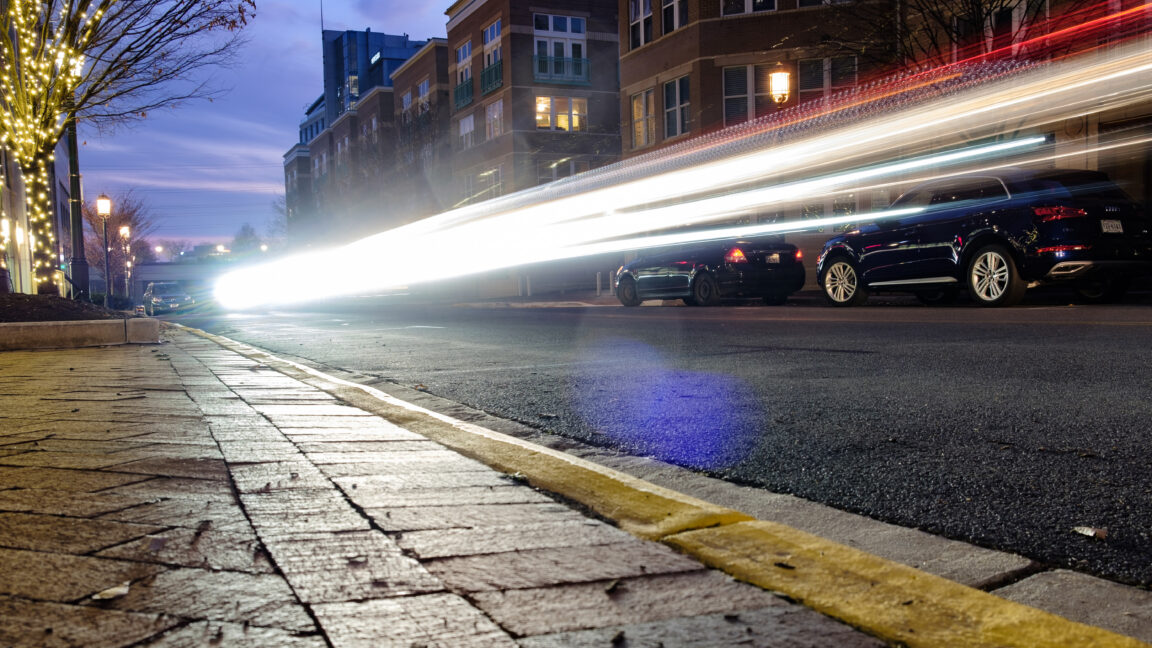
Every so often, I’ll be piloting some sensor-laden, software-defined press car down a dark stretch of highway when an oncoming driver’s high beams arrive like a targeted retinal strike, an involuntary reminder that modern automotive lighting has entered its own lumen arms race.
Anyone who has driven at night in the last few years knows what I’m talking about: A modern crossover crests a hill in the opposite lane, and the cabin briefly fills with enough cold-white light to suggest a police helicopter has joined traffic. The obvious assumption is that drivers are simply leaving their high beams on more often, but the reality is more complicated.
Before cars became the modern mode of transportation, horse-drawn carriages used oil lanterns to light the way, as roads were largely unlit outside of towns and cities. These lanterns weren’t particularly bright, though, meaning that after-dark collisions and near-misses were common.
The late 1880s brought the motorcar, which used railway-style oil lamps. These emitted light like a candle and were prone to spilling, which could cause the vehicle to ignite.
Acetylene lamps arrived in the early 1900s. Like oil lanterns, they were dangerous, primarily because they relied on an open flame and produced highly flammable acetylene gas. If the gas nozzle became clogged or leaked, pockets of concentrated acetylene could build up and ignite, causing localized explosions.
Setting aside the occasional inferno, early motorcars did at least one thing well: They were faster than the horse-drawn traffic they were busy displacing. The problem, of course, is that this newfound speed arrived in a world whose lighting technology had not quite caught up with the idea of vehicles moving at more than a brisk trot. Early automotive lamps were less like searchlights and more like dim lanterns politely suggesting that there may or may not be a vehicle present.
From the driver’s perspective, these early headlights did little more than marginally improve visibility. They struggled to illuminate meaningful distance ahead, leaving hazards—including ruts, livestock, and pedestrians—well outside detection range until the last possible moment.
Pedestrians had it worse. You might have been walking along a road at night when a faint glow appeared in the distance, followed by the realization that the glow was attached to a rapidly accelerating machine that was not good at noticing you. The entire system effectively relied on mutual improvisation: Drivers guessed where the road went, and pedestrians guessed whether they were about to become part of automotive history.
Headlight regulation didn’t emerge from a single incident so much as from a steady mismatch between early motor vehicles and roads still designed for horses and pedestrians. Late-19th- and early-20th-century laws in the UK, US cities, and parts of Europe initially treated cars as “locomotives on highways,” requiring only that they carry lamps at night so they could be seen, an intentionally vague standard rooted in carriage-era lighting rules.
There was no notion of beam pattern or glare control at first, just basic visibility in otherwise unlit environments. As speeds increased and night driving became routine, these simple visibility requirements gradually hardened into the more technical headlight regulations that shaped modern automotive lighting design.
By the early 1900s, complaints from horse riders, pedestrians, and other drivers were already shaping US and European regulations that didn’t just require lamps but also implicitly pushed toward controlled illumination: shielding, positioning, and later beam shaping to reduce dazzle.
The tension was visible even then—drivers wanted more forward light as speeds rose, while everyone else wanted fewer blinding lights from oncoming traffic. That trade-off never went away; it just became formalized over time into beam cutoffs, alignment standards, and eventually modern photometric rules that try (with mixed success) to balance visibility for the driver against glare for everyone else.
Headlights have become brighter over the past two decades, largely because the automotive industry abandoned the old halogen paradigm in favor of LEDs, HID projectors, and increasingly sophisticated adaptive lighting systems.
Older halogen setups, particularly the reflector housings common through the 1980s, 1990s, and early 2000s, produced a comparatively soft, warm beam with limited reach. They were inefficient, generated excessive heat, and scattered light somewhat indiscriminately. But they tended to fail gracefully. Visibility wasn’t exceptional, but neither was the likelihood of accidentally assaulting an oncoming driver’s eyes.
Modern systems have an entirely different engineering goal. LEDs consume less power, last far longer, and can emit vastly more light from a much smaller package. Their compactness allows designers to create thinner headlights and more aggressive front-end styling, but it also means the light source itself becomes intensely concentrated. Automakers have additionally shifted toward cooler color temperatures—closer to daylight white than the yellowish glow of old halogens—because we perceive these wavelengths as sharper and more detailed at night.
The downside is that blue-white light also produces more glare and discomfort, especially in rain or on poorly marked roads. Add in the current SUV and pickup truck boom, where headlights are mounted higher off the ground than on older sedans, and even correctly aimed low beams can shine directly into the eyeline of drivers in smaller vehicles.
Then there’s the escalation effect. Modern vehicles are heavier, faster, quieter, and packed with driver-assistance systems that encourage confident nighttime driving at highway speeds. To support that, manufacturers continuously increase forward illumination distance and beam intensity.
Adaptive matrix headlights, which can selectively dim portions of the beam to avoid dazzling other drivers while maintaining maximum illumination elsewhere, are theoretically the technological solution to the problem. In practice, though, adoption remains inconsistent, regulations vary by country, and many vehicles still rely on brute-force brightness rather than precision. The result is that nighttime driving increasingly feels less like navigating through darkness and more like surviving a rolling photonics demonstration from the consumer electronics industry.
According to 2019 to 2023 Fatality Analysis Reporting System (FARS) data, 46,154 fatalities on US roads were due to crashes at night and in non-lit areas. 446 were due to glare impeding the driver’s vision.
At the top end of the data set, the clustering of fatalities in California, Texas, and Florida is broadly consistent with baseline exposure: they are the three most populous states and, by extension, host the largest absolute number of vehicle miles traveled, so their prominence is not especially surprising. Illinois and Indiana likewise track expected behavior given their placement among the nation’s more populous states.
More notable are the outliers further down the list, where states such as Alabama and Kentucky exhibit disproportionate fatality counts that are less easily accounted for by population alone and appear, on first inspection, anomalous relative to traffic volume.
But the distribution becomes more legible when cross-referenced with demographic structure. A significant share of recorded fatalities, 108 in total, occurred among drivers aged 65 and older, suggesting that vulnerability factors tied to age may be amplifying outcomes in certain jurisdictions.
This reframes Florida’s position in fifth place, where its unusually large elderly driving population likely acts as a multiplier, helping contextualize why Texas and California remain in the upper tier. Alabama, meanwhile, remains a persistent outlier, retaining the highest relative fatality burden even when normalized against population size, indicating that exposure alone does not fully account for its placement in the distribution.
High-beam rules are pretty similar throughout the US. In most states, the distance you need to dim your high beams when an oncoming vehicle is approaching is 500 ft (152 m). When you’re behind a vehicle, this is reduced to 200 to 300 feet (61-91 m).
An IIHS study found that vehicles with “good”-rated headlights were involved in 19 percent fewer nighttime crashes and 23 percent fewer pedestrian crashes than those with lower-rated systems. In general, higher-performing LED systems dominate the top of the ratings, while older halogen designs tend to cluster at the bottom, constrained by lower output and less precise beam control, despite offering advantages in simplicity and cost.
US federal headlight brightness standards have remained largely unchanged since 1997. In 2022, however, the US finally allowed adaptive driving beam headlights.
The 1997 system effectively reset industry incentives. Only one of more than 80 headlight systems tested in 2016 earned a “good” rating, but by model year 2025, that figure had risen to roughly 51 percent, with “marginal” or “poor” systems falling from 82 percent to about 16 percent.
So what do manufacturers have to say about all this? I chatted with engineers at Skoda (one of VW’s brands) to find out.