
I’ve had only one experience of pedaling an e-bike after it ran out of juice, but it was enough to make checking the battery display an anxiety-driven habit: “Can I afford to use the highest assist level up this hill? Should I switch to eco mode to preserve power and make sure I have enough to get home with the bike lights on?”
These aren’t fun questions to have rattling around in your head while riding home in the dark.
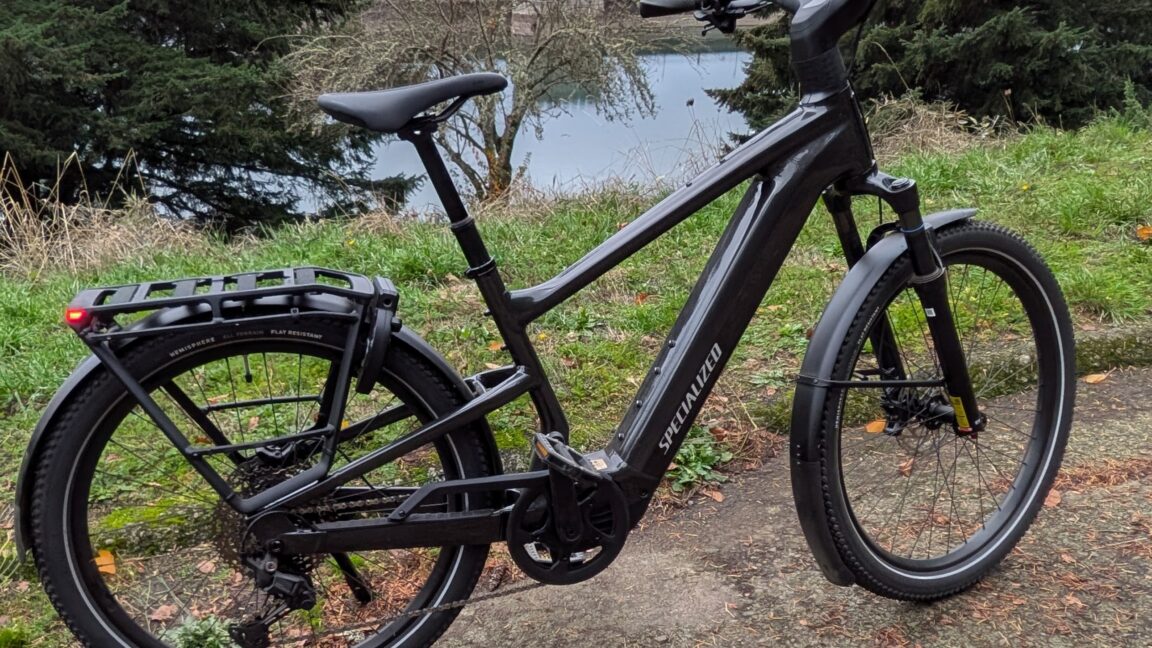
But those intrusive thoughts never crossed my mind while I was testing Specialized’s Turbo Vado 3 Evo. I didn’t experience range anxiety, even while blowing through city streets at 25-plus mph (40.2 kph). The bike has so much juice (840 watt-hours) and power (810 watts of peak power and 105 newton-meters of torque) from Specialized’s 3.1 motor system that I could ride as far and as fast as I wanted without worrying about having enough battery to get back home.
Given my preference for biking over driving, I need a bike that can get me across town at a decent clip without draining an entire charge. That’s exactly what the Evo delivered on my longest rides.
What sold me on the bike was a 24-mile round trip that took 83 minutes and used just 56 percent of the battery. According to Specialized’s app, which connects to the bike over Bluetooth, I averaged 235 W of assist power while moving an average of 17 mph, though I was generally closer to 20 mph on stretches where I didn’t have to slow down. I also hit a max speed of 27.3 mph with little effort.
The bike is a beast, weighing around 70 pounds for the large-size frame I tested. Despite being the heaviest e-bike I’ve ridden, the Evo makes pedaling easier than ever. The bike lacks a throttle, so it takes a few rotations to get moving, but once the assist kicks in, it’s remarkable how easily you can reach the 18–20 mph range.
That higher speed comes from the bike’s Sport mode, which became my default setting. It requires a bit more pedaling to reach full assist, which explains why my smartwatch recorded my heart rate in the moderate-to-vigorous zone if I was riding above 20 mph.) The other modes are Eco (minimal assist, with you supplying most of the power), Turbo (max power with little effort, making uphill climbs trivial), and Auto (which adjusts assist level to your pedaling). You can also tune each setting to your liking.
The added bulk is also meant to handle rougher terrain. I’ve had the occasional flat tire from road debris on slimmer bikes, so I appreciate the sturdier, all-terrain, flat-resistant tires. Still, the 70-pound frame makes me hesitant to venture too far from pavement. I won’t be bombing down any mountain bike trails, but it’s helpful to have the option to jump off a curb or ride on dirt or gravel roads.
The weight makes the bike markedly different from the previous Turbo Vado we reviewed; this isn’t a bike I’d want to ride without assistance. Even the Eco mode, which you’d have to use exclusively to get the bike’s purported 150-km (93-mile), five-hour range, felt a bit sluggish compared to the more powerful modes I preferred. Specialized also sells a 280-Whr range extender, but at $700, it feels like overkill.
The RockShox Psylo suspension fork, with 120 mm of travel, also made this the smoothest-riding e-bike I’ve tested. Other e-bikes I’ve ridden have felt stiff over even small bumps in the road, but the Evo’s bounciness made hitting bumps feel like a nice change of pace. I used to be scared of going over a curb, and that’s no longer the case. The 40 mm dropper seatpost is another nice feature, giving riders a bit of travel and letting them lower the seat to make it easier to touch the ground when stopped or dismounting.
While other e-bikes I’ve owned initially offered good range, storing them in colder weather has been an issue for their longevity.
So I’m grateful that Specialized made the downtube battery removable. Being able to store the battery in my house helps since I keep my bikes in an outdoor shed—I no longer have to worry about it sitting in freezing temperatures. A full charge takes four hours, though you can tweak the battery to cap charging at 80 percent to further extend its life.
The other electric components are nice, too. On the Evo 5.0 I rode, a touchscreen lets you cycle through ride data, including your speed, estimated range remaining, and power assistance level. The front light even comes with low-beam (450 lumens) and high-beam (805 lumens) settings, making my night rides more visible.
If I have any complaints about my time with this bike, they boil down to two things. First, it’s incredibly heavy, making it difficult for many people to take up stairs. Second, the convenience of riding at high speed and making quick journeys has left my road bike gathering dust unless I’m specifically going out for a workout (and those are harder now that I’m so accustomed to riding the Evo). That’s more of a personal issue than a mark against the bike, though. It’s fun to ride, but maybe at the cost of consistent manual pedaling.
And then there’s the cost. I tested the Evo 5.0 ($5,200), which sits between the 4.0 ($4,500) and 6.0 ($7,000) in terms of cost, performance, and features. At $5,200, though, I would’ve liked to see a phone mount on the 5.0, which is a common enough feature on less-expensive bikes.
Those prices make securing the bike even more important, and Specialized offers a few safety features to thwart theft. As mentioned, you can remove the battery, lock the back wheel, and disable the power system; there’s also Apple Find My integration if the bike ever escapes your purview (a bummer if you use Android, though).
In all, Specialized has upgraded the e-bike experience enough for me to want to upgrade, though the price makes me blanch a bit. Maybe I can subsidize a purchase by selling an older e-bike.