
This story originally appeared in The Algorithm, our weekly newsletter on AI. To get stories like this in your inbox first, sign up here.
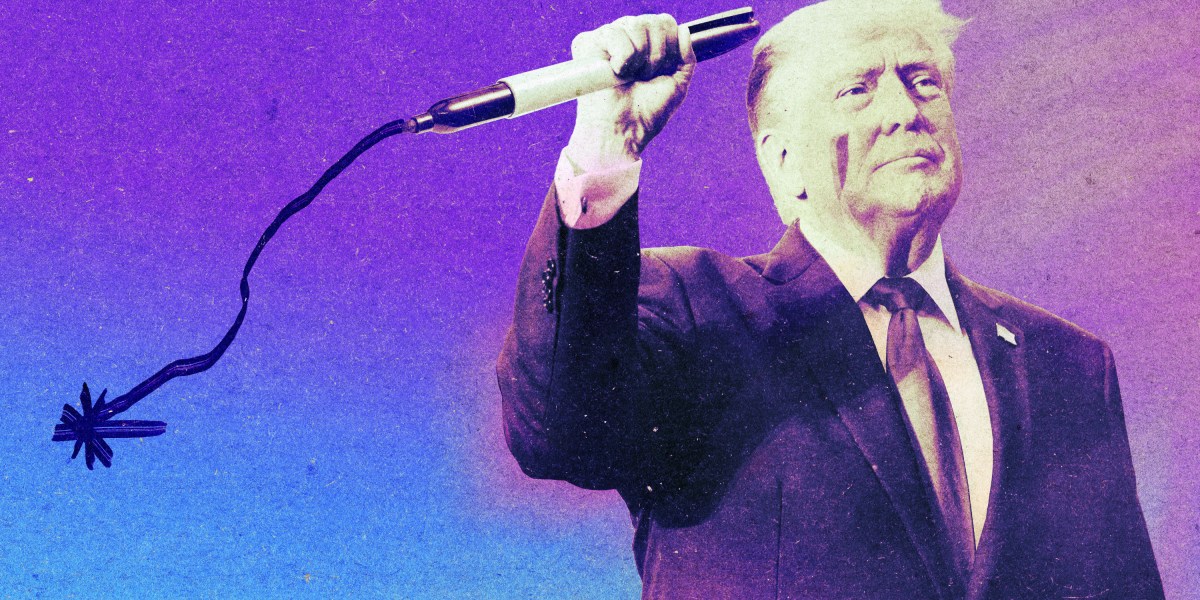
At the end of September, President Trump signed an executive order that contained just one directive, ordering government agencies to rebrand what they had been calling artificial intelligence as “Super Intelligence.” That term beat out other contenders, including “Extreme Intelligence” and “Supreme Intelligence,” offered by the president in a poll on X a couple of weeks earlier.
Rebrands are, of course, now a White House tradition: Trump has changed names to project US dominance of certain bodies of water (the Gulf of America and Lake America), to signal new institutional priorities (Department of War), or simply to leave his mark on storied places (see the ongoing fight over renaming the Kennedy Center).
The stated reason for this name change is that today’s AI systems “amplify human ingenuity” rather than merely “imitate” intelligence, and the government’s terminology should reflect that. But if this rebrand follows the pattern of others, its effects will extend beyond government.
It will turn a choice of words into a political loyalty test: Those who use the new term demonstrate allegiance to the administration, and those who don’t become marks for attacks (recall that the Trump administration barred the Associated Press from some White House press events after the news outlet did not adopt the term “Gulf of America”).
But most Americans go months without ever pondering what to call the major lake between New York and Canada. AI, on the other hand, is at the center of our national conversation and a technology two-thirds of Americans report interacting with multiple times a week. It might be the boldest rebrand yet.
So one month in, who’s on board?
Let’s start with the government itself. The term “Super Intelligence”—or simply “SI”—now appears more often on government solicitations, like a new request by Immigration and Customs Enforcement for companies to build “SI-powered” surveillance for ICE detention facilities. The new term has been swapped in silently on most government websites. Some, including that of the National Institutes of Health, now include a banner warning visitors they might see both the new and the old terms during the transition period.
There have been hiccups. A day after the rebrand order, the Pentagon announced an ambitious new initiative to study the future of warfare, called Project Meridian; it used the old terminology. A Federal Trade Commission press release last week used “superintelligence” instead of the two-word, capitalized version ordered by the president, and recent press releases from Health and Human Services show no sign of the new language.
The term “AI” will likely stick around given the countless AI-related offices, initiatives, and programs that have sprung up in recent years, like the Chief Digital and Artificial Intelligence Office at the Pentagon (the executive order says it doesn’t apply to previously issued regulations or documents).
As for government employees, it appears to be taking time for “SI” rather than “AI” to roll off the tongue. One researcher at a national lab I interviewed a few weeks ago used “AI” repeatedly before sheepishly acknowledging the slip-up. Even Defense Secretary Pete Hegseth used “AI” in an interview on October 3.
But Trump’s other rebrands suggest the goal isn’t merely to change the government’s vocabulary. It’s to change how the rest of us speak, too.
In the past couple of weeks, most of President Trump’s posts on Truth Social have been endorsements for candidates in the midterms. But on October 27 he took a break from electioneering to criticize the Wall Street Journal for not using “Super Intelligence,” “the name which virtually everyone else is using, or soon will be.” He suggested that a new rule will soon go further than the executive order to outright ban “artificial intelligence” from government documents.
But the Wall Street Journal is not alone: Even Newsmax, an outlet whose founder described it as “supportive of the President and his policies,” isn’t using the president’s preferred term.
Are Big Tech executives falling in line? It’s complicated. The same day that President Trump signed the rebranding order, he also released a nonbinding statement on AI safety, the White House Accord on Super Intelligence, signed by six of the most powerful people in tech: Sundar Pichai of Google, Dario Amodei of Anthropic, Mark Zuckerberg of Meta, Greg Brockman of OpenAI, Elon Musk of xAI, and Jensen Huang of Nvidia.
But even among this group—three members of which attended Trump’s inauguration—the term has not caught on.
In an analysis of third-quarter earnings calls, CNBC reported that only Zuckerberg and Musk used the term consistently. But Zuckerberg doesn’t quite count: Meta has been saying “superintelligence” since last year anyway. Musk’s companies seem to use the term the most—and he even pledged to rename SpaceXAI to SpaceXSI. Musk himself still mixes SI and AI when posting on X.
Executives from Amazon, Microsoft, and Alphabet used “AI” in their calls, though Microsoft’s recent letter to shareholders referred to the “Super Intelligence era.” Huang has referenced the term but still uses AI too.
One objection to this rebranding project is that it will cost time and taxpayer dollars. It is Salesforce CEO Marc Benioff’s prerogative to decide that SIForce is a better name than AIForce and direct his company to implement that change. But government employees are now spending time writing guides on how departments should navigate the rebrand. And, per the executive order, leaders of federal agencies will be required to put their heads together to draft a new legislative definition of “Super Intelligence” to be run by the president by the end of this month.
But I’m more worried about what this does to our national conversation about AI than I am about the potential waste of time and money. Surprisingly often I overhear strangers at a grocery store or coffee shop who have struck up a conversation about AI. The substance of the conversation is rarely uplifting—they most often talk about a jobs apocalypse or AI-powered warfare—but what is heartening is how often I see a widespread desire among people to have a say in how this technology transforms their lives.
People may have wildly different feelings about AI, including outright hostility, but those differences don’t yet map neatly onto the partisan divisions that make it awkward for strangers to discuss immigration or climate change.
If “Super Intelligence” turns into a loyalty test, this will cease to be the case. It’s easy to imagine that two people chatting about, say, whether chatbots are good or bad for our mental health will stop once they realize one of them is saying “super intelligence” and the other “AI.” That would be a shame for us all.
Midterm elections are tomorrow. Americans say AI is more important to them in this election than environmental and climate policy (and Democrats even rank it above abortion and gun policy). We’re only just beginning to have a national conversation about what AI will mean for our lives. Whether or not “Super Intelligence” catches on, turning the terminology itself into a loyalty test will do nothing to advance a national conversation about AI that’s only just getting started.