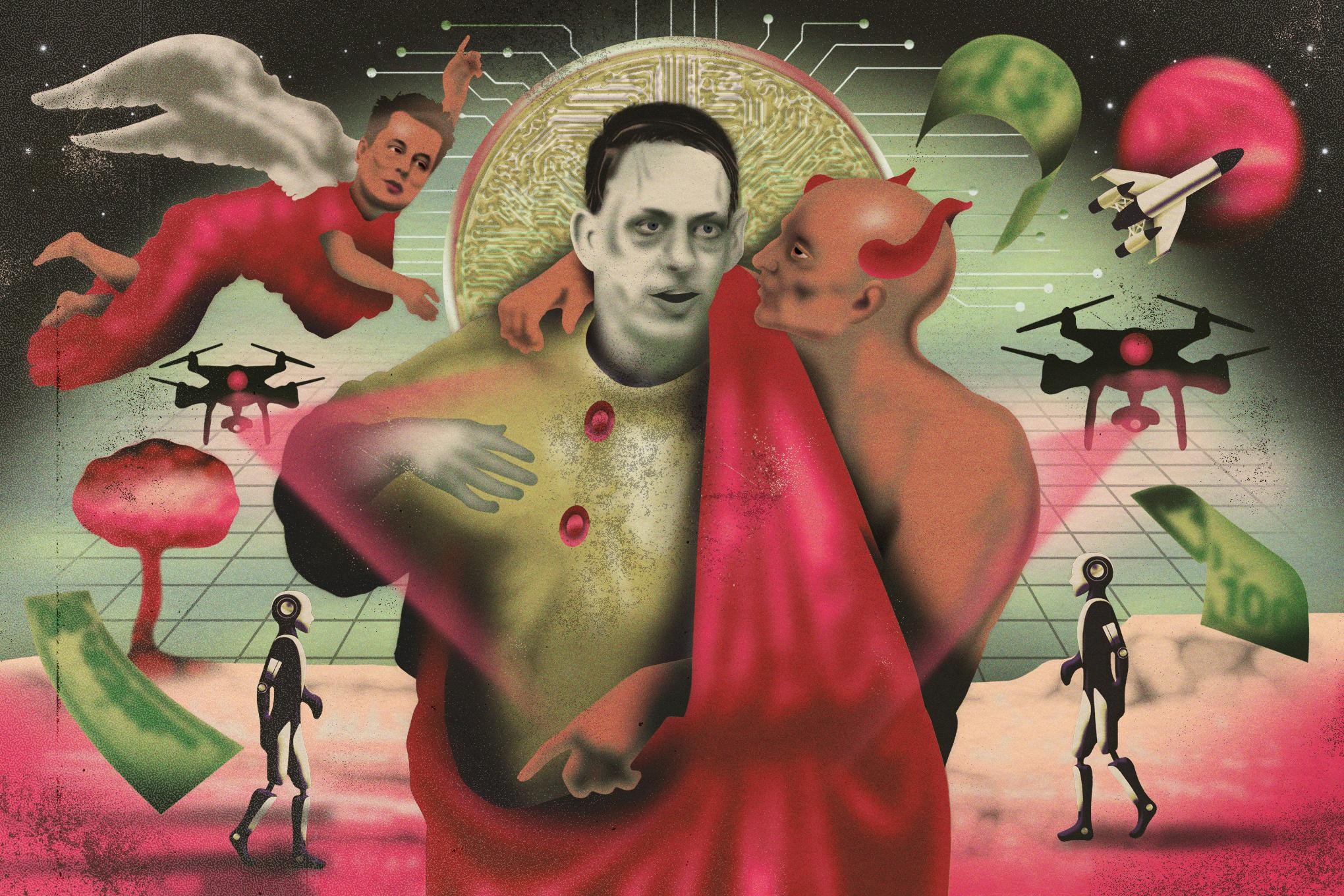
We have Peter Thiel’s secret lectures about the Antichrist.
It’s a time of apocalyptic worldviews in Silicon Valley. The latest AI doom cycle is driven by effective altruism (EA), a philosophy that has lurked around the fringes for years but recently burst into the mainstream because its adherents are embedded across the AI industry, from Anthropic to newly appointed AI safety watchdog METR. EA is a utilitarian approach to charity premised on doing the most good for the most people over the longest time, and EA advocates see halting an AI-induced doomsday as critical to saving as many humans as possible.
But EA has an important and equally apocalyptic rival in the crosscutting cosmologies of the tech titans — a strain of Christianity best represented by Peter Thiel, who believes EA will bring about the Antichrist. It’s an issue on which the billionaire techno-capitalist is a self-styled expert, and, somehow, Thiel has become America’s most provocative and visible Christian theologian.
Thiel’s current fixation on the End of the World as We Know It is in theological language called eschatology, the study of the “last things.” His specific bête noire is the Antichrist, the villain of these end times scenarios. Thiel’s riffs on the Antichrist began a little over three years ago, first in a 2023 talk at the Catholic University of America but then, starting in 2025, only in closed-door, invitation-only, multipart lectures out of San Francisco. While that secrecy is frustrating for those of us interested in how uber-rich and politically powerful tech titans see the future of our world, it’s also rather savvy — no surprise from the guy who started hugely successful ventures like PayPal and Palantir. “It’s a pretty good marketing shtick if you want everybody to hear about something, not to let anybody in the room,” Thiel reportedly told one San Francisco audience last fall.
Months ago, recordings of Thiel’s lectures were leaked to The Verge. We have listened to and read transcripts of all four of these lectures, which provide a window into Thiel’s dizzying religious and sociocultural philosophy. He comes off as an intellectual magpie who somehow combines disparate elements into grave warnings against the AI and general “safetyism” that he claims precedes the Antichrist.
“Peace and safety” — the slogan of the Antichrist, according to Thiel — trouble him throughout the lectures. In the first, he wonders if we’re headed toward World War III or Cold War II, and afterward, potentially, an unjust peace, the corollary to an unjust war:
Somehow, it’s very strange how the first Cold War from ’49 to ’89 ended. But it ended with roughly what I think of as a just peace. Where somehow you didn’t have a nuclear war. And somehow our side, which I think was more the good side, basically won. And you ended up not with a perfect peace, but more or less a just peace. And so if we have World War III, it will be an unjust war. If we have Cold War II, maybe it can end in a just peace or an unjust peace.
Reflecting on this material and thinking about it, it’s obviously not written in stone and there’s a lot of different ways this stuff can go. But I keep thinking that, if you had to put odds on it, aren’t the odds that we’re trending towards the fourth quadrant this time? The fourth possibility is that Cold War II will end an unjust peace. And it’s because the Antichrist talks about Armageddon nonstop. We’re all scared to death that we’re sleepwalking into Armageddon. And then because we know World War III will be an unjust war, that pushes us very hard towards peace at any price.
What I worry about in that sort of situation is you don’t think too hard about the details of the peace and it becomes much more likely that you get an unjust peace. This is, by the way, the slogan of the Antichrist: 1 Thessalonians 5:3. It’s “peace and safety,” the unjust peace. And then what Christ says in Matthew 24:6, the full verse: “And you shall hear of wars and rumours of wars, see that ye be not troubled.” If you’re too troubled, will we always end up with very unjust peace? Or something like this.
We are publishing an analysis of these lectures now because Thiel published a version of these same ideas in the conservative religious journal First Things in July. You can read along for yourself. Titled “The Pope and the Antichrist,” the essay fills in the huge gaps in Thiel’s thinking and allows us to better understand his ideas, such as they are.
The bottom line is that after sifting through all of the arcane references and esoteric exegesis, it turns out that Thiel — a Protestant who likes to describe himself as a “heterodox Christian” — offers a fairly standard-issue American evangelical worldview, and a rather fundamentalist one at that.
He’s less a coherent religious thinker than a repackager of recognizable ideas — dressing them up in the rhetoric of a tech nerd turned theological hobbyist — which he uses to promote his own ideology. He reads everything from the Bible to pre-papal writings of a future pope to Robert Hugh Benson’s 1907 novel Lord of the World to semi-obscure Scottish poetry with an eye toward his own, sometimes shockingly literal interpretation of the Antichrist’s arrival (ideally, he should make his mark, as it were, more quickly than Jesus, who died at 33 and a few months — although Thiel allows in his third lecture that perhaps “in our gerontocracy, 66 is the new 33”). While his mashup of religious concepts and authoritative assertions on dubious interpretations make him sound like an undergrad who just took his first philosophy class and then a few too many hits on the bong, the goal of his eschatology is the same as every apocalyptic visionary: to divide the world between the saved and the damned. And Thiel is, clearly, one of the righteous.
It’s notable here that Thiel is coming from the heart of what is arguably America’s latest, and most unexpected, religious revival — one concentrated among the Silicon Valley elite, like the ACTS 17 Collective, which is a reference to St. Paul’s preaching to the Greek pagans in the Acts of the Apostles and an acronym for “Acknowledging Christ in Technology and Society.” But that movement presents an upbeat message of self-improvement through Jesus, the kind that the clean-and-fit Bay Area crowd tends to embrace. Thiel’s worldview is quite unusual for Silicon Valley, and perhaps especially unexpected for a gay German billionaire; he’s right at home in the US tradition of apocalypticism.
The key to Thiel’s theological vision comes at the very opening of his most recent First Things essay, and it is his fixation on, and fear of, the Antichrist. The Antichrist has traditionally been associated with, as Thiel himself put it elsewhere, “an evil king or tyrant or anti-messiah who appears in the end times.” That is true, though Thiel says that the Antichrist interests him “mostly because nobody else is talking about it.” That would be news to anybody with even a passing familiarity with American Christianity.
In fact, the Antichrist and eschatology are arguably the central religious impulse running through American Christianity, and that focus distinguishes the US from most other churches and cultures around the globe. In America, biblical teachings tend to jump from the Ten Commandments at the beginning of the Old Testament to the Book of Revelation at the end of the New Testament. The Gospels, the Beatitudes, all that provides the key teachings of Jesus Christ is a footnote.
The enthusiasm for the end of the world has been fueled in large part by the series of sweeping revivals, or “Great Awakenings,” that have marked American religious history from the Colonial era up through the 1800s and, some would say, on into the 20th century. These revivals focused not only on personal conversion but on dark warnings about the “end times” as foretold in the New Testament, when Christ would return to gather believers up to Heaven and those who remained would be stuck facing various tribulations on their own.
For American Christians especially, the quest to save souls from eternal damnation was increasingly driven by the fear that the Second Coming was imminent, so you’d better repent now. New apocalyptic movements and sects and cults continued to flourish, from those early tent revivals through the more slickly branded televangelists and, later, the enormously popular Left Behind series of novels in the 1990s. Forecasters variously took snippets in the Book of Daniel and other prophets in the Hebrew Bible and joined them with the often phantasmagoric array of visions from the Book of Revelation, and eventually what had been a confusing jumble of end times scenarios solidified into a widely accepted timeline: increasing natural and human-made disasters, the Second Coming of Jesus, aka the Rapture of true believers, followed by the rise of the Antichrist and seven years of the Great Tribulation on Earth, ending with a final battle between good and evil and a thousand years of peace.
“One of my friends was telling me that I should not pass up on the opportunity to tell those people in San Francisco that Bill Gates is the Antichrist. I will concede that he is certainly a Dr. Jekyll and Mr. Hyde-type character. The public Mr. Rogers, the neighborhood character — but I saw the Mr. Hyde version about a year ago, where it was just a nonstop Tourette’s, yelling swear words, almost incomprehensible what was going on. Certainly, of course, there are a lot of people who are wannabe Antichrists. They sort of want peace and safety. [He] definitely wants a Nobel Peace Prize. He would give his soul for that, no question about it.”
“There is another book — I haven’t been able to get a copy of it because it’s coming out tomorrow, but we sort of downloaded it — that fits this thesis even better. It’s from the East Bay rationalist Eliezer Yudkowsky. I’m embarrassed about all the ways I was once affiliated with these various people and how deranged and crazy they’ve all gone. It started with these Baconian aspirations of transformative technology: We’re going to build it, it’s going to change the world. And then it’s somehow ended in some sort of blackpilled thing that’s probably more depressed and more Luddite than Greta.”
“I think one of the ways these things always get reported is I denounce Greta as an Antichrist. And I want to be very clear, Greta is not, I mean, she’s maybe sort of a type or a shadow of an Antichrist of the sort that would be tempting, but I don’t want to flatter her too much.”
“It’s not Andreessen, by the way. I think Andreessen is not the Antichrist. Because, you know, the Antichrist is popular.”
Phew. Now enter Peter Thiel. He is in effect the latest in a long line of apocalypticists, though his own spin is that anxieties over strange new technologies like AI will prompt demands for greater regulation and that would be a grave, almost apocalyptic, mistake. Given the latest warnings from AI leaders themselves that the new technology could risk human extinction within a decade, Thiel’s concerns run counter to what you’d expect from an apocalypticist.
Thiel’s theological justification for criticizing this instinct toward what he derides as “safetyism” rests on a verse in St. Paul’s first letter to the Thessalonians in which the apostle warns that many will promote “peace and safety” to lull people into a false sense of security and then POOF, Jesus returns and the Antichrist appears and unbelievers are doomed.
Thiel identifies promoters of this kind of peace and safety with a “restraining” force that will be a sign of the coming of the Antichrist and which will eventually pave the way for the Antichrist. He has pointed to Anthony Fauci as one example of such a “restrainer.” And now the apostles of effective altruism, with their concern for protecting as many people as possible, are in Thiel’s sights. Thiel uses the original Greek term for “the restrainer,” katechon, because of course he does. Deploying arcane terms is part of the mystery that gives apocalypticism its allure, and prophets their power.
So who is actually the Antichrist? Thiel at one point dismissed such speculations as “down-market” behavior, but he himself cannot resist weighing in. Viewing the Roman pontiff as the Antichrist or a collaborator with the Antichrist is a standard trope of end times theology, and in his First Things essay Thiel follows that tradition by suggesting that the late Pope Francis could have been the Antichrist. In previously leaked snippets of Thiel’s talks he has accused the current American pope, Leo XIV, of being a “Chinese communist agent” or, more recently, Beijing’s “useful idiot,” because he wants to regulate AI — all very Antichrist-adjacent behavior.
Thiel has a somewhat unusual relationship to the Catholic Church. True to the more anti-papist strains of his tradition, he worries that Pope Leo XIV is a “woke American pope” who will join with American liberals to create a tyrannical “Caesaro-Papist fusion.”
At the same time, the German-born Thiel’s record-breaking financial support propelled JD Vance, a relatively recent Catholic convert, to the US Senate and now a heartbeat away from the presidency. Thiel has also made a little-known Catholic literary theorist from France, René Girard, a spiritual guide for America’s political right — though only by completely inverting Girard’s famous teaching about the scapegoat mechanism by which a society eases internal divisions by blaming a single person or subgroup of people for their problems.
Thiel’s latest essay is also unusual, or inventive, in that rather than denouncing the papacy as the Whore of Babylon — a traditional fundamentalist Protestant trope drawn from a stark image in Revelation 17 — he tries to co-opt one pope, the late Benedict XVI, into his very American and Protestant worldview and against the papacy and the Catholic Church itself.