
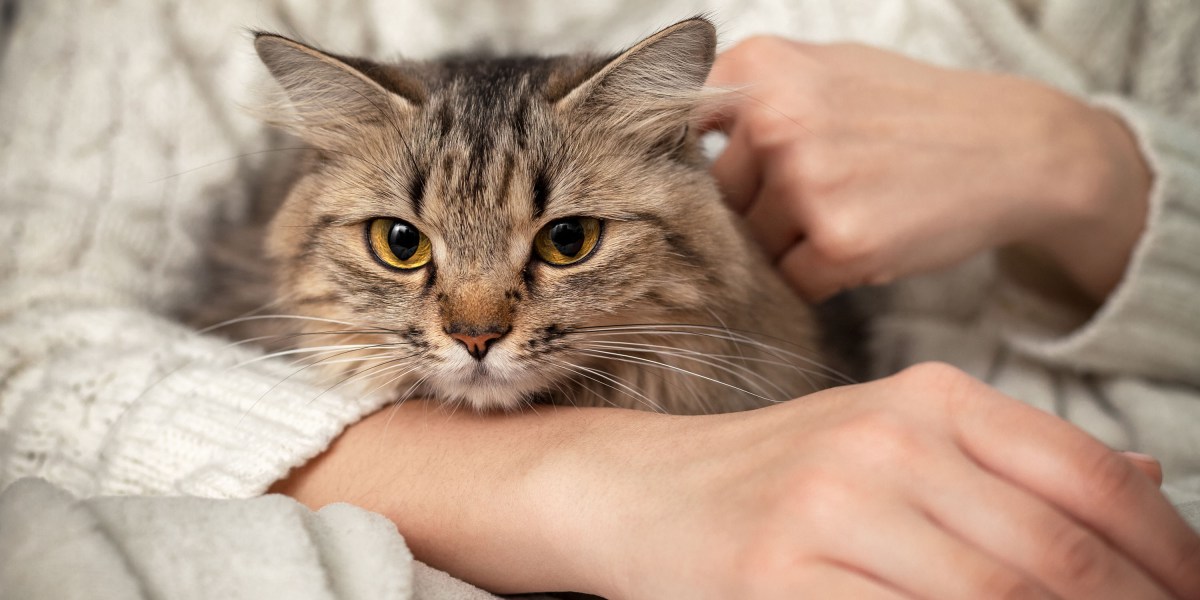
I don’t remember much about Peppy, my first and only pet cat. I can conjure the sensation of stroking her while she purred, recall how she used to get stuck in trees (just like in cartoons!), and chuckle about the time she pooed in my baby sister’s cot. That’s about it.
What I do vividly remember, though, is the day she went missing. I was 10 years old, and I searched everywhere for her, scouting nearby fields and woods until sunset. I made posters. We never found her. I was devastated.
There was no way to get more time with Peppy, but almost 30 years later, pet owners are being offered an ever-expanding set of options to potentially prolong their years with their furry companions. The possibilities include drugs, cloning, and even cryonics. But is that a good thing?
There’s certainly a market for pet preservation. And a growing number of biotech companies have their sights set on pet longevity. Loyal, a company that is currently working on three potential longevity drugs for dogs, is trialing one designed to improve metabolic health in around 1,300 pet dogs across the US. Others are testing dog drugs that aim to combat both age-related diseases, including conditions like obesity and osteoarthritis, and aging itself. There’s even a company focused on longevity medicines for domesticated cats.
I don’t know how or when Peppy died. But if there had been a drug that might have protected her from diabetes or arthritis, there’s no doubt I would have tried to get my hands on it.
That’s about where my enthusiasm for pet life extension ends, though.
I’m far less interested in cloning, a relatively new option for people mourning a pet and seeking a replacement. In most cases, this technology involves taking the DNA of a pet, putting it into an egg cell from another animal of the same species, and growing the resulting embryo in a surrogate animal. It worked for Dolly the sheep, who was born the year before Peppy went missing. It has since worked for other mammals, including cattle, horses, and ferrets—and cats and dogs. In the US, a company called Viagen Pets offers to clone cats and dogs for $50,000 a go. This doesn’t result in an exact replica of the animal but a genetic twin.
Still, there are lots of reasons why a person might want to clone a pet. On its website, Viagen explicitly offers customers “a way to hold on.” Lori Kogan, a professor of clinical sciences at Colorado State University who has studied human-animal relationships for decades, doesn’t have a problem with the practice. She points out that while we have well-established rituals for coping with the loss of a person—such as funeral services, time off work, and memorial gifts—we don’t really have the same for pets. As a result, pet owners can experience what is sometimes called “disenfranchised grief,” she says. Having their feelings go unrecognized can feel isolating. If cloning a pet brings a person peace, she says, “who are we to judge?”
Fair enough. But I can’t help thinking that pet loss in childhood might be different. It’s often the first time a child confronts death. Losing Peppy was a formative experience, and distressing though it was, I like to think it helped prepare me for losses I experienced in adulthood. I wouldn’t want my own children to think that death is not final, and that individuals can be replicated or replaced.
Or, for that matter, revived, which is the promise behind pet cryonics. For a fee, a handful of companies offer to cool dead pets to extremely low temperatures and store them for long periods of time—even indefinitely. The idea is that at some point in the future, we’ll have invented incredible technologies that will not only bring your pet back to life but also cure whatever it died of. Alcor, a cryonics facility in Arizona, is currently storing the remains of hundreds of pets as well as people. It even recently announced it had cooled a small marsupial—its first pet sugar glider.
With cryonics, the chances of being reunited with your pet are bordering on zero. Even those who work in the field acknowledge that the stored people and animals are unlikely to be reanimated. As things stand, there is no way to really and truly bring any animal “back.”
I miss Peppy. But given the chance, would I stick her in a vat of liquid nitrogen? Or get another cat to give birth to a genetically identical animal? No, I would not.
RIP to the one and only Peppy.