
The tropical Pacific has seen heat build for months as a “super” El Niño takes shape.
A climate phenomenon that forms every few years, this year’s iteration of El Niño has been on a tear of daily records and is forecast to reach unprecedented strength this winter. While it’s characterized by hotter-than-normal waters in the eastern tropical Pacific, El Niño is a global problem.
It’s fair to wonder how another global problem is interacting with El Niño: climate change, driven by burning fossil fuels. While a hotter climate begetting a hotter El Niño might seem like a done deal, “I have more questions than I have reactions” to what’s happening, says Christopher Callahan, a climate researcher at Indiana University. In other words, the relationship is still an area of active research—and this year’s event could provide vital insights.
El Niño’s added ocean heat affects the atmosphere, causing weather patterns around the world to shift. Consider it kind of like a domino run, where one tile starts a chain reaction. Such a major slug of heat in the Pacific will act more like a shove then a light flick on the atmosphere, and the resulting shifts in weather are expected to be generationally intense.
The US National Oceanic and Atmospheric Administration is forecasting 100 percent odds of an extremely strong El Niño through December and above 80 percent odds it stays that way through February. Data shows this El Niño has already set multiple all-time daily heat records including a recent peak of 3.4 degrees Celsius.
NOAA issues its El Niño forecast as a three-month rolling average, and the agency predicts heat could peak at 2.7 degrees Celsius above normal for the period from October to December. (It’s not out of the question that heat could surpass 3 degrees Celsius, though.) If the forecast holds true, it would smash the previous record of 2.4 degrees Celsius, which was set during the 1982-1983 event.
There is a growing body of evidence that climate change is likely playing at least some role in influencing El Niño. The magnitude and frequency of the phenomenon has increased over the past 60 years, says Francisco Estrada, coordinator of the Climate Change Research Program at the National Autonomous University of Mexico, and so has the variability and how the effects are distributed around the world. He says there shouldn’t be a debate framed as a choice between a “natural El Niño” and an “El Niño caused by climate change” but rather as an interaction between the two processes.
“You can’t separate El Niño from global warming—they’re inextricably linked,” he explains.
Modeling also indicates that El Niño is likely to strengthen as the planet warms, though Callahan notes that many models struggle to accurately represent long-term temperature trends in the eastern tropical Pacific. That can give researchers some pause, but there’s also other evidence that climate change is juicing El Niño.
“The majority of climate models say that El Nino amplitude shall go up in a warming climate, and all of our paleoclimate records say that we're currently in a more active period of El Niño than the last several 1,000 years,” Callahan says.
Research published in August uses data collected from ancient coral, and provides that 1,000-year glimpse Callahan mentions. (He wasn’t involved with the study.) The scientists found an uptick in El Niño amplitude that neatly mirrors when humans started pumping greenhouse gases into the atmosphere, though they didn’t attempt to attribute the shift to climate change.
This year’s El Niño will provide another data point to help researchers suss things out.
But as Callahan notes, there’s also an important question about how El Niño is layering on top of climate change.
“Even if climate change has not made the event itself stronger, even if the [sea surface temperature] anomalies are totally natural, the presence of those SSTs in a climate that has been changed by global warming might produce unprecedented impacts,” he says.
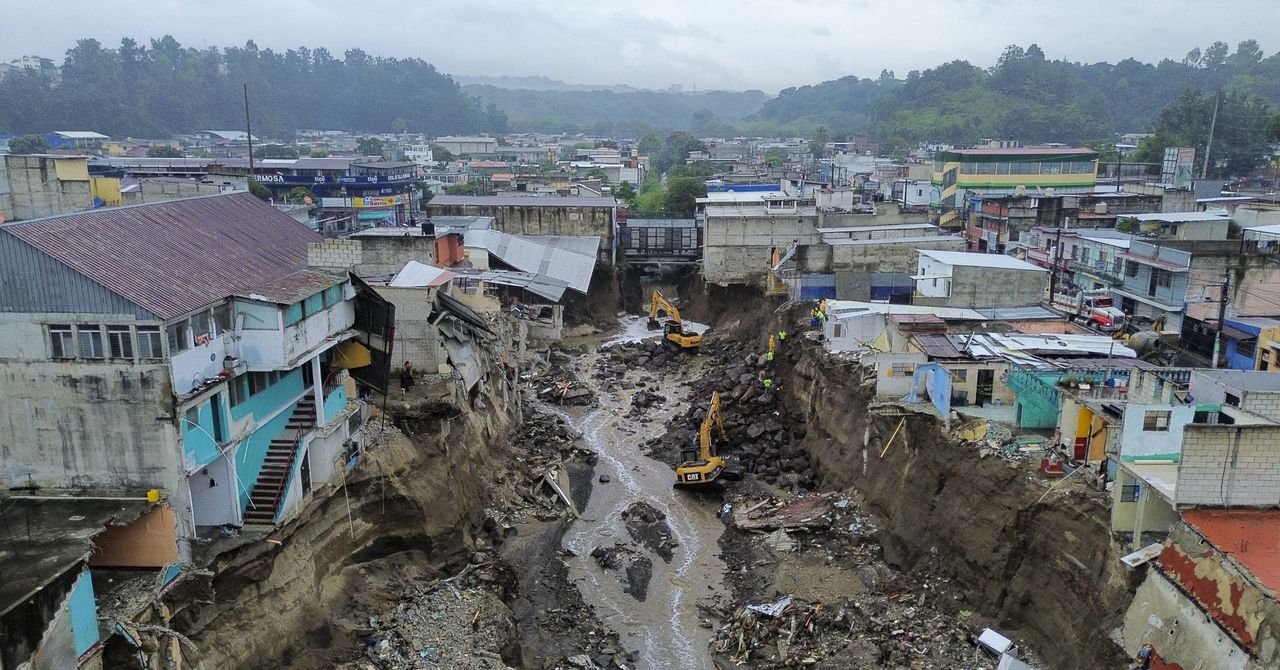
El Niño’s impacts on weather—known as teleconnections—are well known, from increasing the odds of drought in the Amazon and Indonesia to juicing precipitation in the Southwest US and lowering the odds of Atlantic hurricanes.
Such an extreme event layered on top of climate change doesn’t mean teleconnections get thrown out the window, though. In fact, some of them may be even more intense.
“We can no longer place as much confidence in the knowledge we’ve gathered from data regarding how El Niño manifests in terms of weather and climate in different parts of the planet,” says Estrada.
Fishermen in the eastern Pacific are suffering the impact of El Niño, which is forcing several species to migrate to deeper waters and leaving nets half-empty.
From a risk perspective, Estrada believes it’s important to understand how the two phenomena interact and how that combination will affect societies.
He and Callahan’s main concern is not merely whether this El Niño will be the most intense on record but rather the combination of an exceptional event with a climate that has warmed significantly.
“Surprises are the last thing you want when you’re trying to manage risk,” Estrada says.
Callahan’s work shows that the impacts of El Niño on society are extreme, with the most severe events knocking off trillions of dollars from the global GDP. Ecosystems also suffer greatly, particularly coral reefs, which are facing a mass bleaching event.
Given this scenario, the United Nations and other international organizations have called for urgent adaptation measures to safeguard the well-being of the at-risk populations and ecosystems. Some places are already doing that: California preemptively declared a state of emergency last month.
“El Niño conditions will pour fuel on the fire of a warming world. Impacts will hit even harder, travel even farther, and cross borders with devastating speed,” UN Secretary-General António Guterres said last month.