This story originally appeared on Vox and is part of the Climate Desk collaboration.
On a bright, sunny day last May, I stood on a boat surrounded by the turquoise waters of the island nation of Palau. I was there in the western Pacific watching scuba divers as they prepared to bring up evidence of a mysterious aquatic world.
Palau is famous for its spectacular and rich coral reefs. But these divers were planning to descend past those sun-lit marine communities and down into a lesser-known twilight zone known as the “mesophotic coral ecosystem.”
Divers prepare to retrieve research structures from down in the “deep reefs.”
Mesophotic essentially means “middle” and “light,” which is where these ecosystems are—not quite in the bright daylight, not quite in the profound darkness, but somewhere in between. For simplicity’s sake, we’ll call these communities, which range from some 30 meters to 150 meters below the surface, the “deep reefs.”
One of the divers on the boat with me was a zoologist and curator at the California Academy of Sciences named Luiz Rocha, who has spent decades studying these deep reefs and their secrets.
“Anything between 30 meters and 150 meters is really, really unknown,” he told me.
Because these deep reefs are so unknown, researchers like Rocha are left with big questions. They want to get a baseline picture of what is going on in these ecosystems—even just who lives there!—so that they can better understand how they function. They’ve also tried to work out whether (or not) these deep reefs might provide a refuge for species living in shallower coral reefs.
I was in Palau for Vox’s Unexplainable podcast because, in an effort to gather more information about these mysterious places, Rocha left some scientific structures down in these twilight depths back in 2016. Those structures then spent almost a decade becoming encrusted with all kinds of marine life. And now, Rocha was back to retrieve them, hoping that he—along with many other scientists — would be able to open them up, like a box of scientific puzzle pieces, full of clues about this under-understood marine world.
One thing that’s often acknowledged in papers about mesophotic coral ecosystems is that scientists don’t know as much as they’d like to. A National Oceanic and Atmospheric Administration article about them from 2019 is full of “mays,” as in: They may “serve as essential fish habitat for economically and ecologically important species.
Luiz Rocha hopes to answer fundamental questions: What is the main energy source for everything down here in the dim light? What does the food chain look like? How have things evolved to live at these depths?
Researchers do know some things, of course. They know that these deep reefs can be found in many of the same regions as shallower coral reefs—so mainly the tropical and subtropical parts of the world, like Micronesia, the Caribbean, and even the Gulf of Mexico. They’ve found that there are many species that seem to be unique to these places, and recent research points to their potential susceptibility to climate change.
Researchers have also gotten a sense of some of the key differences between these deep reefs and their shallower coral neighbors. In shallow reefs, hard corals team up with photosynthesizing algae. The algae provide the corals with nutrients, and the corals secrete a calcium-carbonate matrix that helps create the architecture of the reef.
As you go deeper, though, the light begins to fade, and the opportunities for photosynthesis start to fade with it. The temperature also drops. So the animals living down in the deep reefs are ones that can survive in a dimmer, cooler world.
Scientists can dive into the deep reefs to try to learn more about these understudied places—as Rocha has—but exploring down at 100 meters requires more difficult, riskier technical diving than exploring at shallower depths. The deeper you dive, for example, the faster gases get pushed into your tissues, which imposes limits on these really deep dives.
“We have a very, very short time,” Rocha says, “And by short time, I mean five minutes. Six, seven minutes.”
Scientists can take some pictures in that time, make some measurements, or collect a few samples, but then they have to move back upwards—a process that can take hours, since they must rise slowly to avoid decompression sickness.
It is, obviously, not particularly efficient to study an ecosystem in five- to seven-minute intervals. People have also used remote-operated vehicles and submersibles to explore the deep reefs, but those have their own issues, and cameras can’t always capture all the detail you might want, or photograph more secretive, cryptic animals. So huge gaps remain in scientific knowledge about these ecosystems.
“Whenever we go somewhere,” Rocha says, “the first thing we find is new species. It’s the most basic thing in science you can do.” But this effort goes beyond just cataloging new species of fish, sponges, or sea slugs.
Rocha wants to answer fundamental questions like: What is the main energy source for everything down here in the dim light? What does the food chain look like? How have things evolved to live at these depths? How similar are they to the shallow ecosystems, and how different? How are they affected by climate change—and what’s the most efficient way to protect them?
But Rocha says that “in some ways, we don’t even know what questions to ask. We really only know what the crucial questions are when we have a baseline understanding of the ecosystem. And for deep reefs, we don’t have that yet.”
Rocha is not deterred by the enormous number of question marks that surround these deep reefs. For years now, he has been gathering bits of basic information about them, often via those very short dives.
About a decade ago, though, Rocha got interested in another method for sampling the biodiversity of this sort of marine ecosystem—a technique involving “autonomous reef monitoring structures” or ARMS.
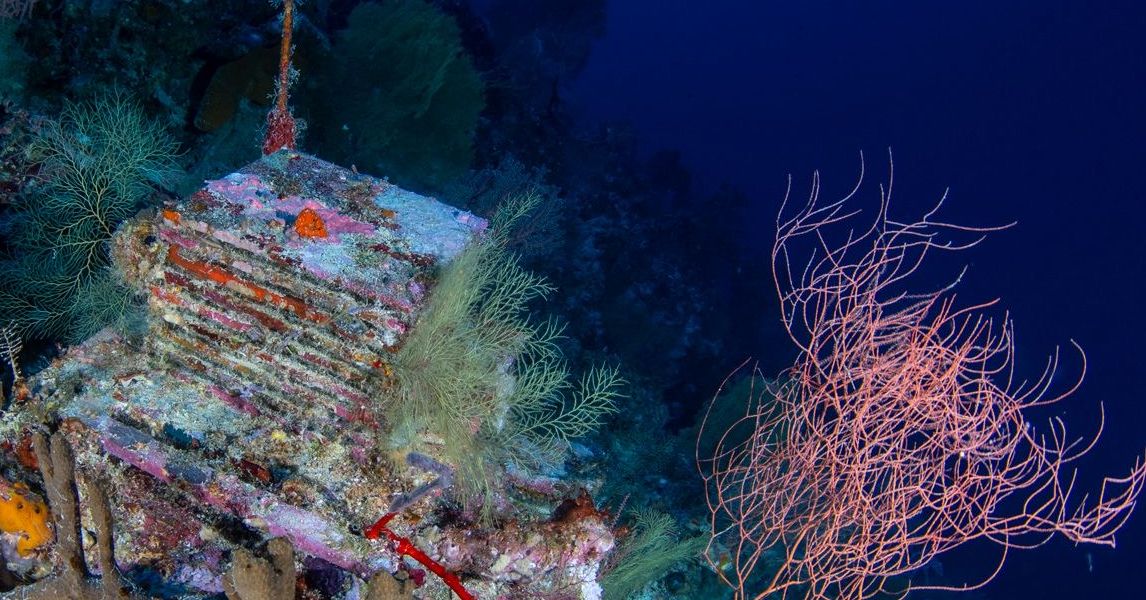
Basically, each ARMS is a stack of several PVC plates, separated at uniform intervals and attached to a base plate. They look like little gray, featureless hotels. You take them to a place that you want to study, bring them down, secure them, and then leave them alone for a while to let them collect … life.
In the bottom left corner, there is an ARMS encrusted with life.
“As soon as you drop any kind of clean structure on a reef,” Rocha says, “it starts getting colonized by larvae of everything around it—of sponges, gorgonians, corals. And then, because there’s a lot of hiding spots between the plates—so between the floors of the hotel—they start getting colonized by shrimp, by mollusks, by ascidians, by anything you can imagine in the ocean. And it becomes this stable, diverse mini reef, if you will, packed with a lot of biodiversity that would be very hard to collect all at once in any given reef.”
A few years after that initial drop, you come back, collect the ARMS, and then study the mini reef that has grown on them. You can sample and touch and analyze things to your heart’s content.
It’s not only a very effective way to collect lots of creatures, all at once, but also a great way to do so in a standardized way. If you went down—or sent a robot down—to collect an encrusted rock from a reef, you could learn a lot about the life on it, but it would be hard to compare the life on that rock to life on other rocks from other reefs, or even the same reef, because each rock would have its own unique characteristics. Not so for ARMS.