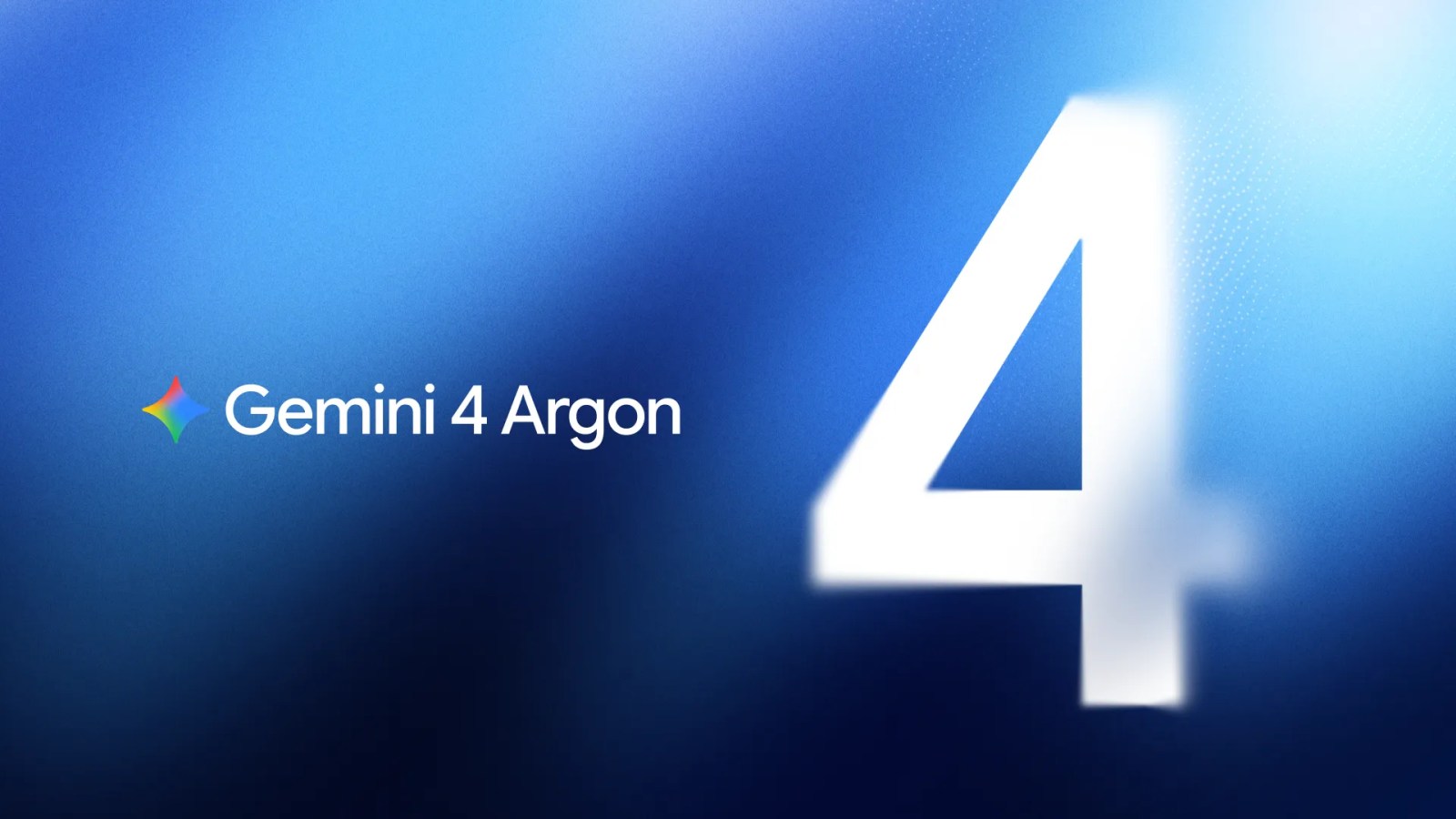
Gemini 4 Argon is Google’s “next era of frontier intelligence” and built for “deep reasoning across complex, long-horizon workflows.” It follows the cancellation of Gemini 3.5 Pro and focus on 3.8 Flash.
With this new model (which has a new naming scheme), Google wants to offer “frontier-level capabilities” across coding, knowledge work, cybersecurity defense, and creative writing.
Gemini 4 Argon’s output token limit is 1M tokens (up from 64K) to allow for longer and more complex use cases. This is paired with expanded coding, reasoning, and multimodal capabilities.
When the model has the headroom to think deeply and generate hundreds of thousands of tokens in a single trajectory, it adds a new level of depth in reasoning to solve tough problems in one go.
In terms of benchmarks, Google touts a DeepSWE v1.1 score of 77.9%. Claude Opus 5.5 comes in at 74.2% followed by GPT-6 Astra’s 74.1%.
Google trained Gemini 4 Argon to be “highly capable at cybersecurity defense” with leaps over 3.8 Flash Cyber. The model will be made available “without cyber guardrails” to trusted defenders and internal Google teams so that they can “leverage its full frontier-level cybersecurity defense capabilities.”
Outside of coding, Gemini 4 Argon also has “leading performance across other domain specific evaluations,” such as Vals Finance Agent v2 (multi-step financial research) and Harvey’s Legal Agent Benchmark (legal research and drafting).
Gemini 4 Argon is “rolling out soon,” starting with Google AI Ultra subscribers and paid API customers.
So far, it has been made available to trusted testers and cyber defenders (via Fairwind Program). Before the broader release, Google is focusing on:
Inside Google, Gemini 4 Argon is already powering internal workflows with “thousands of Googlers highlighting the model’s strengths in specialized coding tasks, conducting deeper research, and writing quality.” The company shared some examples today:
Memory efficiency: A team of Argon agents analyzed fleet-wide profiling telemetry to autonomously identify and apply memory optimizations across Google’s data centers, freeing up over 300 TiB of memory once rolled out, with an estimated 500 TiB to 1 PiB in total savings.
Large Scale Codebase Migrations and Optimizations: Argon agents are working on migrating C/C++ codebases to Rust across Google—scaling from tens of thousands of lines in core libraries like re2, libgav1 up to 800K+ lines for the Fuchsia OS Zircon kernel. Given the criticality of many of these systems, such large-scale rewrites are undergoing rigorous automated and manual auditing, emulation testing, and review before rolling out to production.
For libgav1, Google’s open source software for decoding video, Argon agents took an existing Rust port and replaced 32K lines of SIMD code by running many rounds of profile-guided experiments, studying the compiler’s output, producing safe Rust so the compiler would vectorize it automatically. The end result is a memory-safe video decoder that runs 2.7x faster than the Rust port, with identical video output, bringing it closer to the optimized C++.
FTC: We use income earning auto affiliate links. More.
Check out 9to5Google on YouTube for more news:
Editor-in-chief. Interested in the minutiae of Google and Alphabet. Tips/talk: abner@9to5g.com