
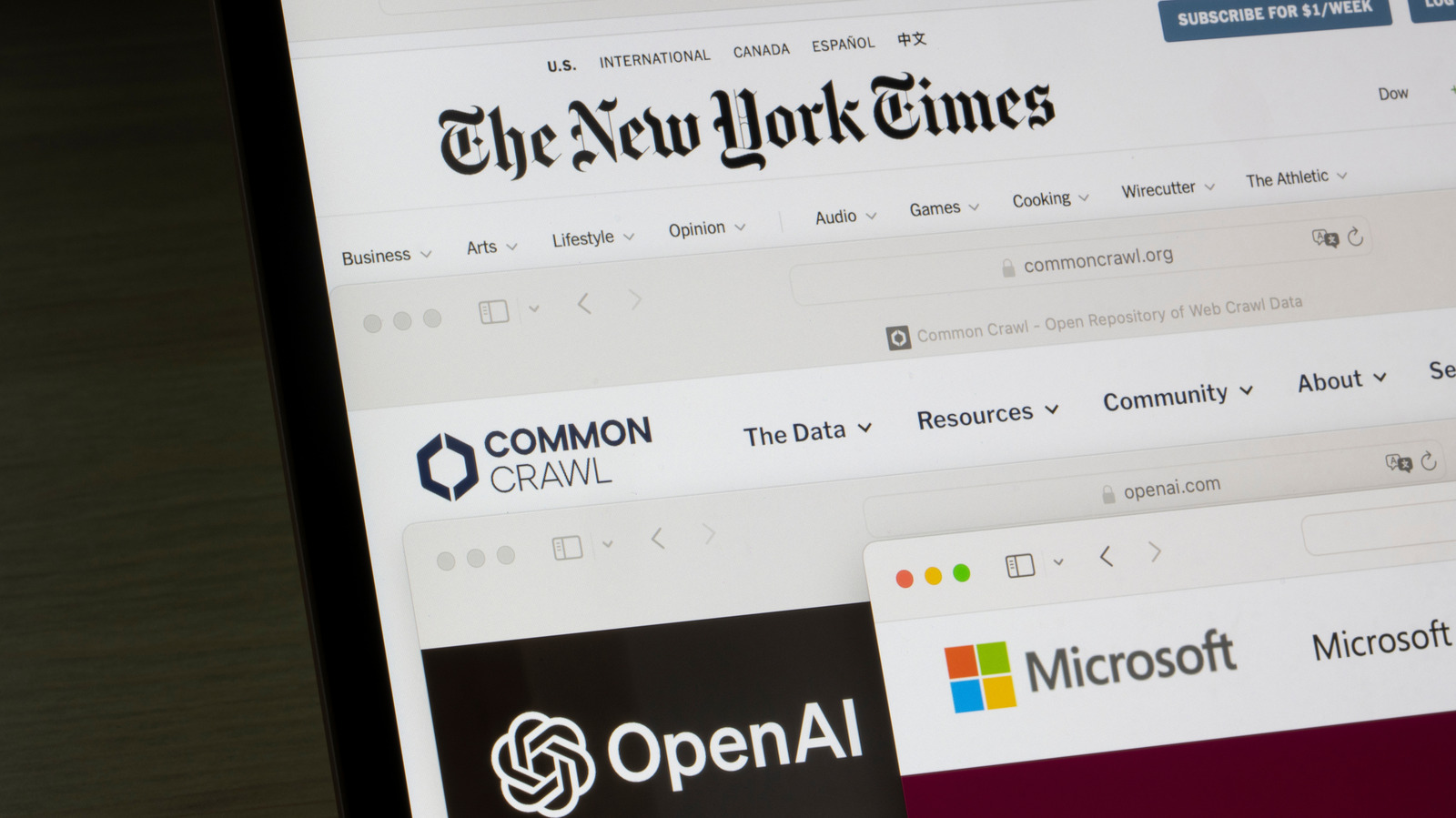
Newly released court documents show that multiple Microsoft execs thought AI training was an 'existential threat' to journalism.
Executives from OpenAI and Microsoft were reportedly worried about ChatGPT training that scraped millions of news articles, The New York Times reported. Microsoft's director of Applied Science, Dr. Brent Hecht, said OpenAI's work was akin to the "largest theft of labor in human history" that could create a "doom loop," while OpenAI exec Nick Turley said it represented an "existential threat to publishers." Those comments came out of newly unsealed court documents as part of a lawsuit launched by The New York Times against OpenAI and Microsoft in 2023. Only snippets from the documents were made public without any context around them.
Along with the quotes, the unredacted materials also show how OpenAI and its partners obtained training content by bypassing paywalls, and built training datasets by scrapping millions of documents and erasing copyright notices from training data.
This release is the latest salvo in the copyright lawsuit originally launched by the NYT alongside five other writers. They argue that big tech companies have broken copyright law by scraping millions of their stories off the internet and using the text without approval or compensation to train advanced large language model (LLM) systems.
Several such lawsuits have already swung in favor of AI companies, but judges have pointedly stated that their rulings were made because the law around AI use has yet to be settled. The NYT lawsuit is considered to be of prime importance in determining whether AI companies can access this data as part of "fair use" legal doctrines that allow copyrighted work to be used without permission in cases like parody or journalism.
That makes the comments from Microsoft and OpenAI executives particularly interesting, though Microsoft disavowed its own employees' statements. "Microsoft's position is set out in its court filings, which explain why these transformative uses are consistent with copyright law and why Copilot is not a substitute for publishers' journalism," Microsoft spokesperson Alex Haurek told The New York Times in a statement.
Though less dramatic, other comments are equally damning. When an employee wrote to OpenAI's president Greg Brockman and told him about a new paywall hack, Brockman responded "ah nice," according to the documents. One internal Microsoft document from 2023 stated that "millions of people around the world will soon consider large models 'hoovering up' all their work to be an astonishing theft of unprecedented proportions."
Executives distinctly recognized the potential danger to news gathering and journalism. In another comment, Dr. Hecht said that large AI models "are a product that destroys its supply chain." In another, an OpenAI software engineers told colleagues in 2023 that "no matter how prominently we show the links, users won't click." OpenAI's Turley confirmed that, saying AI products are "largely substitutive" to journalism.